<?xml version="1.0" encoding="UTF-8"?>
<feed xmlns="http://www.w3.org/2005/Atom">
    <title>Technical Tutorial - Misumi | Empowering Engineers around the world</title>
    <link rel="alternate" type="text/html" href="https://www.misumi-techcentral.com/tt/en/" />
    <link rel="self" type="application/atom+xml" href="https://www.misumi-techcentral.com/tt/en/atom.xml" />
    <id>tag:www.misumi-techcentral.com,2009-07-09:/tt/en//3</id>
    <updated>

2018-03-23T02:12:26Z

2014-09-21T03:47:37Z

2013-07-26T00:48:50Z

2019-01-16T07:05:41Z


</updated>
    
    <generator uri="http://www.sixapart.com/movabletype/">Movable Type Pro 6.0.3</generator>


<entry>
    <title>#333 Know-how on automation: Pressurized heating technology - 5: Multilayer pressurized heating process technique</title>
    <link rel="alternate" type="text/html" href="https://www.misumi-techcentral.com/tt/en/lca/2018/03/333-know-how-on-automation-pressurized-heating-technology---5-multilayer-pressurized-heating-process.html" />
    <id>tag:www.misumi-techcentral.com,2018:/tt/en/lca//5.1384</id>


    <published>2018-03-23T02:05:46Z</published>
    <updated>2018-03-23T02:12:26Z</updated>


    <summary>The pressurized heating process in mass ...</summary>
    <author>
        <name>システム管理者</name>
        
    </author>
    
    
    <content type="html" xml:lang="ja" xml:base="https://www.misumi-techcentral.com/tt/en/lca/">
        <![CDATA[<p>The pressurized heating process in mass production requires a processing method where the same production pitch as those of the previous and subsequent processes can be maintained without having a buffer for storage.This section describes multilayer pressurized heating process technique.</p>
<h5 style="padding:2em 0 5px; border-bottom:1px #CCCCCC dashed;">(1)Multilayer pressurization process technique</h5>
<h6 style="margin-bottom:0.5em;">1)Multilayer pneumatic pressurization method for rigid body</h6>
<p>&#12539;In the case of a product consisting of two panes of bonded glass materials together, the same production pitch as those of the previous and subsequent processes can be maintained by laminating several slices of bonded glass materials.<br>
&#12539;In this collective pressurization process in the composite fabrication, uniform contact stress can not be applied to each layer of the bonded glass body because of plate thickness variations of the bonded glass materials (Fig. 1).<br>
&#12539;The plate thickness variations of bonded glass bodies can be eliminated by inserting spacers (pressure buffer sheets) having the same effect as that of the pressure buffer material discussed in D549, between the bonded glass bodies in order to absorb the variations to maintain even pressurization (Fig. 2).<br>
&#12539;The requirements for the material of the spacer are as follows: (1) thin and uniform in terms of plate thickness, (2) free from local hardness or variations, (3) durable (tolerable for repeated use), (4) free from producing dirt and grime, (5) free from being electrically charged, (6) cost-effect.<br>
&#12539;&#34;Paper&#34; spacer is possible for prototyping, but it is not appropriate for mass production because of issues in points (3) and (4) above.</p>

<p><img src="/tt/en/lca/D552_01.png" alt="[Fig. 1] Case of direct multilayer pressurization method for bonded glass body and pressure variations" width="527" height="340" title="[Fig. 1] Case of direct multilayer pressurization method for bonded glass body and pressure variations"></p>

<p><img src="/tt/en/lca/D552_02.png" alt="[Fig. 2]Case of multilayer pneumatic pressurization method" width="527" height="200" title="[Fig. 2]Case of multilayer pneumatic pressurization method"></p>

<p>&#12539;If the quality of pressure buffer sheet used for laminating pressurization is poor and produces local hardness, or if foreign substance is attached to the sheet due to static electricity, contact stress is applied locally to the section, which may cause the product to be defective.</p>

<h6 style="margin-bottom:0.5em;">2)Multilayer pressurized heating method for rigid body</h6>
<p>&#12539;When a heating process is required for the case of Fig. 2, the property of thermal conduction also needs to be considered for characteristics of the pressure buffer sheet.</p>


]]>
        
    </content>
</entry>

<entry>
    <title>#332 Know-how on automation: Pressurized heating technology - 4: Points to remember when designing mechanism of pneumatic pressurization method</title>
    <link rel="alternate" type="text/html" href="https://www.misumi-techcentral.com/tt/en/lca/2018/03/332-know-how-on-automation-pressurized-heating-technology---4-points-to-remember-when-designing-mech.html" />
    <id>tag:www.misumi-techcentral.com,2018:/tt/en/lca//5.1382</id>


    <published>2018-03-16T01:34:24Z</published>
    <updated>2018-03-16T01:35:50Z</updated>


    <summary>A pressurization method using rubber exp...</summary>
    <author>
        <name>システム管理者</name>
        
    </author>
    
    
    <content type="html" xml:lang="ja" xml:base="https://www.misumi-techcentral.com/tt/en/lca/">
        <![CDATA[<p>A pressurization method using rubber expansion body requires some empirical design technique such as a method of fixing the expansion body in place in the mechanism design, although it is advantageous in uniformity of pressurization.This section describes points to remember when designing mechanism of pneumatic pressurization method.</p>
<h5 style="padding:2em 0 5px; border-bottom:1px #CCCCCC dashed;">(1)Points to remember when designing mechanism of pneumatic pressurization method using rubber expansion body</h5>
<h6 style="margin-bottom:0.5em;">1)Countermeasure for pneumatic pressure fluctuations by heating</h6>
<p>&#12539;When a pneumatic pressurization method much like rubber expansion body is used with heating treatment, the energy inside the heating furnace will be greater than the pneumatic pressure in the room temperature, since the pneumatic pressure rises because of the heating temperature.The pressure conditions, thus, must be selected in consideration of this effect.<br>
&#12539;If pressure rise due to heating cannot be addressed just by changing the pressure conditions, use of a pressure switch (mechanical or electrical), which reduces pneumatic pressure during heating process, might be one solution for the situation.<br>
&#12539;When a heating furnace is used, it is simple to adopt a mechanical pressure release handle (for example, ball valve, Misumi BRKT) and to reduce the pressure by mechanically opening an open valve with a pneumatic cylinder, etc. (Figs.1 and 2).</p>

<p><img src="/tt/en/lca/d551_01.gif" alt="[Fig.1]Overview of mechanical pressure reduction method with pneumatic pressurization method [Fig.2] Example of pressure release inside the heating furnace" width="527" height="224" title="[Fig.1]Overview of mechanical pressure reduction method with pneumatic pressurization method [Fig.2] Example of pressure release inside the heating furnace"></p>

<h6 style="margin-bottom:0.5em;">2)Fixing rubber expansion body of balloon type</h6>
<p>&#12539;The rubber expansion body as shown in Fig.1 is fixed with the platy metal frame onto the pressurization plate. It has to be fastened in such a way that smooth curved surface is formed without making wrinkles on the surface of the rubber expansion body.<br>
&#12539;The shape of the metal frame for holding the rubber expansion body is thus important.<br>
&#12539;Fig.3-a shows a commonly-used angular holding frame, whereas Fig.3-b shows a holding frame with large round inner corners.<br>
&#12539;Fig.4 shows the states of circle parts of those rubber expansion bodies in Fig.3. The rubber expansion bodies are fixed to the individual holding frames and expanded.<br>
&#12539;In Fig.4-a, the corners of the rubber expansion body are deformed in a complex manner.In Fig.4-b, the rubber expansion body is expanded with smooth curved surface.<br>
&#12539;It is required to select the proper shape of holding frame as shown in Fig.4-b and the optimal volume of expansion of the rubber expansion body, and also to adopt a fixing mechanism free from air leaks during expansion even after use for long hours.</p>
<p><img src="/tt/en/lca/d551_03.gif" alt="[Fig.3]Example of holding frame of rubber expansion body" width="527" height="260" title="[Fig.3]Example of holding frame of rubber expansion body"></p>
<p><img src="/tt/en/lca/d551_04.gif" alt="[Fig.4]Comparison of shapes of holding frames of rubber expansion body and expanded states of rubber expansion bodies" width="527" height="220" title="[Fig.4]Comparison of shapes of holding frames of rubber expansion body and expanded states of rubber expansion bodies"></p>

]]>
        
    </content>
</entry>


<entry>
    <title>#142 Two-Stage Ejecting Structure</title>
    <link rel="alternate" type="text/html" href="https://www.misumi-techcentral.com/tt/en/mold/2013/02/142-two-stage-ejecting-structure.html" />
    <id>tag:www.misumi-techcentral.com,2013:/tt/en/mold//5.1074</id>


    <published>2013-02-21T15:00:00Z</published>
    <updated>2014-09-21T03:47:37Z</updated>


    <summary>The two-stage ejecting structure is a st...</summary>
    <author>
        <name>システム管理者</name>
        
    </author>
    
        <category term="Structural Components" scheme="http://www.sixapart.com/ns/types#category" />
    
    <category term="structuralcomponents" label="Structural Components" scheme="http://www.sixapart.com/ns/types#tag" />
    
    <content type="html" xml:lang="ja" xml:base="https://www.misumi-techcentral.com/tt/en/mold/">
        <![CDATA[<p>The two-stage ejecting structure is a structure in which it is possible to carry out the ejecting operation twice at the time of ejecting the molded article from the core.</br>
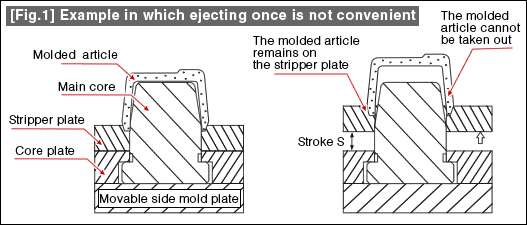
Although ejection is done only once in the usual injection mold, since in the case of the two-stage ejecting structure it is possible inside the mold to carry out ejection two times with a time gap between them, this is a mechanism that is very convenient in cases in which the molded item cannot be taken out the mold with only one ejecting operation.</p>

<p>For example, in the case of the stripper plate ejecting structure such as that shown in Fig. 1, since the shape of the molded item is engraved on the stripper plate, it becomes difficult for the molded item to fall freely.</p>

<p><img src="http://www.misumi-techcentral.com/tt/en/mold/images/142_01.gif" alt="Fig. 1" name="image" width="527" height="225" /></p>

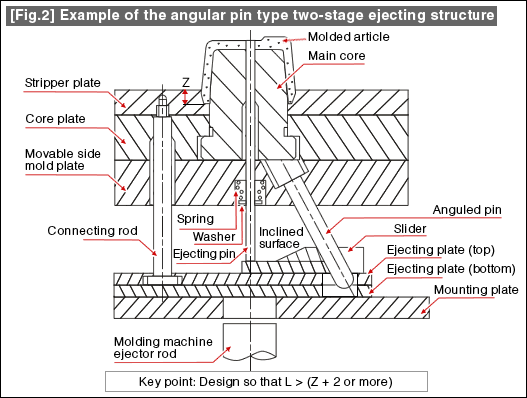
<p>In view of this, if a two-stage ejecting structure as shown in Fig. 2 is used, it is easily possible to make the molded article fall freely.</p>

<p><img src="http://www.misumi-techcentral.com/tt/en/mold/images/142_02.gif" alt="Fig. 2" name="image" width="527" height="398" /></p>

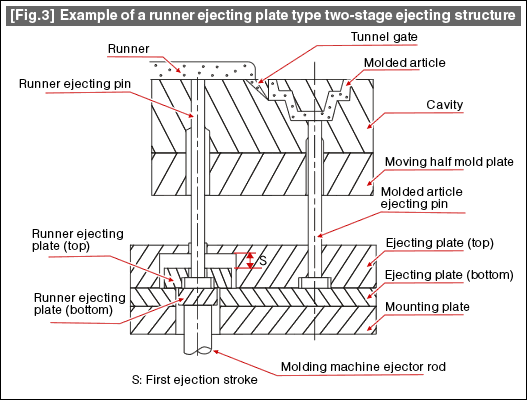
<p>On the other hand, in the structure shown in Fig. 3, a technique has been used in which a runner ejecting plate is provided within the ejector plate thereby making only the runner to be ejected earlier than the molded item. This has the effects of improving the gate cutting ability of the tunnel gate and of reducing the cutting scrap.</p>

<p><img src="http://www.misumi-techcentral.com/tt/en/mold/images/142_03.gif" alt="Fig. 3" name="image" width="527" height="400" /></p>

<p>Apart from this, it is also possible to carry out two-stage ejection using other mechanisms. This will be a useful hint for solving problems when techniques have to be devised for the molded article ejection, runner, cutting of the gate, etc.</p>]]>
        
    </content>
</entry>

<entry>
    <title>#141 Ejecting Stripper Plate Structure</title>
    <link rel="alternate" type="text/html" href="https://www.misumi-techcentral.com/tt/en/mold/2013/02/141-ejecting-stripper-plate-structure.html" />
    <id>tag:www.misumi-techcentral.com,2013:/tt/en/mold//5.1073</id>


    <published>2013-02-14T15:00:00Z</published>
    <updated>2013-02-15T01:41:10Z</updated>


    <summary>The ejecting stripper structure is a str...</summary>
    <author>
        <name>システム管理者</name>
        
    </author>
    
        <category term="Structural Components" scheme="http://www.sixapart.com/ns/types#category" />
    
    <category term="structuralcomponents" label="Structural Components" scheme="http://www.sixapart.com/ns/types#tag" />
    
    <content type="html" xml:lang="ja" xml:base="https://www.misumi-techcentral.com/tt/en/mold/">
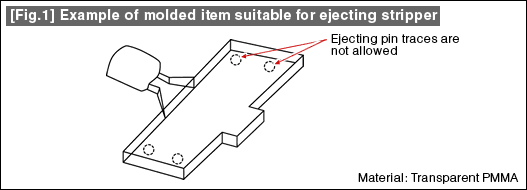
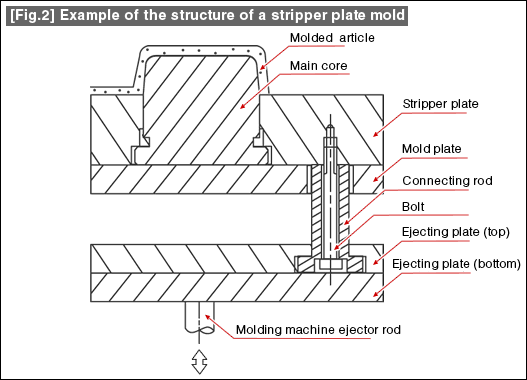
        <![CDATA[<p>The ejecting stripper structure is a structure that is used when there should be no traces of the ejector pin on the molded item.</br>
This is used for transparent optical components made of acrylic or polycarbonate, etc., such as that shown in Fig. 1.</p>

<p><img src="http://www.misumi-techcentral.com/tt/en/mold/images/141_01.gif" alt="Fig. 1" name="image" width="527" height="190" /></p>

<p>Fig. 2 shows an actual example of the ejecting stripper structure</p>

<p><img src="http://www.misumi-techcentral.com/tt/en/mold/images/141_02.gif" alt="Fig. 2" name="image" width="527" height="380" /></p>

<p>Firstly, the main core that forms the molded artilce is fixed to the moving half  mold plate using bolts, etc.</br>
The stripper plate is placed so that it envelopes the side surface of the main core, the stripper plate is further connected to the ejector plate via a connecting rod.</br>
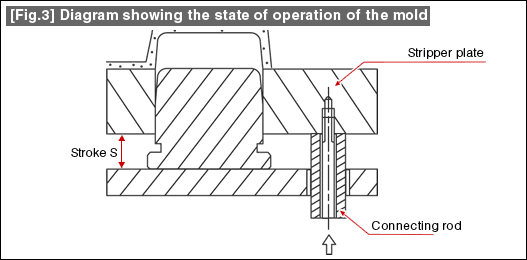
In other words, when the ejector plate moves forward, even the connecting rod moves forward along with it, thereby causing the stripper plate to move forward and ejecting the molded article.</p>

<p>As the ejector plate returns, the stripper plate also returns to the original position.</p>

<p><img src="http://www.misumi-techcentral.com/tt/en/mold/images/141_03.gif" alt="Fig. 3" name="image" width="527" height="260" /></p>

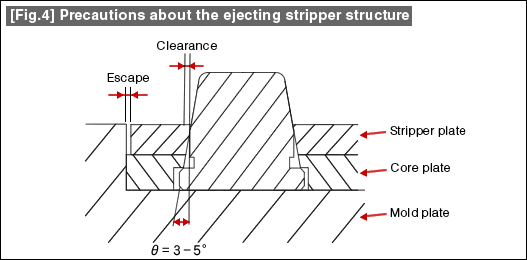
<p>At the time of carrying out the basic design of the stripper plate structure, while it is of course necessary to prepare properly the drawing of the operating states, in addition it is very important for smooth operation to take measures such as managing the clearance between the stripper plate and the main core, tapered escape, etc.</p>

<p>In addition, adoption of a guide system, selection of the steel material for the stripper plate, heat treatment, etc., also become very important factors.</p>

<p><img src="http://www.misumi-techcentral.com/tt/en/mold/images/141_04.gif" alt="Fig. 4" name="image" width="527" height="260" /></p>]]>
        
    </content>
</entry>


<entry>
    <title>#167 Problems in Punching and their Countermeasures (6) Scrap Processing in Punching</title>
    <link rel="alternate" type="text/html" href="https://www.misumi-techcentral.com/tt/en/press/2013/07/167-problems-in-punching-and-their-countermeasures-6-scrap-processing-in-punching.html" />
    <id>tag:www.misumi-techcentral.com,2013:/tt/en/press//4.1099</id>


    <published>2013-07-25T15:00:00Z</published>
    <updated>2013-07-26T00:48:50Z</updated>


    <summary>In punching operations, the processed ma...</summary>
    <author>
        <name>システム管理者</name>
        
    </author>
    
        <category term="Die Design" scheme="http://www.sixapart.com/ns/types#category" />
    
    <category term="diedesign" label="Die Design" scheme="http://www.sixapart.com/ns/types#tag" />
    
    <content type="html" xml:lang="ja" xml:base="https://www.misumi-techcentral.com/tt/en/press/">
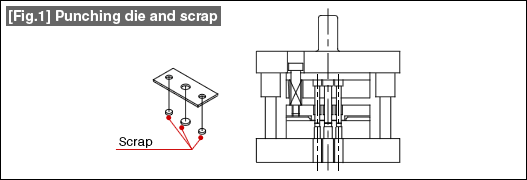
        <![CDATA[<p>In punching operations, the processed material is separated into a part that remains on the die and a part that passes through the die and falls down. Every body will carefully handle the one that falls down if it is the final product, but very often people will handle it carelessly if it is just scrap. This frequently causes problems in making improvements. Fig. 1 shows the relationship between the die and the scrap in an example of hole punching operation. The scrap passes through the die and falls down.</p>

<p><img src="http://www.misumi-techcentral.com/tt/en/press/images/167_01.gif" alt="Fig. 1" name="image" width="527" height="180" /></p>

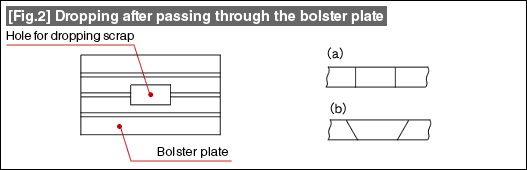
<p>Fig. 2 shows the bolster plate of the press machine.</p>

<p><img src="http://www.misumi-techcentral.com/tt/en/press/images/167_02.gif" alt="Fig. 2" name="image" width="527" height="170" /></p>

<p>The bottom die of the die set is fixed to this plate. In case there is no die cushion device in the press machine, a scrap dropping hole is opened as shown in the figure. The scrap or the product passes through here and gets collected in the collecting container. Although a square scrap dropping hole has been shown in the figure, round shaped holes are also used. Although it is convenient if the scrap dropping hole is large because then the scrap can fall easily, the support for the die becomes low and holding the die becomes a problem. In terms of holding the die, it is better that the scrap dropping hole is small. Normally, the scrap dropping hole has the cross-sectional shape shown in Fig. 2 (a). When the area where scrap is generated is large such as in progressive forming, etc., as a measure for dropping scrap while maintaining the strength of the bolster plate, there is the method is shown in Fig. 2 (b) in which the hole is made to have a tapered shape and the recovering area is made wider.</p>

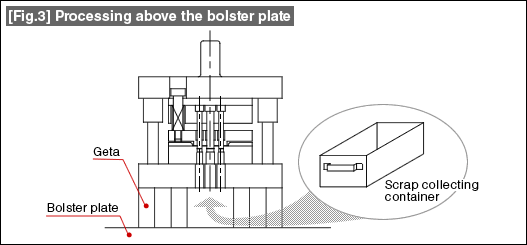
<p>When the press machine is installed with a die cushion, since the die cushion comes at the part where the scrap dropping hole is present, it will not be possible to drop the scrap by passing through the bolster plate. As a result, as shown in Fig. 3, a space for collecting scrap is prepared below the die (collecting the product in some cases). At this time, the plate that is placed below the die is called a "Geta" (in Japanese, meaning wooden clogs) (also called a parallel block, spacer, etc.).</p>

<p><img src="http://www.misumi-techcentral.com/tt/en/press/images/167_03.gif" alt="Fig. 3" name="image" width="527" height="245" /></p>

<p>The Geta has the purpose of supporting the die so that it does not become excessively deformed due to the force of forming, and the purpose of preparing a space for collecting scrap (it is also used for adjusting the die height which is the height of the die with respect to the press machine). The scrap that is collected in this space is processed by scraping out from between the Geta. Although this processing is easy if the scrap has a suitably large size, small scraps of hole punching remain on the bolster plate, and cause damage to the bolster plate or die at the time of replacing the die. Sometimes, such scrap gets dispersed in the surroundings creating a bad environment. Because of this, in operations in which the press operating time is long (production quantity is high), instead of scraping out the scrap, it is also taken out by installing a conveyor or a chute. In the case of small quantity production, there is the method of collecting scrap by preparing a scrap collecting container as shown in the figure. While this has the advantages of it being possible to collect hole punching scrap without the scrap being scattered around, on the other hand, if this is used in large quantity production, there is the danger that work is continued without noticing that the container is full, thereby causing breaking the die.</p>

<p>The methods of processing scrap are not uniform, but will have to be planned considering the relationship between the shape and size of scrap and the production quantity.</p>]]>
        
    </content>
</entry>

<entry>
    <title>#166 Problems in Punching and their Countermeasures (5) Trimming of Drawn and Shaped Parts</title>
    <link rel="alternate" type="text/html" href="https://www.misumi-techcentral.com/tt/en/press/2013/07/166-problems-in-punching-and-their-countermeasures-5-trimming-of-drawn-and-shaped-parts.html" />
    <id>tag:www.misumi-techcentral.com,2013:/tt/en/press//4.1098</id>


    <published>2013-07-18T15:00:00Z</published>
    <updated>2013-07-19T00:55:37Z</updated>


    <summary>In drawing or shaping, it is common to p...</summary>
    <author>
        <name>システム管理者</name>
        
    </author>
    
        <category term="Die Design" scheme="http://www.sixapart.com/ns/types#category" />
    
    <category term="diedesign" label="Die Design" scheme="http://www.sixapart.com/ns/types#tag" />
    
    <content type="html" xml:lang="ja" xml:base="https://www.misumi-techcentral.com/tt/en/press/">
        <![CDATA[<p>In drawing or shaping, it is common to prepare the shape while shrinking the outer periphery of the blank. Because of this, the flange edge part after forming will have changed from the shape of the original flange edge part and has an irregular shape. For example, if a cylinder is drawn from a circular blank, very often we see that the flange shape after drawing is not a neat circular shape but is a shape closer to a rectangle. The shape of the edge will be far from the edge shape required in the product and hence trimming will be necessary.</p>

<table width="527" border="0" cellspacing="0" cellpadding="0">
<tr>
<td class="text" align="left" valign="top">
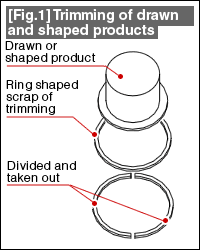
Fig. 1 explains trimming of drawn products. As shown in this figure, the scrap obtained after trimming has the shape of a ring. In this condition, the scrap gets stuck to the punch of the die and cannot be taken out of the die. In order to remove the scrap, it is necessary to divide the scrap into two portions. In the case of small products, the scrap is usually removed by dividing it into two parts.
</td>
<td><img src="http://www.misumi-techcentral.com/tt/en/images/sp.gif" width="12" height="1" border="0" alt="" /></td>
<td align="left" valign="top"><img src="http://www.misumi-techcentral.com/tt/en/press/images/166_01.gif" alt="Fig. 1" name="image" width="200" height="250" /></td>
</tr>
</table>
</br>

<p>If the operation is a single step operation (one shot operation), if the scrap is separated from the die, the processing thereafter is not particularly a problem although it is somewhat cumbersome. However, if the shape of the product becomes large or if trimming is to be done in an intermediate process in transfer forming, it is necessary that the removing of the scrap needs to be done without any problems.</p>

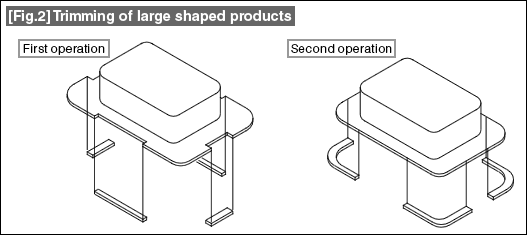
<p>If the product becomes large, the scrap will be too large and even if removed from the die by dividing it into two parts, very often the processing thereafter (recovering by sliding above the chute, etc.,) cannot be done well. It is good that the scrap is made into appropriate sizes that make their processing easy. Fig. 2 shows such an example. The size of the scrap is made small using two steps thereby making the processing easy.</p>

<p><img src="http://www.misumi-techcentral.com/tt/en/press/images/166_02.gif" alt="Fig. 2" name="image" width="527" height="235" /></p>

<p>In shaping operations, attention is given strongly (of course, naturally) to the formed shape, and problems can occur if trimming and scrap processing is taken lightly. Care should be taken about these.</p>]]>
        
    </content>
</entry>


<entry>
    <title>#337 Mechanical Applications of Thermal Spraying-2</title>
    <link rel="alternate" type="text/html" href="https://www.misumi-techcentral.com/tt/en/surface/2018/03/337-mechanical-applications-of-thermal-spraying-2.html" />
    <id>tag:www.misumi-techcentral.com,2018:/tt/en/surface//4.1386</id>


    <published>2018-03-30T01:30:16Z</published>
    <updated>2019-01-16T07:05:41Z</updated>


    <summary>(1)Thermal spraying for improving heat r...</summary>
    <author>
        <name>システム管理者</name>
        
    </author>
    
        <category term="Thermal Spraying" scheme="http://www.sixapart.com/ns/types#category" />
    
    
    <content type="html" xml:lang="ja" xml:base="https://www.misumi-techcentral.com/tt/en/surface/">
        <![CDATA[<h4 style="margin-top:30px;">(1)Thermal spraying for improving heat resistance</h4>

<p>This sounds like a low-tech example, but the steel chimneys are known to corrode when they are exposed to heat under approximately 550 &deg;C. Corrosion occurs not because of the heat itself but for the air and moisture content combined.To form films that can withstand such conditions, aluminum spraying films of approximately 150 to 200 &micro;m thick are applied by wire flame spraying, followed by sealing treatment using silicone-based materials.In the same manner, to achieve heat resistance up to 900 &deg;C, sealing treatment using asphalt-based materials is applied after forming aluminum spraying films.<br>
To withstand temperature of as high as 750 to 1000 &deg;C without sulfur, sealing treatment using asphalt-based materials is applied after forming nickel-chromium alloy spraying films (200 to 300 &micro;m).For the same temperature range conditions where sulfur is present, sealing treatment using asphalt-based materials is applied over nickel-chromium alloy spraying films (350 to 450 &micro;m) + aluminum spraying films (80 to 130 &micro;m).</p>

<h4 style="margin-top:30px;">(2)Thermal spraying for improving heat insulation</h4>

<p>Thermal spraying is also used for preventing heat dissipation from the surfaces of machinery and equipment.For this purpose, thermal spraying films having low heat conductivity are used.Ceramics such as magnesium oxide, and zirconium-based materials containing calcium oxide, are the common materials.<br>
To prevent the films from being peeled off due to the difference of heat expansion rates between the substrate and ceramics, spraying materials having enhanced oxidation and corrosion resistance at high temperature, such as nickel-chromium alloy and nickel-chromium-aluminum alloy, are adopted for the undercoat. In addition, cermet containing both of these materials can be sprayed between the undercoat and the ceramic coatings, as a measure of alleviating heat expansion.</p>

<h4 style="margin-top:30px;">(3)Thermal spraying for biomaterials</h4>

<p>As the human life expectancy increases, more people start experiencing problems with body parts and organs.To substitute these, developments of artificial organs, such as heart, and artificial bones are becoming more popular than before.<br>
Dentures are the typical example of artificial body parts that have been around quite a while.For a missing tooth, a bridge is mounted between the existing teeth using metals after drilling the surrounding teeth. A ceramic or dental alloy crown is placed over a chipped or discolored tooth after preparing the tooth to fit into it.<br>
If no tooth is left, full dentures are attached over gum lines.If no root is left due to progressed cavities or periodontal diseases, artificial dental roots need to be formed in the gum.This is called implants.Materials for implants should not be harmful to human body. They also need to be corrosion resistant and be strong enough to withstand the biting force, while being compatible with other parts of the human body.<br>
Implants are artificial tooth roots that are mounted on secure jawbones by drilling a hole in them.Eventually, the jawbones grow around the artificial roots and the implanted roots are secured in place.On the artificial roots, artificial teeth are attached with screws.Titanium is the common material for artificial roots.To improve the affinity with tissues, titanium powder and hydroxyapatite, a component of bones, are sprayed over the implants.Thermal spraying films are also used for artificial joints.</p>
]]>
        
    </content>
</entry>

<entry>
    <title>#336 Mechanical Applications of Thermal Spraying-1</title>
    <link rel="alternate" type="text/html" href="https://www.misumi-techcentral.com/tt/en/surface/2018/03/336-mechanical-applications-of-thermal-spraying-1.html" />
    <id>tag:www.misumi-techcentral.com,2018:/tt/en/surface//4.1385</id>


    <published>2018-03-23T02:14:27Z</published>
    <updated>2018-03-23T02:15:01Z</updated>


    <summary>This volume introduces the mechanical ap...</summary>
    <author>
        <name>システム管理者</name>
        
    </author>
    
        <category term="Thermal Spraying" scheme="http://www.sixapart.com/ns/types#category" />
    
    
    <content type="html" xml:lang="ja" xml:base="https://www.misumi-techcentral.com/tt/en/surface/">
        <![CDATA[<p>This volume introduces the mechanical application examples of thermal spraying.</p>

<h4 style="margin-top:30px;">(1)Thermal spraying for improving corrosion resistance</h4>

<p>To add rustproof and anti-corrosion properties to large structures, such as bridges and steel towers, zinc, aluminum, and zinc-aluminum alloy are used for thermal spraying.In general, a thermal spray layer of as thick as 150 to 300 &micro;m is applied after a pretreatment process consisting of sandblasting which is designed to clean and roughen the surface.<br>
The humidity control is an important factor during this process. If the humidity is not below 80%, the corrosion resistance is significantly degraded.Sealing treatment must be applied immediately after thermal spraying (within four hours).This treatment not only seals tiny holes on porous films but also improves adhesiveness of the topcoat because of the anchor effect.<br>
Coatings that are appropriate for the intended operating period are applied over the sealant.In this way, the recoating interval can be drastically extended by applying thermal spraying as an undercoat.</p>

<h4 style="margin-top:30px;">(2)Thermal spraying for improving chemical resistance</h4>

<p>Various thermal spraying methods are adopted for applications requiring higher chemical resistance, such as chemical equipment.Spraying materials having high chemical resistance do not necessary form the films that are strong enough to withstand varying chemical agents. The materials should be evaluated by taking test pieces out and exposing them in the operating environment for a long period.<br>
In general, metals or ceramics are adopted for films requiring high chemical resistance, which are processed by wire flame spraying or powder flame spraying.For large structures, spraying is applied on site.<br>
One of the applications is to use nickel chromium, nickel aluminum, tantalum, or molybdenum as the undercoat over the sandblasted substrate and to apply ceramic spraying on the topcoat, followed by sealing treatment.Another method of the applications is to spray cermet, which is a mixture of undercoat metal and topcoat ceramics, between the undercoat and the top coat.<br>
It is also possible to improve chemical resistance by re-melting the multi-layered films with heat and eliminating the pores.</p>

<h4 style="margin-top:30px;">(3)Thermal spraying for improving abrasion resistance</h4>

<p>Abrasion occurs in various forms.However, these varying types of the abrasion, including adhesive wear, abrasive wear, fatigue wear, and corrosive wear, hardly occur by itself; one or more types of abrasion and wear are observed concurrently.When a certain degree of abrasion is expected, lubricants are used.<br>
Since the spray coatings are porous, using oil will improve the lubricating properties.Commonly, spraying materials such as high chrome stainless steel and molybdenum are applied over the shafts and role shaft bearings by wire flame spraying or plasma spraying.<br>
Besides this method, plasma spraying of various metals, ceramics, and cermet is widely used for the industrial purposes.</p>]]>
        
    </content>
</entry>


</feed>