#020 Basics of Blanking Work (10) Outer Cutting Work - 4: Matching
The cutting and joining parts indicated by (a) to (d) in Fig. 1 are generated when the outer contour shape is prepared by outer cutting operation in progressive cutting, etc. The cutting and joining parts are the shape parts prepared due to the intersection of two punches. Such parts are generally called "Matching parts".
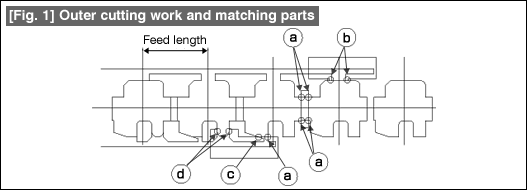
The part indicated by (a) in Fig. 1 is the matching part where there is a 90º right angle intersection. The part indicated by (b) is a matching part that is generated in a straight line part. The part indicated by (c) is a matching part in an angular part and that indicated by (d) is a matching part in a rounded part. These four patterns are the basic matching parts. The 90º right angle intersection matching part does not need any special measures, and can be said to be an ideal matching condition.
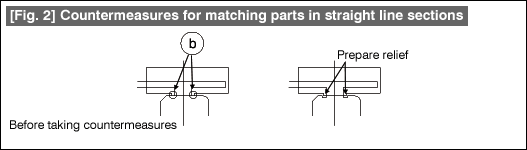
Unless countermeasures are taken for the straight line section matching part of Fig. 2, it will lead to generation of steps or burrs. This is because the same part is cut twice by a punch. The action to be taken is to provide a relief at the part which is cut twice, thereby making the cut parts intersect each other. In the external appearance of the formed product, the matching parts will remain as depressions. Since the matching parts have some effect in this manner in the external appearance, care should be taken so that matching parts are not created in parts where they can affect the functions of the product.
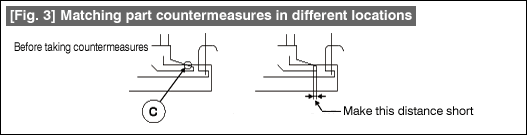
In the matching parts in angular sections shown in Fig. 3, it is easy for plucking type of burrs to be generated. Design a cutting edge shape (cut punch) in which the extension part of the inclined line is as short as possible.
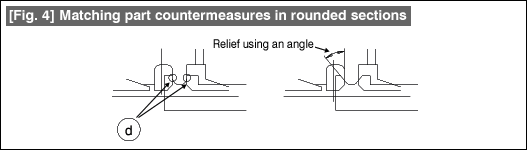
In the matching part in a rounded section shown in Fig. 4, is the rounding shape is attempted to be made correctly, the same condition as in a matching part in a straight line section occurs. Therefore, the cut punch should be designed so that a tangent is drawn from the rounded section and so that it intersects the straight line part at an angle.
In outer cutting work, although various measures can be taken because the cut punch can be prepared freely, the drawback is the generation of matching parts. If any mistake is made in the countermeasures against matching parts, it can lead to the generation abnormalities such as burrs. When such a thing has happened, it is very difficult to take corrective countermeasures. Therefore, it is very important to think of countermeasures at the time of designing the cut punch so that problems do not occur and then carry out the design.



- #167 Problems in Punching and their Countermeasures (6) Scrap Processing in Punching
- #166 Problems in Punching and their Countermeasures (5) Trimming of Drawn and Shaped Parts
- #165 Problems in Punching and their Countermeasures (4) Scrap Clogging in Punching
- #164 Problems in Punching and their Countermeasures (3) Bending and Twisting of Narrow Punched Parts
- #163 Problems in Punching and their Countermeasures (2) Bending due to Punching





Please visit your Regional MISUMI website for additional information or to request our latest catalog.

Unauthorized reproduction is prohibited by all applicable laws and is subject to criminal prosecution.