#036 Motion Mechanism Design - 6 : Timing Belt Drive
Discussed here is accuracy requirements of stepper motors using a simple single axis robot with a timing belt and a stepper motor.
![[Fig.1] Timing belt driven single axis robot mechanism](http://www.misumi-techcentral.com/tt/en/lca/images/036_1.gif)
(1) Calculating rotational accuracy needed for the motor
For converting motor rotations to linear motion, accuracies needed for the linear motion mechanism and the drive motor are as follows.

This equation is a conversion of needed linear positioning accuracy and rotational accuracy per 360 degree rotation, easily understandable by the [Fig.2] show below.
![[Fig.2] Needed motor accuracy and linear positioning accuracy](http://www.misumi-techcentral.com/tt/en/lca/images/036_3.gif)
(2) Example
1. If timing belt and pulley selection candidates are as follows...
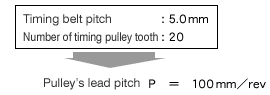
If linear positioning accuracy A is to be: A = ± 0.1mm...

2. If a ballscrew is used
The accuracy equation above can be used for ballscrew cases by replacing the pulley's lead pitch P with a ballscrew lead pitch.


- Positioning technology
- Designing and processing
- Sensor Technology
- Automation elements technology
- Clean room technology
- Design hints
- Design tips
- Designing and Machining
- Drive mechanism design
- Hints on designing
- Linear Motion Components
- Locating Technology
- Manufacturing technology
- Motion mechanism design
- Pneumatic Drives
- Production Technology
- Technology Outlook
- General description
- Low-cost automation and materials
- Transfer LCA

- #333 Know-how on automation: Pressurized heating technology - 5: Multilayer pressurized heating process technique
- #332 Know-how on automation: Pressurized heating technology - 4: Points to remember when designing mechanism of pneumatic pressurization method
- #331 Know-how on automation: Pressurized heating technology - 3: Pneumatic pressurization method and pressure profile
- #330 Know-how on automation: Pressurized heating technology - 2: Pressurization method and pressure profile
- #329 Know-how on automation: Pressurized heating technology




Please visit your Regional MISUMI website for additional information or to request our latest catalog.

Unauthorized reproduction is prohibited by all applicable laws and is subject to criminal prosecution.