September 2009 Archives

#013 Thermal Expansion of Mold Components (Example of Calculation)

Let us see a case study about the thermal expansion of mold components described in the last course.

Question:

The overall length of a core pin prepared in a 20°C machine formation room was 30.52 mm. When this core pin is heated to 150°C, how long is the amount of thermal expansion? The material of the core pin is pre-hardened steel of the SCM440 series.

Sample Answer:

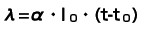
The equation for calculating the thermal expansion of metals is the following. Let us substitute the values in this equation.

Where λ is the elongation (mm) of the core pin due to thermal expansion and α is the linear thermal expansion coefficient of the metal (mm/mm).
In the case of a pre-hardened steel of the SCM440 series, α = 11.5 x 10⁻⁶ mm/mm, l is the initial length of the core pin (mm), l= 30.52 mm, t is the initial temperature (°C), t = 20°C, and t is the temperature after heating (°C), t = 150°C.
Therefore, λ = 11.5 X 10-6 X 30.52 X (150-20) = 0.0456 (mm).

#012 Thermal Expansion of Mold Components

The basic knowledge about the thermal expansion of components in the molds for plastic injection molding is discussed below.

In the case of a mold for plastic injection molding, in order to maintain the appropriate cavity surface temperature, it is maintained at a temperature of 30 to 150°C. On the other hand, molten plastic flows into the sprue, runner, and cavity, which receive heat from the plastic at temperatures in the range of 180 to 300°C. Metals generally undergo thermal expansion when the temperature rises. Therefore, even the constituent parts of a mold for plastic injection molding undergo thermal expansion. Thermal expansion can disrupt the mating between the guide post and guide bush, or can cause bad movement of the slide core, or can enlarge the dimensions of the core pins.

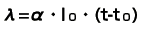
The basic changes in the dimensions due to thermal expansion can be calculated using the following equation.

Where, λ is the expansion (in mm) in the dimensions expected to thermally expand, α is the linear thermal expansion coefficient (mm/mm) of the metal, l is the initial length (mm), t is the initial temperature (°C), and t is the temperature after heating.

The linear thermal expansion coefficients for typical metallic material used in molds are given below.

Materialα Linear thermal expansion coefficient (mm/mm)
S50C11.7×10-6
SKD1111.7×10-6
Pre-hardened steel (SCM440 series)11.5×10⁻⁶
18-8 Stainless steel(17~18)×10-6
36% Nickel stee0.9×10-6
Super duralumin23.4×10-6
Brass(18~23)×10-6
Coppe16.5×10-6

#011 Bending of Core Pins due to Injection Pressure

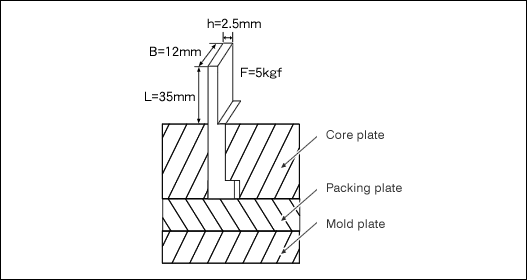
The basic equations for calculating the bending deformation of core pins due to the injection pressure are explained here.

In injection molding, since a high filling pressure acts inside the cavity, thin and long mold parts such as core pins can get deformed or may even cause breakage accidents. The pressure acting on a core pin is different in different cases depending on the flow pattern of the molten plastic, the gate placement, etc., and hence actual calculations of the accurate strength are quite complex. Therefore, usually, the state of action of the pressure is approximated (simplified) and only basic calculations are made. The basic method of calculating the deformation (bending) of a core pin is explained below.

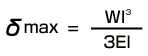
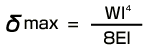
The maximum amount of deflection (δmax) in a cantilever beam structure is calculated using the following equations.

(1) When a concentrated load acts upon the tip of the core pin

Here, δmax is the maximum amount of bending (cm), W is the concentrated load (kgf), E is the longitudinal elastic modulus (kgf/cm2), and I is moment of inertia of area(cm4).

(2) When a uniformly distributed load is assumed to act on the side surface of the core pin

Where, W is the uniformly distributed load(kgf/cm2

In actuality, in the periphery of the core pin, since the molten plastic flows around instantaneously, it is considered rare that the pressure acts simply in only one direction. In the case of a thin and long core pin, etc., since the pressure may act during the process of (1) or (2) depending on the gate position, it is possible to carry out the basic calculations by substituting the data in the above equations.

#010 Procedure for Determining the External Dimensions of a Cavity

How are the external dimensions of the cavity (nest in the fixed side) determined? In most cases, the reality is that the dimensions of a similar past mold are used as a reference, or the dimensions are determined by experience and intuition. If the correct procedure for determining the external dimensions is known, it is possible to avoid the danger of accidents of the mold breaking due to the pressure of the plastic, and also to avoid the wastage of preparing an unnecessarily strong and large mold.

The correct procedure for determining the dimensions is explained below.

Step 1: Calculating the minimum wall thickness

A cavity is formed by carving a concave shape inside a block of steel material. Unless the thickness 'h' of the wall between the carved complementary shape of the molded product and the external shape of the steel material has a certain thickness, the mold may break or may become greatly deformed due to the filling pressure of the plastic. It is possible to obtain the recommended value of this thickness by theoretical calculations by applying the equations of the field of strength of materials.

The appropriate equation should be selected since the equation to be used differs depending on - (1) the external shape of the cavity (cubical or cylindrical), and (2) the structure of the cavity (unified or separated).
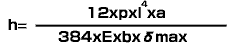
The data to be substituted in the equation are determined considering the molding conditions, and the type of steel material, etc. The technique of a professional is also to assume a variety of cases such as the case of bad preconditions for calculation, a case of the best preconditions, etc., and to make a comparison of the results of the calculations. The minimum wall thickness based on theory is determined by taking into account a margin of safety for the value of h obtained by the calculations.

Step 2: Cavity

If the external shape of the cavity is determined using the value of h obtained by calculations, at the time of fixing the cavity to the mold plate, etc., it may some times not be possible to obtain sufficient dimensions of flanges or to obtain sufficient space for drilling screw holes. In such cases, dimensions should be determined so that any one of these can be placed, and the final cavity dimensions are determined using even integer numbers that are round numbers (for example, 50 mm, 80 mm, etc.).

[Fig. 1]

[Fig. 2]

About this Archive

This page is an archive of entries from September 2009 listed from newest to oldest.

August 2009 is the previous archive.

October 2009 is the next archive.

Find recent content on the main index or look in the archives to find all content.