April 2012 Archives

#121 Method of Determining Cavity Dimensions (1)

| No Comments | No TrackBacks

In the previous lesson we have explained the molding shrinkage ratio and in this lesson we describe a method of determining the cavity dimensions using the molding shrinkage ratio.
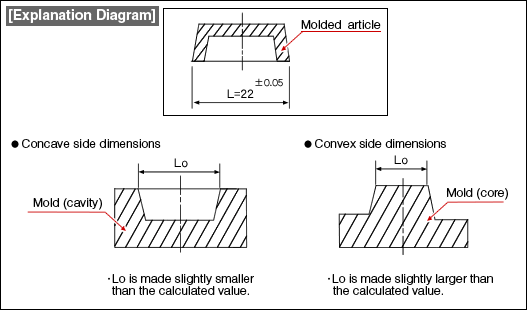
Explanation Diagram

Firstly, we determine the molding shrinkage ratio α.
Example: α = 0.005

Next, we select the dimension of the molded article that is to be determined. (When the dimensional tolerance is a ± tolerance value)
Example: 22 ±0.05

Next, we calculate the cavity dimension that is to be obtained using Eqn. 2 below.

L0 = (1 + α) * L ... [Eqn. 2]
Where,
L0: Cavity dimension (mm)
L: Dimension of the molded article (mm)
α: Molding shrinkage ratio

Example:
L0 = (1 + α) * L
= (1 + 0.005) * 22
= 1.005 * 22
= 22.11

Therefore, theoretically the target dimension of the cavity will be 22.11 mm.

In addition, slight adjustment is made in the calculated dimension of 22.11 mm considering machine operability and mold correction after trial fabrication. Although machining a mold component with a width of 22.11 mm is of course possible with the present day machines, since the machining dimensions are specified in units of 0.01 mm and since the machining cost will be high, if possible we would like to round the 0.01 mm part of the dimension to an even number.
Therefore, we correct as 22.11 → 22.10 or 22.11 → 22.12.
Of course it is possible to leave it as 22.11 if we want to machine as precisely as possible.

Finally, when the calculated dimension is on the concave side of the mold, in some cases, the adjustment of the dimension on the convex side is made one more time than in the case of the concave side.
In the case of the concave side, it is also possible to make the dimension slightly smaller so that the mold can be corrected later on.
In this case, the correction is made as 22.10 → 22.08 or 22.12 → 22.08.
The mold is prepared with a slightly larger dimension on the convex side.
In this case, the correction is made as 22.10 → 22.12 or 22.12 → 22.14.
These adjustments are not necessary if it is judged based on experience that the mold need not be corrected.

#120 Mold Deposits

| No Comments | No TrackBacks

Mold deposits are materials that are deposited in the gaps between the inserts of molds for plastic injection molding or in the corners of the cavity. When the deposits accumulate, defects occur such as short shot of the molded item, or the shape is not accurately transferred to the molded article.

The causes of deposits can be the deposition of chemical constituent in the plastic or can be due to the effect of the chemicals or oil traces on the surface of the mold. The moisture in air can get adhered to the gap between the inserts and can cause the generation of rust, deposits get accumulated on such rusted parts, and the accumulation of deposits grows.

Although it is difficult for the "soot component" or the gas component in the volatile gases generated from the plastic to get adhered when the mold temperature is high due to molding operation, if the mold is removed from the molding machine and the mold temperature decreases, the gas components, etc. become solidified and become deposits.

The mold will last long if the deposits are removed periodically by dismantling and cleaning the mold. At the time of designing the mold, it is important to consider the optimum periodicity at which to dismantle and clean the mold.

In addition, it is also effective to adopt a mold structure which makes it difficult for deposits to get accumulated. For example, methods such as providing a gas vent surrounding the core pin and providing a groove surrounding the ejector pin and the runner lock pin for gas to escape are used in practice. It is also effective to use rust resistant steel such as stainless steel for the material of the mold components, or to provide hard chromium plating or a PVD film coating.

There are also some cases in which the gaseous components are forcibly exhausted using a vacuum suction device, but this makes the structure of the mold complicated.

During maintenance of the mold, the adhered matter is removed carefully by ultrasonic cleaning or using organic solvents to degrease the mold.

#119 Cooling Time of the Central Part of the Molded Article

| No Comments | No TrackBacks

While in the last lesson we discussed the experimental equation that predicts the cooling time for the average temperature of the wall thickness of the molded item to be cooled up to a prescribed temperature, in this lesson we explain the experimental equation that predicts the time taken for the temperature of the central part of the molded product to be cooled to a prescribed temperature.

When we want to reduce the so called "post-shrinkage" which is the shrinkage after the molded item has been taken out of the mold, it is necessary to cool the molded article inside the mold until the central part of the wall thickness of the molded item is cooled to a prescribed temperature.
The cooling time tlc for the central part of the wall thickness of the molded article to reach the temperature θe can be calculated using the following equation.

  tlc = s2 / (π2α) ln (4/π ∙ (θr - θm) / (θe -θm))
   tlc: The cooling time (seconds) for the central part of the wall thickness of the molded article to reach the temperature θe.
 
Where,
s: Wall thickness of the molded article (mm)
α: Heat diffusion ratio of the plastic at the cavity surface temperature (mm2/sec)
α = λ/ (c ∙ ρ)
λ = Thermal conductivity of the plastic resin(kcal/m∙h∙°C)
c: Specific heat of the plastic resin(kcal/kg∙°C)
ρ: Density of the plastic resin(kg/m3)
θr: Temperature of the molten plastic resin (°C)
θe: Temperature at the center of the wall thickness of the molded article (°C)
θm: Cavity surface temperature (°C)

* References: "Molds for injection molding" (Keizo MITANI, Sigma Publications (1997))

About this Archive

This page is an archive of entries from April 2012 listed from newest to oldest.

March 2012 is the previous archive.

May 2012 is the next archive.

Find recent content on the main index or look in the archives to find all content.