November 2010 Archives

#063 Wear of Molds

The parts of plastic injection mold wear out due to contact or friction between parts, and in addition, due to glass fibers contained in the plastic resin.
If the shape of the wear exceeds the tolerable range, problems occur such as the mold can no longer move correctly, the mold will be broken, or the shape of the molded product becomes deformed.

The worn out of molds is classified into normal wear and abnormal wear.

Normal wear is the worn out that is caused when parts that touch or slide against each other gradually get worn out.
Although it is technically possible to make it difficult for parts to get worn out, it is extremely difficult to prevent wear fundamentally unless the parts do not contact each other.
Normal wear is classified into initial wear and steady wear.
If the part is replaced with a new part when the steady wear reaches managed scheduled dimensions, it is possible to prevent in advance failures or problems with the molds.

On the other hand, abnormal wear is wear that is not normal wear. There are five typical classifications of abnormal wear.

1. Abrasive wear(abrasive wear)

This is the form of wear that can occur easily when there is a difference in the hardness of the materials that are rubbing against each other. The harder material bites into the softer material generating scratches, and causing wear.

2. Adhesive wear

This is the form of wear in which projecting parts of materials hit against each other causing a part to get adhered, and as a result of growth of the adhered part, it becomes a transfer particle, and eventually falls off as wear dust.

3. Fatigue wear

This is the form of wear in which metal fatigue occurs due to repletion of the application and removal of load (repetition of operation and stopping), causing wear,

4. Fretting wear

This is the form in which wear of fine pitching shape occurs on the surface of mating parts.

5. Corrosion wear

This is the form of wear that is caused when a potential difference is generated between metals in a corrosive atmosphere, thereby causing the sliding parts to disappear, resulting in damage occurring speedily due to the addition of friction wear.
#062 Types of Plastics and Guidelines for Selecting Steel for the Cavity

 When the steel material for the cavity is selected depending on the type of plastic resin and the functions expected of the molded product.
 If the selection of the steel is not appropriate, it may not be possible to polish the fined surface into a fine surface, or corrosion may progress during the molding, or the wearing out may occur at a fast rate.
 The table below shows the major types of plastic resins or the guidelines for selecting the recommendation of steel.

  Plastic
resin
Example
of molded
product
Characte-
ristics
expected
of the plastic resin
Characte-ristics
expected
of the steel
Recommend-
ed type of steel
Thermo- Plastic ResinPP
ABS
Bumpers
OA chassis
Shock
resistance
Surface glossS50C
SCM440
PS
PMMA
ABS
Lighting fixtures
General goods
Containers for
cosmetics
Design
flexibility
Surface gloss
Mirror
finishing
SKD61
Pre-
hardened steel
POM
PA
Gear wheels
Bearings
Abrasion
resistance
Abrasion resistance SKD61
Pre-
hardened steel
PC
PMMA
Lenses
Light guides
Transparency
Optical transmittivity
Mirror
finishing
SUS420J2
Precipitation hardened steel
PC
PMMA
CDs
DVDs
Optical transmittivity
Optical birefringence characteristics
Mirror
finishing
Corrosion resistance
SUS420J2
PVCRainwater
pipes
Flaming
resistance
Corrosion resistance SUS
Fire resistant ABS TV cabinets
Consumer electronics components
Flaming
resistance
Corrosion resistance SUS420J2
Pre-
hardened steel
PBT-GF
PA-GF
Camera chassis
Electrical components
Durability Abrasion resistance Pre-
hardened steel
SKD11
PA with magnetic powder added Printer rollers
Sensor
components
Formability
Electrical characteristics
Non-
magnetic characte-ristics
Abrasion resistance
Non-
magnetic steel
Mg
Forming
PC chassis
Mobile
phone
chassis
Durability
Light weight
Heat resistance
Abrasion resistance
Non-
magnetic steel

Thermo-
Set Resin

Phenol
resin
Melamine resin
Kitchen utensils
Ash trays
Heat
resistance
Abrasion resistance Pre-
hardened steel
SKD11
Phenol
resin
Un-saturated polyester
Switches
Connectors
Heat resistance
Flaming
resistance
Abrasion resistance
Corrosion resistance
SUS420J2
SKD11
Epoxy resin IC sealing
Transistors
Electrical
insulation
Abrasion resistance
Corrosion resistance
SUS420J2
SKD11

#061 Mean Time Between Failures of Molds (MTBF)

In plastic injection molding, when molding operations are being carried out in mass manufacturing, initial failures or random failures can occur at certain probabilities.
In the last course we explained the different failure periods, and this time we will explain what is called the "Mean Time Between Failures (MTBF)".

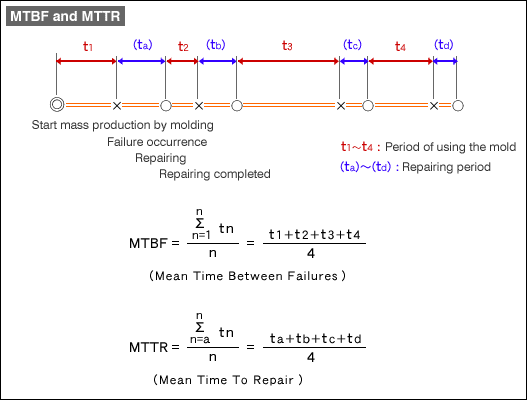
The average time after a mold has failed until the next failure occurs is called the MTBF. Therefore, the unit of MTBF used is time (hr, min, etc.) or the number of shots.

When the value of MTBF is large, it can be evaluated that the mold is one in which failure is difficult to occur.
On the other hand, if the value of MTBF is small, it can be said that the mold is likely to fail easily, and it is difficult to make a plan of production of stable molding operations.

Let us consider MTBF in a more realistic example. When several repeated molds are manufactured using the same design drawings, although initial failures and random failures are more likely to occur in the first mold, if technical improvements are made in response to such failures, it will be difficult for such failures to occur in the second and subsequent molds. Therefore, the MTBF of second and subsequent molds will be a large number compared to that of the first mold.

When considering the "production cost + maintenance and management cost" of a mold from it is initially produced until it is disposed off, if the cost of a mold is evaluated based only on the fact that the initial cost (initial production cost) of the mold is cheap, in the end it may become an expensive purchase.
MTBF has a lot of importance as an index for evaluating the maintenance and management cost.

On the other hand, as an index for evaluating the ease of repair of molds, there is what is called the Mean Time To Repair (MTTR).
In case a mold fails, the MTTR of that mold has a small value if it is possible to repair it quickly.
As an example, if spare parts are always in stock, and also if the structure is such that it is possible to replace the spare parts from the parting surface even without removing the mold plate of the cavity, then the MTTR will become a small value.
MTTR, also, has a lot of importance as an index for evaluating the maintenance and management cost.

MTBF and MTTR

About this Archive

This page is an archive of entries from November 2010 listed from newest to oldest.

October 2010 is the previous archive.

December 2010 is the next archive.

Find recent content on the main index or look in the archives to find all content.