November 2009 Archives

#021 Measures to Solve Molding Defects (Sink Marks)

Sink marks arise from the phenomenon when the surface of the molded product shrinks and becomes slightly depressed.

This may cause quality defects in the case of molded products whose outer surface is important as a product.

The following measures can be taken to solve the problem of sink marks.

(1) Measures related to molds
1. Slightly decreasing the cavity surface temperature.
2. Making the gate wider.
3. Making the runner size larger.
4. Making the sprue thicker.
5. Re-studying the cooling path of the mold, and increasing the cooling efficiency.
6. Changing the cooling structure of hard-to-cool parts to easy-to-cool parts. (Example: Baffle plate structure, cooling pipe structure, heat pipe, nests of non-ferrous metals)
7. Increasing the number of gates.
8. Changing the gate position to a thick wall part.

(2) Measures related to injection molding conditions
1. Making the dwelling time longer.
2. Setting the dwelling pressure to a higher value.
3. Setting the injection speed to a higher value.
4. Lowering the nozzle temperature.
5. Try increasing the value of the measure.
6. Try increasing the weight of the cushion.
7. Try changing the injection molding machine.
8. Replacing the reverse flow prevention ring of the injection unit.

(3) Measures related to the design of the molded product
1. Removing the thick wall parts in the molded product. (Example: Forming a recessed shape, using parts for other purposes)
2. Using a non-crystalline plastic.

#020 Example of Calculating the Cooling Time (1)

Problem:

How long is the necessary cooling time for an injection molded product made of ABS plastic (natural material) with a wall thickness of 1.5 mm? However, assume that the cavity surface temperature is 50°C, the temperature of the molten plastic is 230°C, and the molded product releasing temperature is 90°C.

Sample answer:

The cooling time tla required until the average temperature of the molded product becomes 50°C is calculated using the following equation.

tla = s2 / (π2•α) ln(8 / π2•(θr - θm) / (θe - θm)),  where,

tla is the cooling time (sec) related to the average temperature of the wall thickness; s is the wall thickness 1.5 (mm) of the molded product; α is the heat diffusion rate of the plastic at the cavity surface temperature, α = λ/(c•ρ); λ is the coefficient of thermal conductivity of the plastic (kcal/m•.h•°C); c is the specific heat of the plastic (kcal/kg•°C); ρ is the density of the plastic (kg/m3); and with the ABS plastic (natural material) at a cavity surface temperature of 50°C, α = 0.0827 mm2/sec; θr is the temperature of the molten plastic (230°C); θe is the temperature for taking out the molded product (90°C); and θm is the cavity surface temperature (50C). Substituting these values into the above equation, we get:

tla = 1.52 / (3.142•0.0827) ln(8 / 3.142•(230 - 50) / (90 - 50)) = 3.57 (sec)

The cooling time required until the average temperature of the molded product becomes 50°C is 3.57 sec.

*Referencee:"Molds for Injection Molding" by Keizo Mitani, Sigma Publications, 1997 (in Japanese)

#019 Molding Cycle and Cooling Time

| No Comments | No TrackBacks

While plastic injection molds are required to have the functions for producing molded parts with the desired quality, at the same time it is also required that production be possible at the lowest possible production cost.

The cycle of plastic injection molding is defined as follows.

Molding cycle t (sec) = t1 + t2 + t3 + t4, where, t1 is the injection time = injection time + dwelling time (sec), t2 is the cooling time (sec), t3 is the time (sec) needed to remove the molded product, and t4 is the time (sec) needed to open and close the mold.

Among the factors determining the molding cycle, the one that is the most important is the cooling time t2. Cooling time is the time from filling the inside of the cavity with molten plastic to the sealing of the gate until the plastic solidifies. From experience, it is known that the cooling time varies depending on the cooling capacity of the cavity of the mold. In addition, it also varies depending on the type of molding material and the wall thickness of the molded product. Predicting what the optimum cooling time is during the mold design stage is a very important matter in estimating the production cost of the molded product. While recently software products have come on the market that predict the cooling time by CAE, in general, the following experimental equation is used for predicting the cooling time.

tla = s2 / (π2•α) ln(8/π2•(θr - θm) / (θe - θm)), where,
tla is the cooling time (sec) related to the average temperature of the wall thickness; s is the wall thickness (mm) of the molded product; α is the heat diffusion rate of the plastic at the cavity surface temperature (mm2/sec), α = λ/(c•ρ); λ is the coefficient of thermal conductivity of the plastic (kcal/m•h•°C); c is the specific heat of the plastic (kcal/kg•°C); ρ is the density of the plastic (kg/m3); θr is the temperature of the molten plastic (°C); θe is the temperature for taking out the molded product (°C); and θm is the cavity surface temperature (°C).

* Reference: "Molds for Injection Molding" by Keizo Mitani, Sigma Publications, 1997 (in Japanese)

#018 Mold Related Dimensions of Plastic Injection Molding Machines (1)

While a mold for plastic injection molding is used by installing it in an injection molding machine, at present the specifications for installing the mold in the molding machine are different for different molding machines. On the other hand, in JIS, the recommended standard specifications have been stipulated regarding the "Mold related dimensions of plastic injection molding machines" (JIS B 6701-1992). From now on, these standards are considered to be referred to for the general injection molding machines manufactured in Japan. These standards will be discussed for several courses beginning with this course.

There is only one point that has to be paid attention to and that is, in the actual design of a mold, as the final information for judgment, giving first priority to the mold installation specifications of the injection molding machine that is scheduled to be used. Since JIS standards are only recommended standards, depending on the individual features of the injection molding machine, it is possible that the contents of the standards have been changed, and hence it is necessary to keep this point in mind.

<JIS B 6701-1992>
"Mold related dimensions of plastic injection molding machines"

(1) Scope

These specifications stipulate the mold installation dimensions, etc. of plastic injection molding machines with a mold clamping force of 196 to 7845 kN (20 to 800 tf).

Explanation:

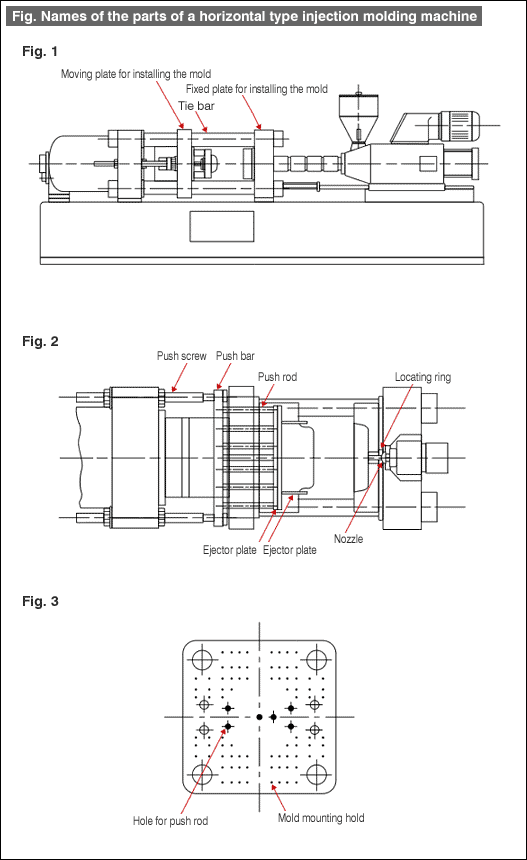
The names of the different parts of the injection molding machine are as shown in the figure below. (These names are merely the names used in the explanation of this standard, and do not indicate the shape or the structure of the different parts.)

Fig. Names of the parts of a horizontal type injection molding machine

In specific terms, the following items have been stipulated.

1. Spacing of the tie bar
2. Mold mounting bolt
3. Placement of the holes for mold mounting
4. Placement of the hole for the push rod (ejector rod)
5. Shape of the tip of the injection nozzle
6. Shape of the hole for the locate ring

About this Archive

This page is an archive of entries from November 2009 listed from newest to oldest.

October 2009 is the previous archive.

December 2009 is the next archive.

Find recent content on the main index or look in the archives to find all content.