July 2010 Archives

#051 Method of Connecting the Cavity and Core

Usually the cavity and the core are connected to the mold plate of the mold base, but some typical of the other fastening methods are shown below.

Explanatory diagrams of the examples of four types are shown in Fig. 1.
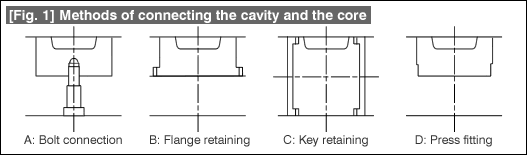
Fig. 1 Methods of connecting the cavity and the core

A. Bolt connecting

Bolt connecting is the method used frequently in large molds in which there is enough space to provide screw holes and bolt fixing holes in the cavity and the core. It is possible to fasten strongly because of the screw. It is possible to consider the method of tightening the bold from the parting surface side or the method of bolt tightening from the side of the mold plate back surface. The direction of bolt tightening is selected suitably depending on the conditions.
For the screw, usually metric coarse thread is used.

B. Flange retaining

Flange retaining is the method used when sufficient space is not available for provided screw holes and bolt fixing holes in the cavity and core.
Usually, the two methods of double side flange and single side flange are used. The amount of catching by the flange is about 1 to 2mm, and the height of the flange is about 3 to 10mm, and the selection is made depending on the size of the core.

C. Key retaining

Key retaining is the method used when fastening several components in which case it is difficult to use the flange retaining or the bolt fastening methods.
The shape of the key can be that of the bracket character "]", straight key, round key, etc.
It is necessary to consider the dimensions of key mating.

D. Press fitting

Press fitting is a mold fastening method that is used very frequently in the case of large molds. The external dimensions of the cavity and core are machined so that they fit tightly in the pocket carved from the parting surface side, and the press fitting is made by hitting with a plastic hammer, etc.
If this method is used, since the dismantling of the cavity and core becomes difficult at the time of maintenance, sometimes a hitting hole is provided in the bottom surface of the pocket for dismantling.
#050 Cavity and Core Integrated Structure and Spliting Structure

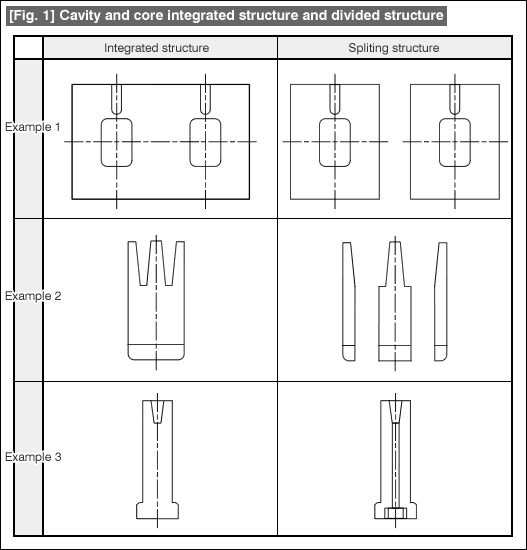
The cavity and the core are very important parts in forming the shape of the molded product, and the method of their preparation can be divided broadly into two types.
These types of the method of preparing are "Integrated Structure" and "Spliting Structure".
The "integrated structure" is one in which, as the name implies, the cavity and the core are prepared as a single integrated component.
The "Spliting structure" is one in which the cavity and the core are divided into 2 or more components which are assembled together.
Each of these methods has its own advantages and disadvantages which are listed in Table 1. Further, some actual examples of the different structures are shown in Fig. 1.

Fig. 1

Fig. 1 Cavity and core integrated structure and divided structure

(Evaluation: = Excellent, = Good, = Partially satisfactory, = Not suitable.)

Comparison itemIntegrated structureDivided structure
Component count
Ease of machining - -
Cost of machining - -
Material cost
Corner part shape accuracy
Ease of polishing
Air vent effect
Ease of maintenance

The decision of whether to use an integrated structure or a Spliting structure should be made considering the shape of the molded product, the life of the mold, the type of plastic, etc., after weighing the pros and cons. We are frequently asked which structure is good, and our answer is that which type is good or bad is determined based on the preconditions for selection.

#049 Features of Motor Driven Injection Molding Machines

Recently, the use of fully electric motor driven injection molding machines is spreading rapidly particularly in the case of smaller sized machines. Research on the realization of fully electric motor driven injection molding machines started about 15 years ago, the great advancement in the their functions in the past few years is considered to be the driving force for their coming into increasingly wider use.

The following are the features of a fully electric motor driven injection molding machine.

1. The electric energy consumption very much smaller compared to a hydraulic type molding machine. A reduction of 40 to 50% is possible. That is, there is the effect of greatly reducing the monthly electricity usage charges.
2. Since the control of the injection molding machine can be made accurately using servo motors, it is possible to achieve stabilization of the molding conditions.
3. Injection molding operations can be made a low noise generation level.
4. Since normally the operations of mold opening and closing, injection, ejection, and weighing can be done using four independent motors, it becomes possible to make the molding operations progress in parallel, and as a result, it is possible to shorten the molding cycle.
5. The operations of accurate control of the amount of ejection, multi-stage ejection, etc. are possible that were difficult in the case of hydraulic molding machines.
6. While it was difficult to increase the injection speed, recently, it has become possible to meet conditions of a level from 1000mm/s to 2000mm/s.
7. Since no oil is used, the molding environment becomes clean, and this is very convenient for molding food containers or products for medical use.
8. At present the price is higher than those of hydraulic molding machines.

Although the use of fully electric motor driven injection molding machines has progressed more in Europe, United States, and Canada than in Japan, it is expected that the advantages of the electric type machine will be exploited more in the case of the injection molded products that are used in new products in IT related industries, and automobile industries.

As the injection molding machines become advanced, even increases in the technological level of molds will gradually be expected. For example, it may be necessary to enhance the level of precise positioning mechanisms, or air vent mechanisms, mold temperature control functions, etc. Even in the world of standard components for molds, it is expected that new products will be developed meeting such needs.

#048 MuCell ® Process Latest Injection Molding Technology of USA

Various new technologies were exhibited in the largest plastics industry exhibition of the millennium "NPE2000" held in Chicago USA during the second half of June 2000. Among them, one of the most unique new technologies that attracted a lot of attention was that of the "MuCell ® Process".

This technology was invented in Massachusetts Institute of Technology, and at present a related venture company called Trexel Inc. has the basic patent and has entered into licensing agreements with eight injection molding machine manufactures in the world.
A feature of this technology is that in a special mixing and kneading cylinder, nitrogen (N2) gas or carbon dioxide (CO2) is sealed in the supercritical state, injected into the mold in a manner similar to ordinary injection molding, filled, cooled, and the molded product is taken out.

Although no differences can be observed between the obtained injection molded product and an ordinary injection molded product, you will recognize the difference once you take the product in your hands. That is, the product will clearly be lighter (by about 12%) than an ordinary molded product. If you cut the product to know the reason for this difference, you will find that although the surface is solid, the interior has innumerable very fine bubbles generated in it and the material will have a sponge shape (with a honeycomb structure).

In this manner, since the surface is solid but the inside has air bubbles, it is possible to achieve a lighter weight compared to the ordinary molded product which is completely solid. In addition, since this is a collection of very fine bubbles (with the bubble diameter being 50 micrometers or less), there is the unique feature that there is no marked decrease in the mechanical strength.

The features of this technology are the following.

1.Lightweight molded products can be obtained.

2.The molding cycle is made shorter, because the solidification time of the central part becomes shorter.

3.It is possible to set the screw heating temperature to a lower value, which results in energy saving.

4.It is possible to lower the viscosity of the plastic. Therefore, it is possible to fill at a low pressure.

5.The pressure maintenance time can be shortened.

6.It is possible to reduce warping and deformation substantially. The principle of operation is similar to gas assisted molding.

7.There is no difference in the outer appearance of the surface between the molded product and an ordinary molded product.

8.A wide range of plastics such as PS, ABS, PP, PA6, PPS, glass fiber reinforced plastic, etc., can be used.

9.It is possible to increase the number of products molded using the mold during its life.

As explained above, this new molding technology has technical content that needs to be mentioned particularly, and it appears that this technology is very highly likely to be applied in various fields from now on.
A license agreement is necessary in order to use this technology, and at present, it is necessary to enter into an implementation rights contract with Trexel via the manufacturers of the molding machine.

About this Archive

This page is an archive of entries from July 2010 listed from newest to oldest.

June 2010 is the previous archive.

August 2010 is the next archive.

Find recent content on the main index or look in the archives to find all content.