October 2010 Archives

#060 Periods of Mold Failures

Machines and manufacturing facilities that contain molds may have their functions stopped or seriously curtailed due to "failure".
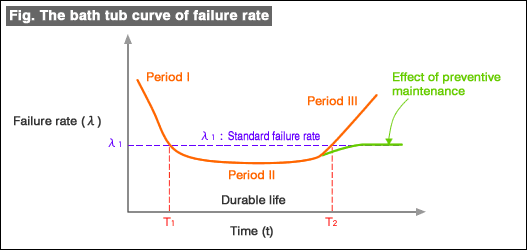
It is known that failures can be classified statistically into three classes depending on the period of their occurrence.
Failures are of the following three types.

 IIIIII
Period nameInitial failure period
(initial failure)
Random failure period
(random failure)
Wear-out failure period
(wear-out failure)
Main causesProduction quality defectDesign quality defectLife
Remarks Difficult to predict the time of failure occurrenceIt is possible to estimate the period of wear-out
Countermeasures can be taken by preventive maintenance

I.Initial failure period (initial failure)

This is the period in which failures occur due to quality defects in the components of molds, etc., or due to basic design mistakes. Since such failures occur soon after starting the use of molds, etc., it will not be possible to start continuous production.

II.Random failure period (random failure)

This is the period in which failures occur due to some cause in the middle of stable operations that are being made for some time using molds, etc., for continuous production.
The causes of such failures can be insufficient quality level in the design, which can cause some of the components to exhaust their lives, or due to some component breaking due to the effect of more than expected stress, etc.
Since it is difficult to predict the period of occurrence of failures during this period, this period is being referred to as the random failure period.

III.Wear-out failure period (wear-out failure)

This is the period in which failures occur during continuous production using molds, etc., due to their being used near the expected life in terms of the number of shots.
The cause of such failures is the wearing out of components. The period when wear-out reaches the limit of usability can be predicted using sampling and by experience.
Therefore, it can be said that it is possible to some extent to avoid the occurrence of wear-out failures by preventive maintenance.

The relationship between the failure period and the failure rate plotted as a curve as shown in the figure is called the bath tub curve because the curve of failure rate with respect to the time axis is similar to the cross-sectional shape of a bath tub.
images

#059 Fool Proof in Mold Design

Literally, the meaning of "fool proof" has the nuance of "prevention of fooling".
In concrete terms, this refers to a construction or shape that prevents wrong assembly or disassembly by humans making an inadvertent mistake.

Taking the example of a mold, consider that there are two core pins A and B that are extremely alike. The position of incorporating in the main core is decided.
If, the mold was disassembled and maintenance work was done on it, there is naturally the possibility that the assembling positions A and B are reversed while assembling again the mold. It is not possible to eliminate completely inadvertent mistakes or misunderstanding even in the case of highly experienced persons.
In view of this, if the flange parts of the core pins are cut in different shapes and the assembly holes of the main core are also machined to those shapes, since it will only be possible to assemble the core pins A and B only at the correct positions irrespective of who does the assembling, there can be no wrong assembly.
These kinds of measures are called "fool proof" measures.

When there are parts that are likely to be assembled wrongly, or when there is a sequence for assembling, it is necessary to make fool proof designs so that there is no inadvertent mistake by the operator while assembling.
If a mistake is made in assembling a large sized mold or a mold for export, carrying out that work again can take a long time. In addition, by clamping a wrongly assembled mold can break the mold which can lead to a huge loss of money, etc.

For judging whether or not fool proof measures are required, it is very important to give training to mold designers not only about simple cost reduction considerations but also about making reviews regarding fool proof measures.

#058 Fail Safe in Molds or Injection Molding Machines

 Fail Safe is a scheme for acquiring the safety of operators even when a system or an element constituting the system fails, by fixing the state to a predetermined state on the safe side and limiting the effect of the failure, so that no labor disasters occur as a consequence of that failure. (From "Guidelines for achieving fail safe operation in the control mechanisms of metal working machines, etc.", Vol. 464 dated July 28, 1998.

In order to achieve fundamental safety of machines such as molds and injection molding machines, after first accepting the two facts of "1. Machines can fail" and "2. Operators can make mistakes", it is necessary during the stages of design, manufacturing, and modifications of machines in order to build a structure that ensures the safety of operators even if these occur by chance. For this purpose, although a "safety confirming system" is adopted, if the "safety confirming system" itself fails, since the safety of the operators is not acquired, and it is possible that a labor disaster occurs, it is necessary to have characteristics that even when the "safety confirming system" fails, always the equipment is on the safe side (stopping the machine in a state in which it does not cause labor disasters).

In order to achieve fail safe, it is necessary to carry out the design, manufacturing, and modifications of molds, injection molding machines, automatic machines, etc., while following the "fundamental rules for achieving fail safe" listed below.

1)As a rule, the following are the control mechanisms that are the target of implementing fail safe.
a. Restart preventing circuit.
b. Interlock circuits for guarding
c. Circuits for sudden stop
d. Circuits for emergency stop
e. Circuits for preventing exceeding the limits
f. Circuits for monitoring operations
g. Circuits for hold stop monitoring
h. Circuits for speed monitoring
i. Hold to run circuits

2)As a rule, the control mechanism should be designed to have "asymmetrical error characteristics". Asymmetrical error characteristics are the characteristics by which even when a system or a component constituting the system fails, the frequency of failures on the safe side is far greater than the frequency of failures on the danger side, or the characteristics of failing only on the safe side.

3)When adopting electronic control equipment such programmable controllers for the control mechanism, use only those having "asymmetrical error characteristics".

4)Danger or fault conditions are not mistakenly reported as safe by making safety information correspond to a high energy state, danger signals and fault signals correspond to a low energy state.

5)Safety information should be conveyed in an information conveying mode (unate information conveying) so that, unless safety information is input to the system, an operation permitting signal is not issued by mistake.

6)In order to acquire resistance to the maximum environmental noise that can be predicted, the safety information should be made to possess sufficient energy.

A fail safe design philosophy is required during the design of molds that are opened and closed at a high speed during high cycle rates or of molds of large sizes.

* Source Document:
1) "Safety Technology for the Future" by Central Labor Accidents Prevention Association, edited by the Japan Association of Safety and Health Consultants.

About this Archive

This page is an archive of entries from October 2010 listed from newest to oldest.

September 2010 is the previous archive.

November 2010 is the next archive.

Find recent content on the main index or look in the archives to find all content.