July 2009 Archives

#005 Why Does a Mold Break?

Although no unnecessary force is applied to a mold when it is being assembled, when it is actually installed in an injection molding machine and the molding operation being conducted, it is subject to various external forces unlike those experienced during assembly.

For example, the mold clamping force when a mold is being clamped can be from several tons to several hundreds of tons, even several thousands of tons. It is necessary that the mold has enough strength to withstand that compression stress.

In addition, in order to completely fill the mold with molten plastic via the sprue and via the runner, it is necessary to apply pressure to the plastic and make it flow inside the mold. The reason for this is that since molten plastic is a fluid having viscosity, a sufficient pushing force is necessary to make it flow into the mold. The force of the pressure can be 1000 to 2000 kgf/cm2 near the sprue inlet, and even inside the cavity the force of the pressure is 200 to 600 kgf/cm2.

In addition, since the force of the pressure acts for a very short time which is normally not even 1 second, considerable shock is applied to the core pin and the walls of the cavity, and in some cases, this may cause buckling of the thin and long pin.

In this way, if we sequentially look at the process by which the parts of a mold break, we can find the corresponding causes. In order to make sure that a mold does not break, at the time of designing a mold, it is very important to make clear the basic environment of use (injection pressure, mold structure, acting stresses, etc.) in terms of numerical values, and to verify in advance the actual operation of the mold. This is because fatal damages can occur that cannot be covered by fine adjustments after the mold has been prepared if the mold preparation is done without carrying out the strength calculations of the basic structure and while defects are allowed to be present in the structure.

In addition, even when machining the parts of a mold or at the time of assembling and adjustment, it is very important to give considerations to machining after understanding the shapes of the parts, the surface quality, the accuracy of mating, etc. In the case of machining, although the minimum possible responsibilities can be said to have been carried out as long as the work has satisfied the dimensions, accuracy, and tolerances specified in the drawings, in order to make a more superior mold, it is desirable to understand the functions of all the parts of the mold, so as to advance one step further.

In order to prepare molds that do not break, it is very important that there is a balance between the basic concepts and the considerations in machining and assembly.
#004 Guide to the Molding Shrinkage ratio of Major Plastic resins (1)

It was already explained that it is very important to determine the molding shrinkage ratio for designing the molds for plastic injection molding. Here we would like to explain some guides to the molding shrinkage ratio of some typical plastic resins.

Table 1 shows some major thermoplastic plastic resins and their molding shrinkage ratios, cavity surface temperatures, and injection molding pressures. For more details, it is common to obtain the material catalogs or technical documents for each grade of material from the manufacturer of the plastic resin and use those documents for making this decision.

* Unless otherwise stated, the values given here are for natural resins.

Plastic resin nameMolding shrinkage ratio (%)
(%)
Cavity surface temperature (ºC)Injection molding pressure
(kgf/sq.cm)(MPa)
Acrylonitrile-styrene copolymer ABS0.4〜0.950〜80550〜175053.97〜171.7
Polystyrene PS0.4〜0.720〜60700〜210068.69〜206.1
Acrylonitrile-styrene AS
AS
0.2〜0.750〜80700〜230068.69〜225.7
Ethylene vinyl acetate EVA0.7〜1.250〜801050〜2800103〜274.8
Polypropylene PP1.0〜2.520〜90700〜140068.69〜137.8
Polypropylene glass fiber 40%0.2〜0.820〜90700〜140068.69〜137.8
High Density Polyethylene HDPE2.0〜6.010〜60700〜140068.69〜137.8
Methacrylic acid methyl ester (acrylic) PMMA0.1〜0.440〜90700〜140068.69〜137.8

#003 The Chemical Composition of Steel for Mold Manufacturing

The steel used in molds for plastic molding have ferrite- carbon alloy (which is normally called steel) as the basic material. It is helpful to know the chemical composition of some typical types of steel as a basic knowledge, because that will become useful when considering the heat treatment and mechanical characteristics, etc.

A table of that data is given below.

Steel nameSymbolContent ratio of chemical constituents (%)
CSiMnPSNiCrMoWV
Rolled steel for general structures[SS400]
[1018 Steel
Equivalent]
[1.0040_
Ust.42.2]
   0.060.06     
Carbon steel for mechanical structures[S50C]
[1049 Steel]
[1.126_C50E
(Ck50)]
0.45
-0.55
0.15
-0.40
0.40
-0.85
0.0350.04     
Chrome molybdenum steelSCM30.33
-0.38
0.15
-0.35
0.60
-0.85
0.030.03 0.90
-1.20
0.15
-0.35
  
Stainless steelSUS230.25
-0.40
0.751.000.040.03 12
-14
   
Carbon tool steel[SK5]
[W1-8]
[1.1525_
C80W1]
0.80
-0.90
0.350.500.030.03     
Alloy tool steel[SKS3]
[A1 or 01
Tool Steel]
[1.2510_
100MnCrW4]
0.90
-1.00
0.350.90
-1.20
0.030.03 0.50
-1.00
 0.50
-1.00
 
Alloy tool steel hot die steel[SKD61]
[H13 Tool Steel]
[1.2344_
X40CrMoV5
-1]
0.32
-0.42
0.80
-1.20
0.500.030.03 4.50
-5.00
1.00
-1.50
 0.8
-1.2
Alloy tool steel cold die steel[SKD11]
[D2 Tool
Steel]
[1.2379_
X155CrVMo12
-1]
1.40
-1.60
0.400.500.030.03 11.0
-13.0
0.80
-1.20
 0.2
-0.5

#002 Introduction to Products by Misumi ~ Spiral Baffle Plates

In the molds used for plastic injection molding from now on, molding in a stable manner maintaining the shape of the molded item accurately is considered as the minimum specification, and in addition, the evaluation of the mold will vary depending on how short the molding cycle can be made.

Normally, the cooling process is the most important among the processes of the molding cycle. In order to shorten the time of the cooling process, it is very important to remove the heat efficiently from the cavity surface after the filling of the molten plastic is completed and to quickly reduce the surface temperature of the molded item.

Although flow paths are provided in a mold for passing cooling water (or cooling oil), it is not necessarily possible that effective cooling is obtained using only simple cooling holes. In order to make the coolant (liquid) act effectively, a very effective means is to take some measures to make the time and area over which the coolant comes into contact with the heat generating part larger. A very common measure is a baffle plate. The leading part of the coolant that hits against the baffle plate flows inside the cooling hole along the baffle plate and removes the heat.

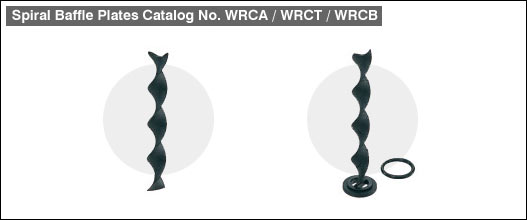
This principle is utilized in the "Spiral baffle plates" of the WRCA, WRCT, and WRCB series. A spiral baffle plate increases the probability of the coolant contacting the inside surface of the cooling holes because the coolant (liquid) flows inside the cooling hole while rotating through a spiral flow path, and hence it is possible to cool the mold more effectively. In addition, one of the features of this product is that it can be easily assembled and adjusted. Since it is made of nylon plastic (with 30% glass fibers), it can be easily cut to the necessary length at the assembling site to match the depth of the cooling water hole. In addition, it is possible to easily remove the baffle plates when dismantling the mold, and even removing the water stains can be easily done.

Since it is quite difficult to shorten the cooling cycle with only one definitive means, it is better to carry out improvements steadily while adding several small measures one by one. As one such measure, please try using the spiral baffle plates.

image

#001 What is the Molding Shrinkage Phenomenon?

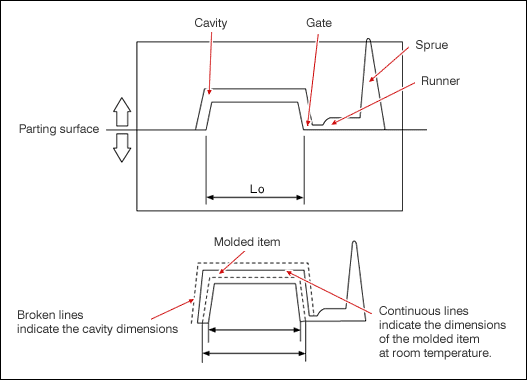
In the injection molding of thermoplastic plastics, it is possible to obtain a molded product with the desired dimensions using the mold shrinkage phenomenon. Mold shrinkage is the phenomenon where the volume of the molten plastic filled inside the cavity of a mold is shrinking at the time as being cooled and solidifying.

The extent of this shrinkage is called the "molding shrinkage factor", and if this molding shrinkage factor is known accurately both scientifically and by experience, by preparing the mold making the dimensions of the cavity a little larger by the amount of shrinkage, it is possible to form the molded item by so that it has the intended dimensions.

The value of the molding shrinkage factor is generally a number in the range of about 2/1000 to 20/1000 (about 0.2 to 2%).

If the molding shrinkage factor is expressed by the symbol α (alpha), it can be defined by the following equation 1.

α=(L0−L)/L0 ... (Eq.1)
Where, L0: the cavity dimensions (mm) L: Dimensions (in mm) of the molded product at room temperature (usually 20ºC).

Further the molding shrinkage factor is affected by the following factors.

1. Type of molding material

The range of the basic shrinkage factor is determined by the type of plastic material being used. However, there will be fine differences depending on the material manufacturer and the grade of the material.

2. Cavity surface temperature

The molding shrinkage factor varies depending on the cavity surface temperature during injection molding. In general, the shrinkage factor tends to be large when the temperature is high.

3. Maintained pressure × pressure maintenance time

The molding shrinkage factor varies depending on the magnitude of the pressure maintained after plastic injection and the time of maintaining that pressure. In general, there is trend in the shrinkage factor becoming smaller when the maintained pressure is high and the pressure maintenance time is long.

4. Wall thickness of the molded item

The shrinkage factor also varies depending on the wall thickness of the molded item. There is a trend in the shrinkage becoming larger as the wall thickness becomes larger.

5. Gate shape

The shrinkage factor varies depending on the gate shape and the gate size. In general, there is a trend in the shrinkage becoming smaller as the cross-sectional area of the gate becomes larger. There is also a trend in the shrinkage becoming smaller in the case of a side gate rather than in the case of a pinpoint gate or a submarine gate.

6. Presence or absence of additive materials to the molding material

It is very common that there is a large difference in the shrinkage factor between natural materials and materials having glass fibers. There is a trend in the shrinkage factor being smaller in the case of materials with glass fibers. In actuality, the molding shrinkage factor for mold design is determined by comprehensively investigating the above conditions.

image

About this Archive

This page is an archive of entries from July 2009 listed from newest to oldest.

August 2009 is the next archive.

Find recent content on the main index or look in the archives to find all content.