February 2012 Archives

#113 Accuracy of Mold Preparation

| No Comments | No TrackBacks

The accuracy of preparation of parts of a mold for plastic injection molding is determined by the dimensional tolerance of the molded product. While each company may have its own internal standards about the policies for this accuracy, one of the standards used in major advanced countries is the standard recommended by VDI (Association of German Engineers).

The details of the molded product tolerances according to the VDI standard are as follows.

Taking the dimensional tolerance of the molded product as 100,
Mold preparation tolerance = 1/3 = 33%
Wear margin of mold = 1/6 = 17%
Fluctuation of molding shrinkage = 1/2 = 50%

Let us obtain the accuracy of mold preparation based on the above standards.

[Case 1]

What is the accuracy of mold preparation when the dimensional tolerance of the molded product is ±0.3 mm?

[Example of investigations]

The dimensional tolerance of the molded product is +0.3 + | -0.3 | = 0.6 mm
(| | indicates the absolute value.)

Therefore, the tolerance of mold preparation is 1/6 × 1/3 = 0.2 mm.
∴ A mold preparation accuracy of ±0.1 mm is appropriate.

[Case 2]

What is the accuracy of mold preparation when the dimensional tolerance of the molded product is ±0.05 mm?

[Example of investigations]

The dimensional tolerance of the molded product is +0.05 + | -0.05 | = 0.1 mm

Therefore, the tolerance of mold preparation is 0.1 × 1/3 = 0.03 mm.
∴ A mold preparation accuracy of ±0.015 mm is appropriate.

#112 Varieties of Tunnel Gates

| No Comments | No TrackBacks

The tunnel gate (submarine gate) is used very frequently as a type of gate having a structure that automatically cuts the molded item and gate at the time of opening and closing the parting surface.

In the basic design of a tunnel gate, although know-how about the shape and size is necessary, we describe in this issue the basic varieties concerning the relationship between the molded item and the runners and gates.
The basic patterns of tunnel gates commonly used are shown in the figure.
Classifying broadly into those on the fixed half and those on the moving half of the parting surface, there are four patterns of gate and runner combinations.
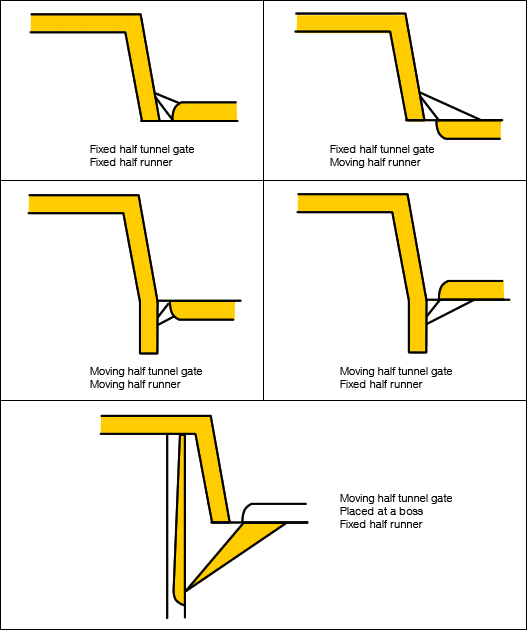
fig.

When a tunnel gate is provided on the fixed half, the molded product is cut off from the gate at the time of opening the parting surface. Therefore, the condition of cutting the gate is considered to vary depending on the speed of opening the mold.
On the other hand, when a tunnel gate is provided on the fixed half, the molded product is cut off from the gate at the time that the runner ejector pin ejects the runner.
Therefore, the condition of cutting the gate is considered to vary depending on the speed of projecting the runner ejector pin.
When the runner is provided on the fixed half, since it is likely that the runner itself remains on the fixed half, a structure that pulls the runner to the fixed side such as a lock pin will be required.
When the runner is provided on the moving half, it is necessary to provide an appropriate ejector pin for ejecting the runner.
As a special example, there is also a structure in which a tunnel gate is provided on a boss shape (crafted by scraping the ejector pin) on the moving half, and the plastic is injected from the underside of the top surface of the molded product.
In actuality, the mold design is carried out by considering which gate pattern and runner pattern is appropriate based on the features of the molded product and on the properties of the plastic.

When the specifications require that traces of gate should not remain on the side surface and top surface of the molded product, it will be necessary to provide the gate on the bottom surface of the molded product.
The curved tunnel gate structure is used very rarely as a technique for such situations.
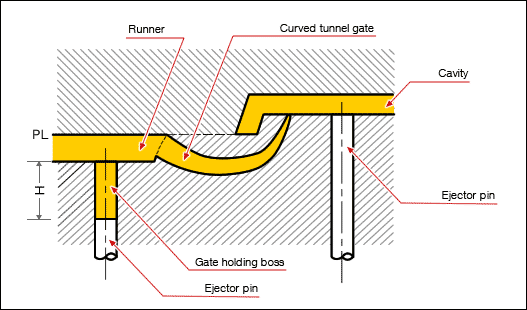
fig.

In the curved tunnel gate structure, a gate is provided that has a shape that is curved from the parting line towards the inside of the movable core. Therefore, the gate opening part is positioned at the top surface of the core.
An ejector pin is placed at the runner near the gate, and a boss is provided above that pin for supporting the gate. The overall length of the boss, denoted by H, should be selected so that, at the time of ejecting, the gate is supported until the molded product is completely removed from the mold and smooth cutting of the gate is possible.

The shape of the curved part is actually determined by trial and error while making several corrections. However, a wise measure is to use a nested division structure from the beginning so that modifications to the mold can easily be made.

Since the removal of the gate is affected by the cooling time and the pressure dwell time of the mold, at the time of prototyping it is desirable to vary even these and take samples.

Whatever method is used, the state of the cut cross-section and the cutting scrap of the tunnel gate can become a problem at the time that the molded product is cut off from the gate.

The state of the cut cross-section is affected mainly by the following factors.

  1. Design of the shape of the tip part of the gate
  2. Thickness of the gate (cross-sectional shape)
  3. The distance from the gate cut off part to the runner lock part
  4. The state of the effect of dwell pressure
  5. The state of polymer orientation at the gate part
  6. The timing of cutting off the molded product from the gate

In the case of precision molded products or multiple cavity molds, it is very important to investigate the above factors sufficiently before starting to prepare the molds.

#111 Basic Structure of an Injection Molding Machine

| No Comments | No TrackBacks

An injection molding machine is a machine for converting the plastic material into a liquid state, injecting into the cavity of the mold, opening the mold, and taking out the solidified molded article. A large number of manufacturers in the major industrial countries of the world today are manufacturing and selling various types of injection molding machines, all of which are not being manufactured to any standardized specifications, but different types are being manufactured according to the purpose of use, size of the machine, accuracy, etc. The common types of injection molding machines that are in widespread use in the market have the following structures.

  1. Material used: Thermoplastic resin
  2. Plasticizing - injection structure: Screw in-line type
  3. Power source: Hydraulic type, electric motor driven type, hybrid type (hydraulic and electric motor drives are used together)

In general, an injection molding machine is constituted from the following functional units

1. Plasticizing Unit

The raw materials of the common thermoplastic resin are sold in the market in the form of pellets, and to carry out injection molding, it is necessary to heat and melt the pellets and to convert them into a fluid state. The unit used for this purpose is the plasticizing unit. Plasticizing is melting the material so that it is soft and can be deformed easily in the plastic state. The following structures are used most commonly for a plasticizing unit.

  1. Plunger type
  2. Inline screw type
  3. Pre-plunger type
  4. Screw pre-plunger type

In all methods, pellets are loaded into a cylinder and plasticized by heating using an electric heater surrounding the cylinder.

The method of supplying the pellets to the heated part can be of the plunger type or of the screw type. The plunger type has a structure in which a plunger moves forward and supplies the pellets to the heated part. In contrast with this, the screw type has a structure in which a screw with a helical groove is rotated thereby making the pellets move forward through the helical groove and are supplied to the heated part. These two methods have their own advantages and disadvantages, and the selection is made based on factors such as the material, molded article, cost of investment, etc.

The parameter that needs to be studied in a plasticizing unit is the plasticizing capacity. The plasticizing capacity is the volume of injectable molten plastic resin that can be prepared in unit time, and this affects the volume of the molded article that can be prepared. Therefore, in the case of a molded item that requires a large volume of plastic, it is necessary to prepare a plasticizing unit having a large plasticizing capacity.

This time we practise the calculations for determining the side gate dimensions explained in the last issue.

Question

Let us design the side gate at one location in the case of an injection molded article made of Polyacetal (POM) plastic, when the average wall thickness of the molded article is 1.5 mm and the surface area of the molded article is 4900 mm2,
In this case, obtain the guidelines for the design dimensions of the gate depth h and width W.

Sample Answer

The side gate dimensions are determined in the following two steps.

First Step: Determining the gate depth

First, we check the wall thickness t (mm) of the molded item.
From the question, we find that t = 1.5 (mm).

Next, we obtain the coefficient n which depends on the molding material from Table 1.
In the case of Polyacetal, n = 0.7.

Therefore, the depth h of the side gate will be:

h = n ∙ t
= 0.7 x 1.5
= 1.05 (mm)

Second Step: Determining the gate width

First we obtain the surface area A (mm2) of the molded item.
From the question we find that A = 4900 (mm2).

Next, we obtain the coefficient n which depends on the molding material from Table 1.
In the case of Polyacetal, n = 0.7.

Therefore, the width W of the side gate will be:

W = n ∙ √A/30
= 0.7 x √(4900) /30
= 1.63 (mm)

In conclusion, considering the ease of machining the mold and its cost, we determine as follows:

h = 1 (mm)
W = 1.6 (mm)

About this Archive

This page is an archive of entries from February 2012 listed from newest to oldest.

January 2012 is the previous archive.

March 2012 is the next archive.

Find recent content on the main index or look in the archives to find all content.