May 2012 Archives

#124 Gate Cutting Unit inside the Mold

| No Comments | No TrackBacks

When injection molding is done with a cold runner, this is a unit product for cutting off the gate using the operation of opening the mold.

Side gates or submarine gates having large gate diameters are used for the gates of thin walled molded article or of molded article in which shrink is not acceptable. But when this is done, not many people would have found it troublesome to carry out cutting of the gates in the subsequent processes.

The "Gate cutting unit inside the mold" is a mechanism by which the gate part is rotated along a spiral groove with the parting surface still closed thereby cutting the gate.

Since the cutting can be done inside the mold, the gate cut surface becomes uniform, and also, it is possible to suppress the generation of gate shreds at the time of cutting.

The following types of structures can be used for the gate.

1) Side gate
2) Submarine gate
3) Jump gate (overlap gate)

In particular, its effect can be expected during the formation of caps, lids, and cases of containers. The effect is further enhanced when the volume of production is medium to large.

The diameter of the rotating gate pin comes in two types, φ16 mm and φ20 mm. High speed steel is used as the material for this.

The materials for which this mechanism can be used are - ABS ,PS , PA 6, PA 66, PBT, POM, PPS, PC, etc.
(This is not suitable for acrylic resin etc. in which case cracks are generated during cutting.)

Since there are limitations on the size of the mold, plate thickness, etc., at the time of considering the use of this mechanism, please check the details given on the catalog page the link to which has been given below.

When it is difficult to use a hot runner gate due to limitations on the gate position, etc., or when a side gate, etc., must be provided this offers a new option.

The cost of cutting the gate becomes quite a substantial amount when the volume of production increases. This product brings out its advantages when trying to reduce these costs.

Click here to view the details of the product "Gate cutting unit inside the mold".
#123 Removable insert

| No Comments | No TrackBacks

In the design of molded article, quite often there will be a need for undercut shapes. (An undercut is a shape that cannot be taken out just by opening the parting surface. For example, a horizontal hole, a projection, a depression, etc.).

In the case of an undercut shape, it will be necessary to design the mold using mechanical engineering techniques so that the molded article can be taken out with a special mold structure such as a slide core or a slant pin, etc.

The design would be easy if the undercut can be handled using the simplest slide core structure, but sufficient knowledge of and expertise in mold design will be required if a complex undercut shape has to be produced.

When a mounting test is to be done by quickly obtaining a sample of the molded article with a trial mold, etc., the delivery time can become as long as two weeks if the development of a special undercut mechanism and mold preparation is to be made. In such situations, a method of handling undercuts called the "removable insert" is used which was devised by our seniors with some skillful techniques.

What is a "removable insert"?

• The core and the cavity that constitute the part of the molded article that becomes an undercut are divided, and then designed and fabricated.
• The removable inserts that are prepared by dividing the mold are taken out from the mold along with the molded product at the time of ejecting the molded article.
• The removable insert is removed from the molded article by a manual operation.
• The removable insert is installed in the mold manually at the time of the next molding.
• In other words, with a removable insert structure, it is not possible to carry out continuous injection molding, and the method is that of forming the undercut shape semi-automatically using manual operations additionally.
• There are also some cases in which the removable insert is pushed out from the mold by an ejector pin.
• In order to position the removable insert, a key structure or a knock pin structure is used in some cases.
• There are cases in which the molding is done after pre-heating the removable insert.
• There is also the method of molding which makes the semi-automatic molding more efficient by preparing two removable inserts, and inserting them alternately into the mold.
• In order to ensure that the direction of inserting the removable insert is not mistaken, there is also the technique of using a direction determining structure.
• The key point is to design the escape and the clearance so as to make it easy to install and remove the removable inserts.
• There is also the management aspect of provisionally preparing the trial mold with a removable insert structure, thereby obtaining time for developing a mold structure such as the slide core structure that can permit continuous molding.

#122 Method of Determining Cavity Dimensions (2)

| No Comments | No TrackBacks

In the last lesson, while we explained a basic method of determining the cavity dimensions, in this lesson we describe an example of application of this method.

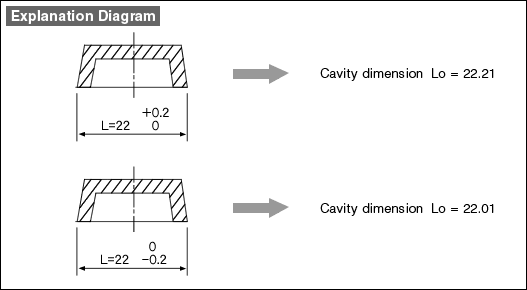
Explanation Diagram

Application Example 1: When the dimensional tolerance is a single sided tolerance value (when it is not a ± tolerance value)

Let us consider the case when a dimension of the molded article is 22.

Example of Failure:
L0   = (1 + α) * L
 = (1 + 0.005) * 22
 = 1.005 * 22
 = 22.11

If the cavity is prepared based on this calculation result, since it can be considered that the probability of fluctuations in the dimensions of the molded article will be the same in the + direction as well as in the - direction, in case the shrinkage becomes larger than predicted, there is the danger that the - side tolerance will be exceeded.
In view of this, in the case of such single sided tolerance, the calculation of shrinkage is made aiming at the center of the width of tolerance.

Appropriate Example:
L0   = (1 + α) * L
 = (1 + 0.005) * (22 + (0.2/2))
 = 1.005 * 22.1
 = 22.21

Application Example 2: When the dimensional tolerance is a single sided tolerance value (when it is not a ± tolerance value)

Let us consider the case when a dimension of the molded item is 22.

Example of Failure:
L0   = (1 + α) * L
 = (1 + 0.005) * 22
 = 1.005 * 22
 = 22.11

Even when the cavity is prepared based on this result of calculation, as in the above example, in case the shrinkage becomes smaller than predicted, there is the danger that the + side tolerance will be exceeded.
In view of this, even in the case, the calculation of shrinkage is made aiming at the center of the width of tolerance.

Appropriate Example:
L0   = (1 + α) * L
 = (1 + 0.005) * (22 - (0.2/2))
 = 1.005 * 21.9
 = 22.01

In this manner, the cavity dimensions are determined appropriately for each dimensional tolerance of the molded article.

About this Archive

This page is an archive of entries from May 2012 listed from newest to oldest.

April 2012 is the previous archive.

June 2012 is the next archive.

Find recent content on the main index or look in the archives to find all content.