December 2010 Archives

#066 Initial Cost Structure of Molds

The value of a mold is determined by the three factors of "Quality", "Delivery", and "Cost".
Among these, the "Cost" is constituted from initial cost and running cost.
In addition, it is very common that the initial cost is constituted by the following cost constituents.

1. Raw material cost
The cost of purchasing the steel raw material for the mold.
2. Cost of purchasing standard components
The cost of purchasing standard components such as the ejector pin, sprue bush, etc.
3. Cost of purchasing the mold base
The cost of purchasing the mold base, and accessory components, additional machining, etc.
4. Mold design cost
The expenses incurred for designing the mold.
5. Program preparation expenses
The expenses incurred for preparing the NC program.
6. Machining expenses
The expenses incurred for machining operations such as cutting, grinding, electric discharge machining, etc.
7. Surface treatment expenses
The expenses incurred for electroplating, PVD coating, etching, etc.
8. Finishing and assembly expenses
The expenses incurred for polishing, finishing, and assembly.
9. Trial operation expenses
The expenses related to trial injection molding such as the cost of plastic materials, etc.
10. Measurement expenses
The expenses incurred for measuring the dimensions of the mold components or the molded product.
11. Packaging and transportation cost
The expenses incurred for packaging and transporting the molds.
12. Trouble shooting expenses
The expenses incurred in trouble shooting such as design mistakes, machining mistakes, etc.
13. Instruction manual preparation cost
The cost of preparing the instruction manual for the mold and of preparing associated documents.
14. Net profit
The net profit obtained by the company manufacturing the molds.
15. Taxes
Corporate taxes, sales taxes, etc.

#065 Causes of and Countermeasures for Gas Burns

In plastic injection molding, a phenomenon can occur in which gas burns occur at the tip parts of thin ribs, etc., and a part of the molded product becomes black because of being carbonized.

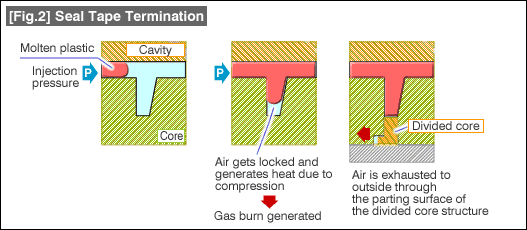
The mechanism of generation of gas burns is that, at the time that the air inside the cavity of the mold is exhausted by the molten plastic flowing into the mold, if some of the air gets locked in a closed space, that air is compressed and gets heated by its own heat generation, thereby causing burning of the plastic.
Although air being a gas gets compressed, it generates heat when compressed. This is the same phenomenon as the pump becoming hot when it is used for filling air into a bicycle tire.

The compression of the air remaining inside the cavity occurs in a very short time of about 0.1 to 0.5 second, and since it is also compressed to a very high pressure such as 200 to 500 kgf/cm2, the temperature easily reaches the burning temperature of the plastic material. (See Fig.)

Fig. Model of flow of molten plastic into a rib

The following countermeasures are effective for preventing gas burns.

1.If the part into which plastic flows is in the closed state, use a divided structure and insert a core pin. Since air is exhausted between the cavity and the core pin, gas burns are not generated. It is more effective if an air vent is provided on the side surface of the core pin.
However, since in this method, parting line will appear on the surface of the molded item, it is necessary to take care because this method cannot be used in the case of molted items that do not permit such parting lines on the surface.

2.In the molding conditions, make the injection speed as low as possible and fill slowly. Although this may improve the situation in the case of light gas burns, it is necessary to be aware that this is not a fundamental countermeasure.

3.Carry out the preliminary drying of the molding material sufficiently, and put it in a condition in which it is difficult for air to get mixed inside the molten plastic.
Even in this case, it is necessary to be aware that this is not a fundamental countermeasure.

4. Change the flow pattern of the molten plastic by changing the wall thickness of the molded product, or by changing the gate position, thereby changing the position where air gets trapped. Although this method is effective, since the shape of the molded product and the weld position change, it is necessary to obtain permission in advance from the designer of the molded product.

5. Change the position where the air gets trapped by changing the position of changing the injection speed of the screw.
This may improve the situation in some cases if the gas burns are light.

#064 Method of Providing Air Vents

Air is present in the space in the cavity of a mold. In injection molding, molten plastic is poured inside the cavity, that is, it is also possible to say that the process is that of replacing air with molten plastic.

Therefore, if it is possible to discharge the air from inside the cavity to the outside efficiently, then it is possible to make small the resistance at the time of filling; therefore it is possible to suppress the filling pressure to a low value, and as a result, it is possible to make small the residual stress in the molded product. In addition, it is also possible to prevent the breakage of core pins, etc., due to the filling pressure.

On the other hand, if it is possible to discharge from inside the cavity to the outside the volatile constituents or gas generated from molten plastic, it is possible to improve the quality of the molded product.

"Air vent" is one that carries out these functions. An air vent can be provided on the parting surface as shown in the example in Fig. 1, or can be provided on the core pin side surface as shown in the example in Fig. 2.

[Fig. 1] Example of an air vent provided on the parting surface[Fig. 2] Example of an air vent provided on the core pin

One end part of the air vent should be in contact with the cavity. The depth of the air vent at this contacting part is generally about 0.002 to 0.02 mm. Although the efficiency of discharging air or gas becomes better when this is deep, care should be taken because it is possible that burrs are generated in the molded product. Select an appropriate value depending on the plastic material and the cavity surface temperature, etc.
It is sufficient if the length of the air vent at this part is about 2 to 5 mm.

The important factor is that the other end part of the air vent is connected to a much deeper air vent. The depth of this deeper air vent should be about 0.2 to 0.5 mm and becomes a path for the air or gas to be exhausted to atmosphere from the side surface of the mold plate or of the packing plate.

Since slag or tar components generated from the plastic during injection molding is deposited in the air vent, it is necessary to clean the air vents periodically, such as about once in a fortnight to once in a month.

The position of providing the air vent can be near a part where a weld is generated, near the final last filling part, or in the middle of the runner. It is also a practical approach to make one trial and then decide the detailed location of providing the air vents.

About this Archive

This page is an archive of entries from December 2010 listed from newest to oldest.

November 2010 is the previous archive.

January 2011 is the next archive.

Find recent content on the main index or look in the archives to find all content.