June 2011 Archives

#084 Basic Dynamics of Injection Molds (Flow Volume Equation)

| No Comments | No TrackBacks

In injection molding, the molten plastic (fluid) flows through sprues and runners and gets filled inside the cavity.

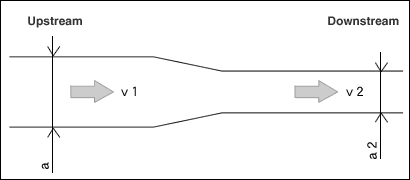
This phenomenon is expressed schematically as a fluid with viscosity flowing in a pipe.

When a viscous fluid flows through a pipe having a certain cross-sectional area, there is a basic equation of calculation called the "Flow Volume Equation" that expresses the basic state.

Flow Volume Equation:
  Q = av, where,
   Q: Flow rate (discharge rate) (m3/sec)
   a: Cross-sectional area of the flow path (m3)
   v:Velocity of fluid flow (m/sec)

The volume Q of fluid flowing through the pipe per unit time can be obtained by multiplying the cross-sectional area of the flow path (pipe) and the flow speed of the fluid.

It can be understood from this equation that in order to increase the flow rate, either the cross-sectional area a of the flow path has to be increased or the flow speed of the fluid has to be increased.

In addition, when the flow rate is constant, the following equation becomes valid.


  a1.v1 = a2.v2, where,
   a1:Cross-sectional area of the upstream flow path
   a2:Cross-sectional area of the downstream flow path
   v1:Upstream flow speed
   v2: Downstream flow speed

In other words, when the flow rate is constant, the fluid flows slowly when the cross-sectional area of the flow path is large, and the fluid flow speed becomes fast when the cross-sectional area of the flow path becomes small.

Therefore, when the molten plastic flows inside a thin runner or gate, the flow speed becomes high.

However, since the viscosity of the molten plastic changes with time, strictly speaking, the above equation will have to be corrected using a variety of factors.
#083 Basic Dynamics of Injection Mold(Fluid Dynamics)

| No Comments | No TrackBacks

In an injection mold, molten plastic is injected into a mold, cooled to solidify it, and then the molded product is taken out.
It is necessary to apply pressure in order to inject molten plastic.
How much pressure is required can be predicted in advance using calculations of fluid dinamics.
Actually, molten plastic has some viscosity (resistance to flow), and since the viscosity changes upon time (as the plastic cools, the viscosity increases making it more difficult to flow), the equations of calculations of fluid dinamics become very difficult.

In this issue, we explain the "Bernoulli's theorem" which is the most fundamental principle for discussing the general state of fluids.

Bernoulli's Theorem:
  v2/2g+p/γ+h=H, where
   v:Velocity of the fluid (m/s)
   g:Gravitational acceleration (9.8m/sec2)
   p:Pressure of the fluid (kgf/m2)
   γ:(Gamma) Specific gravity of the fluid (kgf/m3)
   h:Position head (m)
   H:Total head (m)
   The item v2/2g is called the velocity head, and the item p/γ is called the pressure head.

In other words, in a fluid, the total energy is determined by the amount of energy based on the velocity, the amount of energy based on the pressure, and the amount position energy.

Since it is difficult to apply the Bernoulli's equation as it is when there are changes in the viscosity or compressibility of the fluid, fluid velocity, it cannot be applied as it is for actual plastic injection molding. However, this is a very important basic equation when considering the principles.

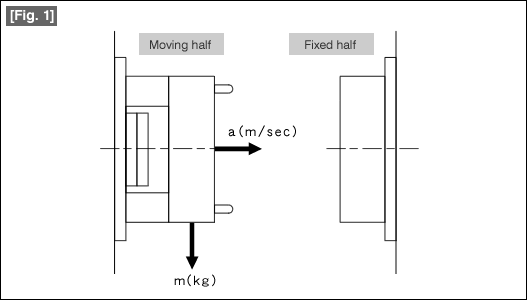
This time we discuss the force required at the time of opening and closing the moving half mold after an injection mold has been installed in the injection molding machine. (See Fig. 1.)

Fig. 1

Force is required to move an object. Force can be calculated using one of the famous Newton's laws of motion.

Newton's Law of Motion:
F = m.a. where,
F = Force (kg.m/sec2 or N),
m = Mass (kg)
a = Acceleration (m/sec2)

The point that should be noted here is that a is "acceleration" and not "velocity".
According to Newton's laws of motion:
1.Force is proportional to the mass.
2.Force is proportional to the acceleration.

Therefore, the force acting at the time of opening or closing a mold can be said to be proportional to the mass on the movable side and the acceleration.

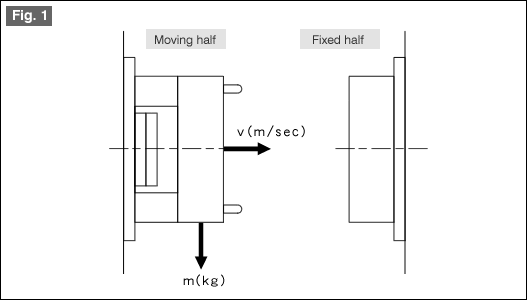
Let us discuss the kinetic energy at the time of opening and closing the moving falf mold after an injection mold has been installed in the injection molding machine. (See Fig. 1)

Fig. 1

Kinetic energy is required when an object moves at a certain velocity. When the amount of kinetic energy becomes large, in order to stop the mold, a brake has to be applied that can withstand an equivalent or higher amount of energy. In addition, if the mold clamping is not done in the state in which the kinetic energy has been reduced sufficiently, there is the danger of the mold getting damaged or broken.

The equation for calculating the kinetic energy is the following.

E = 1/2mv2, where,
E: Kinetic energy(kg・m2/sec2
m: Mass (kg)
v: Velocity (m/sec)

The following points are evident from this equation

1. The kinetic energy E is proportional to the mass m on the movable side.
2. The kinetic energy E is proportional to the square of the movement velocity v on the movable side.

Therefore, as the mass of the moving half becomes large, even the kinetic energy becomes large proportionally. If the speed of mold opening and closing is made higher, even the energy increases proportional to the square of the speed.

Therefore, in the case of a mold in which a large number of core pins with ejector structure or pillbox structure have been placed, or a mold having abnormally shaped parting surface, at the time of mold clamping, if the slowing down (speed reduction) is not made sufficiently, since the mold may break due to the kinetic energy, it is necessary to take sufficient care.

About this Archive

This page is an archive of entries from June 2011 listed from newest to oldest.

May 2011 is the previous archive.

July 2011 is the next archive.

Find recent content on the main index or look in the archives to find all content.