An embedded split structure is used very frequently as the cavity and core structure. This splitting has the following purposes.
1.A part that is difficult to form by machining is divided as a different part, thereby making its machining easy. The machining cost can be reduced and it is possible to increase the machining quality.
2.It is possible to provide the air vent function of discharging air or gas from the parted surface.
3.A part that can easily break is divided in advance so that it can be replaced easily.
The following patterns can be considered as the patterns for embedded splitting.
1.Round core pin shape splitting
2.Square core shape splitting
3.Odd shape splitting
Among these, a little know-how is described here related to assembling when the splitting is made in the shape of a square core.
The following figure shows an example of splitting a square core shape. In order to insert a square core, it is necessary to machine a square shaped hole in the main core.
The commonly used machining methods are - wire cutting electric discharge machining, shape carving electric discharge machining, or further dividing the main core and carrying out grinding operations.
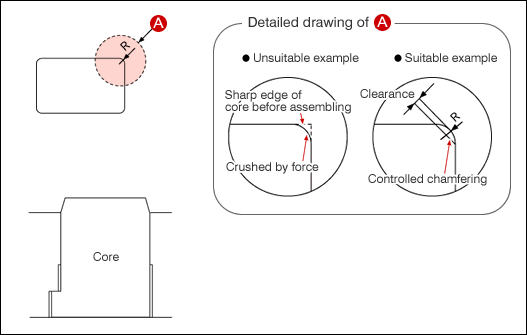
Whatever be the machining method used, a very small rounding will remain in the corner part. The size of rounding is about R0.15mm to R0.05mm. If even such a fine rounding remains, if assembly is attempted with the corner of the core having a sharp edge, the assembling does not progress smoothly. If hitting with a copper hammer is done by force the assembly, the edge of the corner is likely to get crushed in an unstable manner.
In order to carry out smooth assembling, fine chamfering is done of the sharp edges of the core by machining or by hand finishing so as to make the edges match with the corner radius R of the square hole. If this is done, the assembling can be done smoothly. Since the magnitudes of R and C are very slightly different, although a clearance may be generated, if the clearance is about 0.03mm, it can be said to be too small for any possibility of the molten plastic flowing in and creating burrs. On the contrary, it may also have the effect of discharging air or gas.
However, in the case of special environments such as a material like PPS having very good fluidity, it is recommended that the management of the clearance is made based on prototyping data.


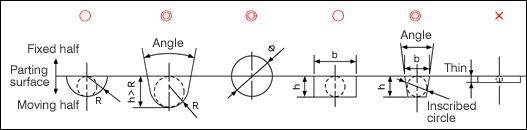
 : Most suitable,
  : Suitable,
  : Not suitable
