September 2011 Archives

#095 Injection Molding of Heat Resistant Polylactic Acid Resins

| No Comments | No TrackBacks

One of the typical biodegradable plastics is polylactic acid (PLA). Polylactic acid is a plant-derived biodegradable plastic resin. It is chemically synthesized using the following synthesizing process, and is recycled using the biodegradation effect.
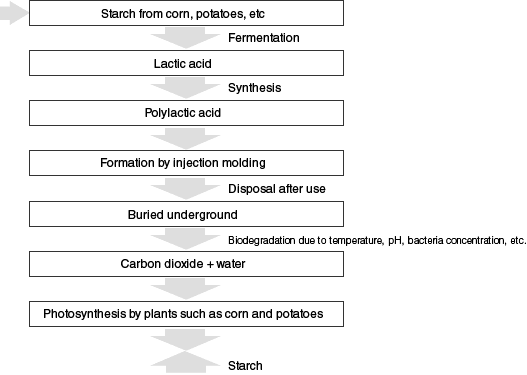
Fig.

Polylactic acid is relatively hard and has about the same mechanical strength as polystyrene. Although it is being used in industrial applications for about ten years, since the strength and heat resistance are insufficient, it has not been used much in industrial products of high added value.
However, recently, polylactic acids having good heat resistance have been developed by the application of nano composites technology. Since such materials can withstand deflection temperatures under load of up to 120°C, it has become possible to clean them in hot water, or to use them continuously in an environment of steam.
Therefore, its application has been opened up to one-way food containers (disposable food containers), returnable food containers (food containers used repeatedly such as in school lunches, etc.), personal computer enclosures, office automation equipment enclosures, bottle containers, packaging containers, etc.

In order to obtain the heat resistance property of polylactic acid, it is necessary to maintain the mold cavity surface temperature at about 110 to 120°C. Therefore, a cartridge heating apparatus or an oil temperature control mechanism is mandatory in molds.
Further, heat resistant polylactic acid has a large shrinkage ratio (about 12 to 20/1000), and has the property of strongly clinging to the core. Mold design and machining, and surface treatment that make the mold releasing resistance small become necessary. Therefore, it is very much necessary to consider the ejection structure.

In particular, ejection is extremely difficult in the case of deep molded product such as cases, containers, etc. Various types of technologies are being developed regarding the mold structure and injection molding methods that make it possible to realize smooth ejection of molded items as well as their heat resistance.

#094 Treatment of Undercuts using Insert Blocks

| No Comments | No TrackBacks

When the product has an undercut, it is removed from the mold using mechanisms such as a sliding core, or a slant projection, or forced projection, etc.
However, in the case of complex undercut shapes, it can also be very difficult to solve the problem using mechanical structures.
In such situations, it may be possible to solve the problem using a traditional method called "insert block structure".

An "insert block structure" is one in which the core is divided at the undercut part, the divided core (insert block) is taken out along with pushing out the molded product, and after that, the insert block is removed by hand.
At the time of the next molding, the insert block is set inside the mold again.
Therefore, in the case of an insert block structure there is the drawback that the molded product becomes a semi-automatically prepared item.
However, since it is possible to provide the desired undercut shape in the integrally molded product, this is a very useful method in special cases when such special structures are required.

In summary, the molded product in which the advantages of the insert block structure are brought out are the following.

  1. Molded product in which it is not possible to handle undercuts using the ordinary slide cores, etc.
  2. Molded product having undercut shapes, but whose production volume is small.
  3. Sample molded product

Since an insert block is installed and removed manually, techniques such as machining or chamfering the escape for guiding the block inserting part, and the mating tolerances will be the know how of the manufacturer.

It is not always necessary that molds must have structures suitable for automatic production, and for designers in the digital age it is very important to know that it is possible to obtain the desired molded product by incorporating manual steps that are more analog than digital.

#093 Biodegradable Plastics

| No Comments | No TrackBacks

Biodegradable plastic is a material that gets dissociated biologically due to bacteria or microorganisms either underground or in air

The conventional plastic resin synthesized by petroleum chemistry cannot be dissociated by bacteria, and are considered to remain permanently as waste. However, due to the recent advances in chemical technology, plastic resin materials have been developed that are dissociated into water and carbon dioxide. Some of such materials have already been made into commercial products and are being used in various injection molded items.

After using the molded items produced from a biodegradable plastic resin, they are buried underground, or are mixed with kitchen garbage as compost and left to decompose. These are ideal materials for preserving the earth's environment and for preventing global warming.

In order to use biodegradable plastics resin in industrial products or as packaging materials, while it is necessary that they have a certain strength and heat resistance, and satisfy the standards related to food and hygiene, products satisfying these requirements are being successfully commercialized one after the other.

The tableware used in the restaurant in the Aichi World Expo held in March of 2005 were made of biodegradable plastics, and this fact was clearly stated in the administrative policy speech by the then Prime Minister Koizumi during the normal Diet session held in February 2005.

It is considered that the practical realization of biodegradable plastics resin will progress at a very fast pace in the fields of electrical home appliances, interior decoration parts of automobiles, tableware etc, and in various other fields in about three years from now.

Some of the major biodegradable plastic materials are described below.

■ Poly-lactic acid (PLA)

This is a plastic resin that is synthesized only from starch produced from corn or potatoes, and is a material whose commercialization has progressed most.
Grades have appeared that can improve the heat resistance and strength, and are being used practically in parts of electrical home appliances, computer products, returnable food containers (bowls, cups, etc. that can be used in dish washers).
In the case of heat resistant grades, although problems have been pointed out that it is necessary to maintain the mold temperature at 110 to 120°C, and that separating from the mold is very difficult, production methods have been developed to solve these problems.

■ Poly butylene succinate (PBS)

This is a biodegradable plastic resin made from soft biomass of which succinic acid is a typical constituent. While poly-lactic acid is suitable for high hardness molded items, PBS is suitable for soft molded items.

■ Poly vinyl alcohol (PVA)
■ Poly glycolic acid

#092 Biodegradable Plastics

| No Comments | No TrackBacks

A biodegradable plastic is a material that, when buried in underground, etc., gets dissociated biologically due to bacteria or microorganisms.
This characteristic of such plastics can be considered to be ideal from the point of view of protecting the environment as compared to plastics based on petroleum.

The development of biodegradable plastic materials having the properties needed in the industry such as transparency, heat resistance, etc., is progressing rapidly. These are being more and more widely used in electrical home appliances, components for OA equipment, food containers, interior decoration parts of automobiles, etc.

In the Aichi Expo held in March 2005 (Aichi World Expo), biodegradable plastics were used in various ways. For example, the food utensils used in the restaurants were all made of biodegradable plastics. Large PC manufacturers have also announced that they will be using biodegradable plastics for the components in a PC, and the demand for biodegradable plastics is considered to increase rapidly from now on in view of the laws on environmental protection and recycling.
In the field of automobile interior decoration parts, Toyota Motor Company has announced that they will be using poly-lactic acid products in successive stages.

The following materials are the major biodegradable plastics.
The manufacturers of the material are given within parentheses ( ).

  • Poly-lactic acid (Nature Works, Mitsui Chemicals, Unitika, Toyobo, Dai Nippon Ink Chemicals, Toyota Motor Company, and others)
  • Poly-butylene succinate (Mitsubishi Chemicals, Showa Polymers)
  • Poly-ethylene succinate (Nippon Catalysts)
  • Polyvinyl alcohol (Kuraray, Nihon Synthetic Chemical Industries)
  • Poly-glycolic acid (Kureha Chemicals)
  • Cellulose acetate (Daicel Chemical Industries)

About this Archive

This page is an archive of entries from September 2011 listed from newest to oldest.

August 2011 is the previous archive.

October 2011 is the next archive.

Find recent content on the main index or look in the archives to find all content.