February 2010 Archives

#031 Jetting

Jetting (jet flow) is an external view defect in which a wavy pattern appears on the surface of the molded product. Jetting occurs because the plastic injected into the cavity from the gate suddenly flows into the cavity at a very high speed, and after colliding with the wall on the side opposite to the gate, proceeds to fill the cavity from the area surrounding the gate. Although the physical phenomenon is different from the injection molding formation of thermoplastic material, it is similar to the unstable and wavy ejection of toothpaste into the air when a tube of toothpaste is suddenly squeezed strongly. This can be thought of as the behavior of a viscous fluid.

The following methods can be considered as the countermeasures against jetting.

Mold related countermeasures
1. Widen the gate. Make sure that the gate is not too thin compared to the wall thickness of the molded product.
2. Change the position of the gate, and move it to a location where successive filling can be done from near the gate.
3. Provide a core in the vicinity of the gate so as to obstruct the molten plastic that tries to suddenly fill the cavity.

Molding condition related countermeasures
1. Make the injection speed lower so that the filling is successively done from the vicinity of the gate.
2. As a corrective measure, set the cavity surface temperature a little higher so that the wavy patterns disappear. However, with this method, understand that the condition of the flow control is still unstable

#030 Appropriate Pre-drying of Plastic Molding Materials (Revised Version)

Usually, the plastic materials are formed in the shape of pellets and sent from the raw material manufacturers in paper bags, etc.

Since these pellets would have absorbed the moisture in the atmosphere, if they are used for injection molding while they still contain a lot of moisture, depending on the type of material, they can undergo hydrolysis, or their physical properties can decrease. Further, it is possible for silver streaks to appear on the surface of the molded product, and it is also possible for short shots or burn due to gas to occur.

In view of this, in the case of most molding materials, before they are put into the hopper drier, it is necessary to carry out pre-drying in a box type drying oven.

In pre-drying it is recommended to observe the appropriate drying temperature and drying time. This is because, if the drying is done at a temperature less than the appropriate temperature, even if the drying is done for a long time, the moisture content cannot be removed as desired. A material whose pre-drying has been completed should be used as quickly as possible. When any left over material is to be used some days later, carry out its pre-drying again before use.

The pre-drying conditions of special plastics are listed in Table 1.

Table 1 Pre-drying temperatures of plastic molding materials
Material nameSymbolPre-drying temperature (°C)Drying time (H)
Liquid crystal polymerLCP110〜1504〜8
Polyether imidePEI120〜1502〜7
Polyamide imidePAI150〜1808〜16
Thermoplastic elastomerTPE1203〜4
Poly ether ether ketonePEEK1508
Poly phenylene sulfidePPS140〜2503〜6
Poly allylatePAR120〜1504〜8
Poly sulfonePSU120〜1503〜4
ABSABS70〜802〜3
AcrylicPMMA70〜1002〜6
PolycarbonatePC1204〜6
Nylon 6PA6808〜15
Nylon 66PA66808〜15
Nylon 11PA1170〜808〜15
Nylon 46PA46808〜10
Poly acetalPOM1102〜3
PBTPBT1204〜5

Pellets of plastic molding materials generally absorb moisture from the atmosphere to a certain extent. If the quantity of absorbed moisture is large, the plastic can undergo hydrolysis (there are plastics that undergo chemical dissociation with water as the initiator) in the process of being melted and mixed in the cylinder of the injection molding machine, or, when molding is done, this can cause silver streaks, air bubbles, or glossiness defects on the surface of the molded product, or can cause copying defects, etc. Therefore, it is necessary beforehand to put the pellets of molding materials in a drying apparatus and remove the moisture content in them. If the pre-drying is not done appropriately, it can lead to variations in the fluidity, deterioration of physical characteristics, and molding defects.

The following are the main types of driers being used at present.

(1) Hot air drier

The hopper drier and the box type drier are the typical equipment used with this type. The drying method is that of blowing hot air at the pellets thereby evaporating the moisture in them. Although this is a common and simple drying method, this method is not suitable for completely removing the moisture content.

(2) Dehumidified hot air t drier

In this method, after first removing the moisture in air, that air is heated and blown on the pellets thereby evaporating the moisture content in them. Since the air used for drying is re-circulated and used again after being dehumidified, heat loss will be small, and it is possible to carry out rational drying. This method is suitable for drying PBT, etc.

(3) Reduced pressure heat transfer type drier

This is a method for evaporating the moisture content in the pellet by heat transfer in a reduced pressure environment. Drying at low temperatures becomes possible, and hence it is possible to prevent the oxidization of plastic and to reduce the effects of additives in the pellet. In addition, this is also a method in which thermal loss is also small. This type of drier is attracting a lot of attention as the drier of the future.

*Reference:"Injection Molding Dictionary", p. 214, Peripheral and accessory equipment (Hideki Kubo, Industry Research Institute, (2002))

#029 Causes of and Countermeasures against Burn

In plastic injection molding, some times burns occur at the end of thin ribs, etc., thereby causing a part of the molded product to become discolored black due to soot caused by burn.

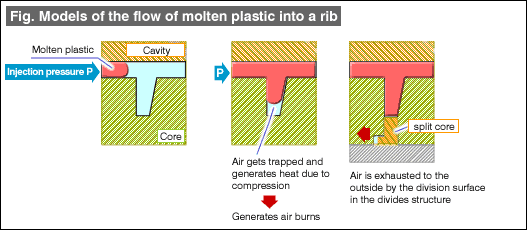
The mechanism of burn is that, as the air inside the cavity of the mold is being vented out by the molten plastic that has entered the cavity it becomes trapped because there is no escape route for it, and because the air is compressed it generates heat and hence the plastic gets burnt due to the resulting heat that is generated. Since air is gaseous and generates heat when compressed, the trapped air generates heat. This is the same phenomenon as an air pump becoming hot when it is used for pumping air into a bicycle tire.

The compression of residual air inside the cavity is made in a very short time which is normally about 0.1 to 0.5 seconds, and also since it gets compressed to a very high pressure on the order of 200 to 500 kgf per square centimeter, the temperature rises easily to above the burning temperature of the plastic. (See Figure.)

image

The following countermeasures are useful for preventing burn.

1. When the part into which plastic flows is closed, place a core pin as a split structure of the cavity. There will be no generation of burn since the air escapes to the outside through the gap between the cavity and the core pin. Providing an air vent on the side surface of the core pin will be more effective. However, since parting lines will appear on the surface of the molded product in the case of this method, care should be taken because this method cannot be used in the case of molded products on whose surface such parting lines can not allowed.

2. In the molding conditions, make the injection speed as slow as possible and fill the cavity gradually. Although this improves the situation in the case of very light air burns, care should be taken because this is not a fundamental solution to the problem.

3. Carry out sufficient pre-drying of the material to be molded, and make sure that the condition is such that air does not get mixed inside the molten plastic.
This too is not a fundamental solution to the problem so care should be taken.
4. Change the wall thickness of the molded product or change the gate position thereby changing the flow pattern of the molten plastic and changing the position where air can get trapped. Although this method is effective, since the shape of the molded product and the weld position change, it is necessary to obtain the acceptance of the designer of the molded product.

5. Change the injection speed selection position of the screw thereby changing the position where the air gets trapped. There are cases in which there are improvements using this method when the burn is light.

A straight core pin for venting air is a new product that has the function of aiding the escape of air in the cavity or gas generated from the plastic to the outside at the time when plastic is being filled inside the cavity of the mold (the cavity is the space inside the mold into which molten plastic flows).

In simple terms, it is easy to understand this as a core pin with air vents provided on its side surfaces.

The key aspects of this product are summarized below.

1. Since it is possible to set the tolerance of the diameter of the tip of the pin from the diameter of the pin body up to a maximum of 0.04 mm, depending on the type of plastic and the position at which the pin is assembled, it is possible to select the clearance of the air vent.

2. Since it is possible to select the effective length of the above small diameter tip part, it is possible to appropriately select this considering the relationship between the efficiency of the exhausting gas and the generation of burrs.

3. Since a deep gas vent groove has been provided in the middle of the pin, it is possible to exhaust the gas to outside the mold mainly from here.

4. There is a lineup of core pins whose diameters are from a minimum of 0.5 mm to a maximum of 5 mm and these can be used as core pins with relatively small diameters. It has been known from practical experience that the efficiency of gas exhaustion in precision fine molds has a big effect on maintaining the quality of molded products. In particular, in order to extend the maintenance cycle of molds, a very important point to which attention has to be paid is the venting of gas from small diameter bosses or hole shapes. In addition, even in the case of molds that carry out continuous molding using hot runners or valve gates, these type of gas vent pins are used very frequently in order to obtain stable quality.

5. It is also possible to add optional machining such as a flange cut to the core pin.

The following are the locations where air burns are likely to occur.

-At the tips of small diameter bosses on the back surface of case molded products.
-Tip parts of thin ribs.
-The end of ribs and bosses at locations where the wall thickness of the molded part has become thinner than other parts.
-The parts that are the farthest from the gate and that are filled last.
-Boundary ribs when square holes are next to each other.
-Molded products requiring high speed filling
-Molded products with thin walls.

When situations such as these have been recognized at the time of investigating the mold design, it is a very good practice to investigate the use of air venting straight core pins or nested divided structures starting in the design stage.

#028 Molding Shrinkage Ratios of Major Plastic Materials

In order to carry out the design of molds for plastic injection molding, it is necessary to determine the molding shrinkage ratio. In this course, rough guides of the molding shrinkage ratios are explained for the typical plastic materials used in injection molding.

[Table 1] is a list of the major thermoplastic materials, their molding shrinkage ratios, cavity surface temperatures, and injection molding pressures.

For more details, it is common practice to obtain the material catalogs and technical documents for each grade from the manufacturers of the molding materials and to use them as the reference materials for making decisions.

*The values given here are for natural materials unless specified otherwise.

[Table 1] List of molding shrinkage ratios of major plastic materials
Plastic material nameShrinkage ratio
(%)
Cavity surface temperature
(℃)
Injection molding pressure
(kgf/cm2)(MPa)
Acrylonitrile Butadiene Styrene polymer
ABS
0.4〜0.950〜80550〜175053.97〜171.7
Polystyrene
PS
0.4〜0.720〜60700〜210068.69〜206.1
Acrylonitrile styrene
AS
0.2〜0.750〜80700〜230068.69〜225.7
Ethylene vinyl acetate
EVA
0.7〜1.250〜801050〜2800103〜274.8
Poly propylene
PP
1.0〜2.520〜90700〜140068.69〜137.8
Poly propylene
with 40% glass fibers
0.2〜0.820〜90700〜140068.69〜137.8
High density polyethylene
HDPE
2.0〜6.010〜60700〜140068.69〜137.8
Methacrylic acid methyl ester (acrylic)
PMMA
0.1〜0.440〜90700〜140068.69〜137.8
Polyamide (Nylon 6)
PA6
0.5〜1.540〜120350〜140034.34〜137.4
Polyamide (Nylon 66)
PA66
0.8〜1.530〜90350〜140034.34〜137.4
Poly acetal
POM
2.0〜2.560〜120700〜140068.69〜137.4
Poly butylenes terephthalate
PBT with 30% glass fibers
0.2〜0.840〜80560〜180054.95〜176.6
Polycarbonate
PC
0.5〜0.780〜120700〜140068.69〜137.8
Poly phenylene sulfide
PPS with 40% glass fibers
0.2〜0.4130〜150350〜140034.34〜137.8
Liquid crystal polymer
LCP with 40% glass fibers
0.2〜0.870〜110700〜140068.69〜137.8
Modified polyphenylene oxide
(Modified PPO)
0.1〜0.580〜90--
Poly sulfone
PSF
0.7〜0.890〜100
Polyether sulfone PES
0.6〜0.8120〜140
Poly ethylene terephthalate
PET
0.2〜0.470〜100
Polyether ether ketone
PEEK
0.7〜1.9120〜160

About this Archive

This page is an archive of entries from February 2010 listed from newest to oldest.

January 2010 is the previous archive.

March 2010 is the next archive.

Find recent content on the main index or look in the archives to find all content.