August 2009 Archives

#008 Method of Preparing Compound Die Structures

The structure for compound work such as compound blanking or blanking and drawing, etc., is made by combining the basic die structures. In such work, the outer shape (the blank) is prepared, and then additional work is made on it (such as hole punching, or drawing (extruding)).

In general, very often during such work the blank is punched upwards and the additional hole punching, etc. is done downwards. The basic die structures that permit such work are selected respectively and combined thereby creating a compound die structure.

An example of a compound die is explained below. See [Fig. 1].

[Fig.1] Method of preparing a compound die structure (example of a compound blanking

In compound press work, the die carries out external shape punching and hole punching simultaneously. This is used because of its good aspects such as a good positional relationship between the external shape and the hole, even good flatness of the product, and that the direction of burrs is the same in the external shape and the hole. Apart from this, there is also the advantage that the process can be shortened. However, since there is the disadvantage that, since the product enters the die (the top die), problems in taking out the product can easily occur.

The external shape forming work in [Fig. 1] uses a reverse placement variable stripper type structure and the product is removed upwards. Hole punching is done as usual downwards using the forward placement variable stripper type structure. Because of this relationship, the problem of processing the scrap in hole punching will not be there. These two types of dies are combined into one unified structure. During such unification, the parts that are not common are left as they are. Two of each of the parts that interfere with each other, the external shape blanking punch, the hole punching die, the stripper, and the knock out are combined together and made into single parts. Such parts are called compound parts. The compound die structure is completed because of using these parts.

When interfering parts are unified at the time of carrying out compound work, a judgment should be made as to whether the shape is suitable as a part of the die and as to whether there is any problem in terms of the strength, and the compound die is realized if there is no problem.

Since compound blanking or compound drawing or extrusion are used very frequently, even their structures are found in reference documents and they are used in a manner similar to ordinary dies, and hence these types of structures are used. Even compound dies for hitherto unknown compound works can be prepared using the procedure as described here.

#007 Basic Structure of Dies

Punches and dies are very important items in press working. The next item would be strippers. Naturally, the structure of dies is centered on these three elements. Figure 1 shows the orderly arrangement of these three elements.

[Fig.1] Basic structure of dies

The details of Fig. 1 are summarized by the following two items. The corresponding structures are explained below.

1.Positions of the punch and die

Forward placement is one in which the punch is above and the die is below, and the reverse placement is one in which the punch is below and the die is above.

2.Presence or absence and placement of a stripper

This is whether the stripper is on the punch side or on the die side, and whether it is of the movable type or of the fixed type.

(1)Forward placement - Structure without a stripper

This is used for work in which the material pressure plate is not necessary and there is no worry of the material biting the punch. This is used in quite a large number of applications. For example, this is used in V-shaped bending dies, extruding and dropping type dies that do not need a wrinkle preventing pressure plate, etc.

(2)Forward placement - Fixed stripper structure

This is a structure in which the stripper is on the die side and is fixed to the die. A typical use of this type of structure is the die for blanking work. This is used when a material pressure plate is not necessary but the material is likely to bite the punch. This is also used in dies for progressive bending or extruding work. Although the structure is simple and easy to use, but since the working part of the material cannot be seen because it is covered by the stripper, the unnecessary part of the stripper is cut out thereby making the working part visible.

(3)Forward placement- Movable stripper structure

This is usually called the movable stripper structure, and is a very well known structure. This is the type in which the stripper is movable and is on the punch side. This structure is used when a material pressure plate is required and also the material bites the punch. This structure is used very frequently in hole punching dies or progressive punching work. This is also considered to be a type of die structure for precision work. In a die for precision work, the stripper is guided by a stripper guide post (pin) thereby restricting the movement of the stripper. Further, the punch tip is guided by the stripper thereby enhancing the relationship between the punch and the die.

(4)Forward placement - Bottom type movable stripper structure

This is a structure in which the stripper is movable and is on the die side. This structure is used during bending work when a material pressure plate is not required but is necessary to take out the product that has gotten stuck to the punch. This is because it is possible to create a space for inserting the material into the interior of the die by making the stripper movable. This is also used for progressive extruding work.

(5)Reverse placement - Structure without a stripper

This is a structure in which the punch is below and the die is above. In a reverse placement structure a knock out is always necessary in the die. A knock out is a part for the purpose of ejecting a product from the die that has gotten inside the die. This structure has no stripper and is frequently used in trimming dies for extruded products

(6)Reverse placement - Movable stripper structure

This is a structure in which a movable stripper is attached on the lower punch side. This structure is used for work requiring a material pressure plate. In addition, since the material passes by sliding over the top surface of the stripper, this surface is also used as a material guide. Since a knock out can also be used as a material pressure plate, it is frequently used for work requiring flatness, or in dies for extruding work.

Even with the same work, the quality changes when the die structure is changed. This is in cases such as when a material pressure plate is not used although it was necessary. On the other hand, care should be taken because the die can be made expensive by pressing the material when a material pressure plate is not required.

The structure should be designed to match the functions necessary for the work.

#006 Shape Design of Banking Dies

In a blanking die, the material that is blanked out passes through the die and falls down. This part (the die cross section) is composed of a cutting edge section, a land part (also called a parallel part), and a relief part (also called the second part). While the land part is prepared foreseeing a margin for re-grinding, the following problems occur if this is made too long.

1. The side surface wear to the land part becomes severe and it becomes easy for burrs to appear.
2. Bending of the blanked and dropped product becomes large.
3. During hole punching, the pressure for pushing down the punching chaff becomes large increasing the load on the punch (causes breakage of the punch).
4. Scraping and seizing can occur and can easily cause clogging

Figure 1 shows the side surface shapes of the blanking dies.

[Fig. 1] Shapes of blanking dies

Explanation of Blanking Die Shape

(1) Relief from the cutting edge

This is used very frequently at the time of forming the die using wire electric discharge machining. The cost of production will be low. Considering the widening of the die due to re-grinding, a smaller clearance is used.

(2) Relief using two stage angles

Although this is a tedious shape to manufacture, this is an ideal shape because there is no difficulty in the passage of blanked material. This is used very frequently in precision dies in order to form thin plate materials.

(3) Relief with a parallel part

This can be said to be the standard type of die shape. This is used frequently in dies for small to large production quantities of ordinary products. For small production quantities, the use of the "relief from cutting edge" is most common.

(4) Step relief

This is very frequently used in the case of small shapes such as hole punching, etc. If the step relief is made halfway (about twice the round hole diameter) it makes clogging occur easily. It is better to make the step difference either very small or very large.

#005 Clearance in the Blanking Operation

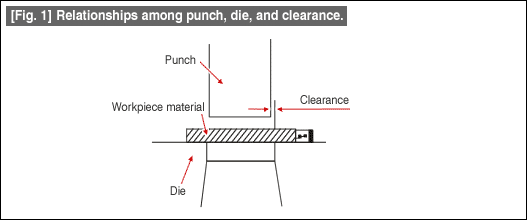
Clearance is the gap between the punch and the die as shown in Fig. 1.

Fig. 1 Relationships among punch, die, and clearance.

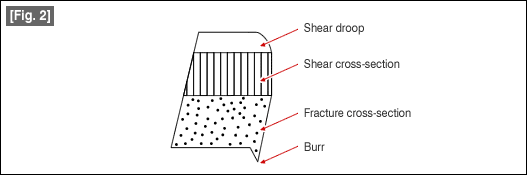
If the clearance becomes large, although the force necessary for blanking will be small, the shear droop of the cut cross-section and the inclination of the fracture cross-section shown in Fig. 2 both become large.

Fig. 2

The clearance values of the blanking operation are given in Table 1.

[Table 1] Blanking clearance for different materials (as a % with respect to plate thickness)
MaterialPrecision blankingOrdinary blanking
Soft steel2〜56〜10
Hard steel4〜89〜15
Silicon steel4〜67〜12
Stainless steel3〜67〜12
Copper1〜34〜7
Brass1〜45〜10
Phosphor bronze2〜56〜10
German silver2〜56〜10
Aluminum (soft)1〜34〜8
Aluminum (hard)2〜56〜10
Permalloy2〜45〜8
1. For ordinary blanking, a larger clearance value is used as the plate thickness increases.
2. A smaller value is used when the blanking conditions are good such as for round holes, etc.
3. A larger value is used when the blanking conditions are bad such as for square holes, etc.
4. Secondary shear occurs easily if a small value is used for thick plates or for hard materials.
5. Use a small value (use precision blanking, if possible) in the case of cutting operations.

Conventionally, although it was considered good to prepare so that the clearance is uniform in all parts, recently it is considered good to change the clearance partially to suit the changes in the cutting conditions, thereby taking measures against wear of the punch and die, and against distortion of the product.

About this Archive

This page is an archive of entries from August 2009 listed from newest to oldest.

July 2009 is the previous archive.

September 2009 is the next archive.

Find recent content on the main index or look in the archives to find all content.