September 2011 Archives

#095 Fundamentals of Press Die Structure Design (4) Method of Using Dowel Pins - 2

The position of installing a component is determined by using two dowel pins. It is better that the two dowel pins are as far apart as possible. Let us explain referring to Fig. 1. One should be aware that there is always a machining error in the positions of the holes machined in the plates. Therefore, when one point is taken as the reference, assuming that the machining error is the same and comparing the case when the position of the other hole is near with the case when it is far, the effect of the error is large when the other hole is near. From this, the accuracy is better when the spacing between the dowel pins is large.
In addition, if the positions of the two dowel pins are symmetrical, it will be possible to fix the part even if it has been reversed leading to the wrong installation of the component. In order to avoid such situations, always make it a point to ensure that the positions of the two holes are asymmetrical. Making it impossible to assemble in the reversed position is called fool-proofing.
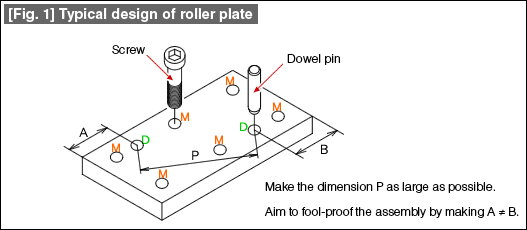
Fig. 1 Spacing of dowel pins placed in a plate

Fig. 2 shows the relationship between the dowel pin and the depth of the hole. When machining a dowel hole in a thick plate, etc., the limit is three times the diameter. A hole deeper than this is not desirable in terms of both accuracy and economy.

Fig. 3 shows the positioning of small components. The position is determined by two dowel pins, and the fixing is done by one screw.
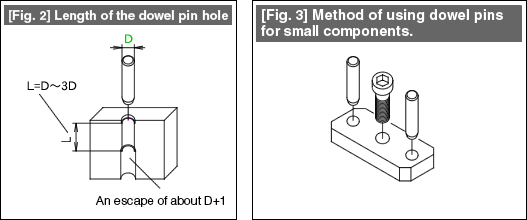
Fig. 2 Length of the dowel pin hole,  Fig. 3 Method of using dowel pins for small components.

In the case of components that are mounted on a plate such as a guide plate, the maintenance of dies becomes easy if they are made easy to disassemble as shown in Fig. 4. Since the function is not affected much even if components such as guide plates, etc., are shifted slightly, instead of removing the dowel pins by hitting, the design is made so that they can be detached easily by making the hole in the installing plate slightly larger.
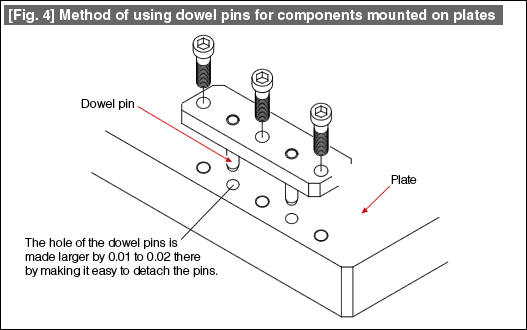
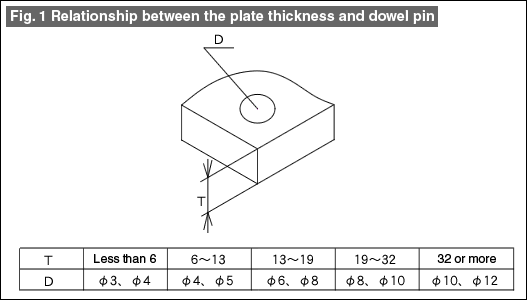
Fig. 4 Method of using dowel pins for components mounted on plates

#094 Fundamentals of Press Die Structure Design (3) Method of Using Dowel Pins - 1

Dowel pins are used very frequently for the positioning of die components. A common method of using dowel pins is to determine the position by lightly pressure fitting a dowel pin in two components. Similar to screws, the diameter of the dowel pin is determined according to the size of the die component.

Fig. 1 shows the relationship between the plate thickness and the diameter of the dowel pin. In general, there is a correlation between the plate thickness and the area, and it is assumed that a plate with a large end surface relative to the thickness is not used.

Fig. 1 Relationship between the plate thickness and dowel pin

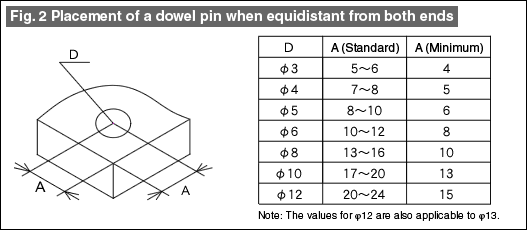
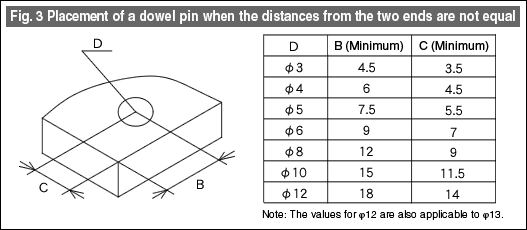
Fig. 2 and Fig. 3 show the dimensions from the end surface of the plate or block taking the dowel pin size as the reference. Although a dowel pin diameter of 12 mm has been shown in the table, there are dowel pins with a diameter of 13 mm also. These dowel pin diameters of 12 mm and 13 mm are created from the standard value of 12.5 mm. Which one of the two diameters to use is up to the liking of the user. Although recently the use of 13 mm is increasing, it is possible to use either of these two diameters.

Fig. 2 Placement of a dowel pin when equidistant from both ends

Fig. 3 Placement of a dowel pin when the distances from the two ends are not equal

#093 Fundamentals of Press Die Structure Design (2) Method of Using Screws - 2

It is important to carefully consider screw placement when designing dies.
There is the problem of whether to make the screw size large and make the number of screws small, or to make the screw size small and make the number of screws large. See No. 285 regarding this problem.

After the screw size has been decided, we have to think what should be the spacing between screws.

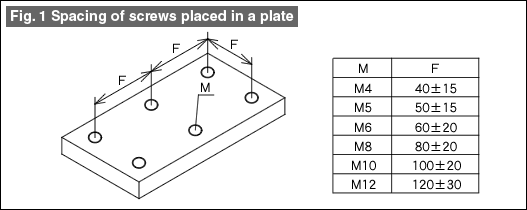
Fig. 1 shows the relationship between the screw size and the screw spacing. Consider that the spacing is 10 times the screw size. Since there is no clear standard regarding the screw spacing, it is convenient in the case of parts like screws to take this as an easy to understand method. (Strictly speaking, the screw spacing will have to be determined taking into account the amount of plate deformation and the fastening force, etc., but since realistically this is difficult, the spacing is usually decided by intuition based on experience.)

Fig. 1 Spacing of screws placed in a plate

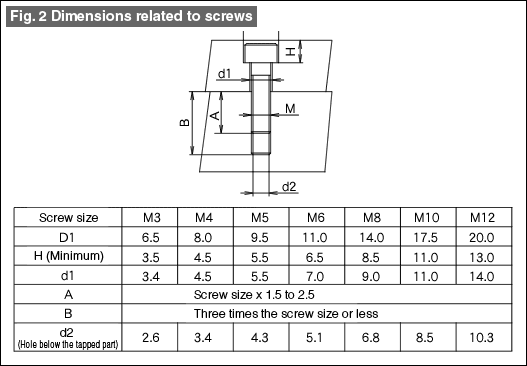
Fig. 2 shows the dimensions related to screws. Although these have been stipulated in JIS also, it is good to decide on your own company's standards. Consider that the following is one such example.

Fig. 2 Dimensions related to screws

When tapping the holes in the plate, there are the problems of determining the dimensions of the hole below the tapped part and the depth of tapping. When a tapped part that is too deep is specified, the effect is not much but the machining becomes difficult. Determine the hole below the tap and the tap depth that is easy to machine the tap, and make the machining work economical.

#092 Fundamentals of Press Die Structure Design (1) Method of Using Screws - 1

A die is constructed from many components which are held together with screws. Although screws are very common, the method of using them can be quite confusing. Here, we explain how to select the screw size based on the plate thickness and the dimensions from the end surfaces.
For information on the tightening force and torque of a bolt, refer to the descriptions given in the "Technical Data" which is an appendix to the Misumi catalog "Standard Components for Press Dies" and use that information for reference.

Here, we define screw as a hexagonal bolt with a hole.

Fig. 1 shows the relationship between the plate thickness and the screw. In general, there is a correlation between the plate thickness and the area, and it is assumed that a plate with an extraordinary large surface area relative to the thickness is not used.

[Fig. 1] Relationship between the plate thickness and screw

Fig. 2 and Fig. 3 show the dimensions from the end surface of the plate or block taking the screw size as the reference. Assume that the material is steel that is not hardened. For materials such as cast iron which is brittle or hardened steel which can break easily, it is better to use values larger than those of being shown.

[Fig. 2] Placement of screw when equidistant from both ends

[Fig. 3] Placement of screw when the distances from the two ends are not equal

When block size needs to be minimized, place a screw, used as a stopper and with sufficient strength, at distance equal to the screw diameter from the end surface.
This would be the minimum dimension of screw placement.
In ordinary dies, M3 screws are avoided because of problems in strength.

About this Archive

This page is an archive of entries from September 2011 listed from newest to oldest.

August 2011 is the previous archive.

October 2011 is the next archive.

Find recent content on the main index or look in the archives to find all content.