February 2010 Archives

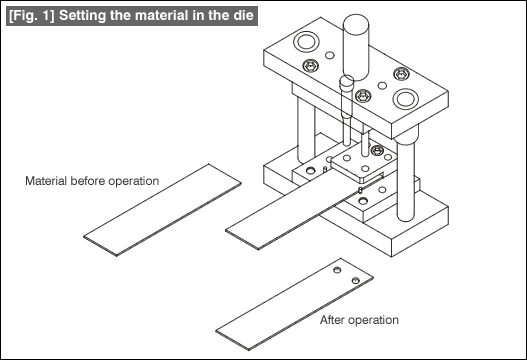
In the case of a product that does not require high accuracy in hole punching work, very often the fixed stripper structure is used because it offers ease of operation. For example, when a hole is to be punched at an end of a long product as is shown in Fig. 1, it becomes easy to do the work if a fixed stripper structure die is used. As can be understood from the figure, it is easy to the work because it is sufficient to insert the material inside the stripper and carry out the work when the material butts against the end.
image

However, if the gap between the stripper and the die is large, although setting the material inside the die becomes easy, the punch gets fanned during stripping and becomes susceptible to breaking. It is better keep the gap small.

Since there is no pressing down of the material during hole punching, deformations such as warping can occur easily in the material. This is not suitable for punching holes close to the outer shape.

Apart from the above methods of use, this is also used frequently for the hole punching of bent products or drawn products. In such formed products, since the periphery of the hole to be punched is quite strong, very often there is no need to keep the material pressed down.

Hole punching need not be done only in flat surfaces, but sometimes it is necessary to punch holes in curved surfaces. In such situations, even the deformation of the area surrounding the hole is small, and very often it is sufficient to take care only about stripping and in a large number of cases the fixed stripper structure is quite satisfactory.

Although the basis of hole punching operation is punching the hole while keeping the material pressed down, depending on the conditions, there are products in which there is no problem even if the material is not kept pressed down and a simple structure can be used. Care should be taken because the easy of preparing the die and cost change depending on your judgment and decision.

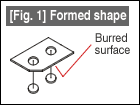
In hole punching work, the operation is made after the material is placed on a die. The scrap of hole punching falls down as is shown in Fig. 1. In other words, the scrap passes through the die and falls down. Fig. 1

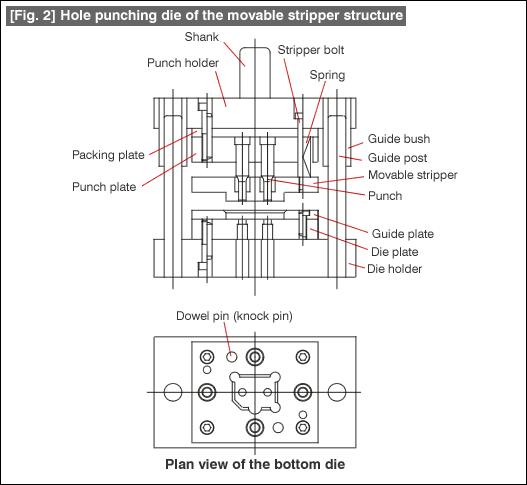
The material above the die tries to jump up when pressed by the punch. If the material is not kept pressed, it is likely that the flatness of the product becomes poor. In order to ensure the flatness of the product, the work should be carried out while pressing down the material. The movable stripper structure shown in Fig. 2 is a die structure that satisfies this condition.

Fig. 2

The condition during working will be explained below.

In the movable stripper structure, the material above the die is kept pressed down and fixed by the stripper and then the hole punching operation is performed. This prevents deformation of the material due to the forces during the hole punching operation. Although the product can get deformed when the punch that has fully penetrated the material is withdrawn (which is called stripping), there is no need to worry about this because the pressing is being done by a movable stripper.

The movable stripper is expected to have two functions, that of pressing down the material and of stripping. Here, we will be concerned about the strength of stripping by the movable stripper. If only stripping is considered, a force of about 5% of the hole punching force will be sufficient. The force of pressing down the material should be as strong as possible. However, generally speaking, very often a force up to about 30% of the hole punching force is set for this force.

Since the formed product remains on the die, recovering the product will have to be done either by an operator using work tools, etc, of by blowing off the product using compressed air.

In the case of a thin punch, for the purpose of preventing the punch from breaking and to improve the relationship between the punch and the die, the tip of the punch is also guided by the movable stripper. This form is called the "punch guiding by stripper".

The drawback of the movable stripper structure is that the material can get scratched because it is being pressed by the stripper. It is necessary to carry out the work while taking care about penetration of dirt or dust from the outside, and about undulations, etc., in the die surface and in the stripper surface.

For the sake of reference, during hole punching work, the dimensions of the hole punching punch are the same as the dimensions of the product. The dimensions of the hole punching die are set to be larger than the dimensions of the hole punching punch by the amount of the clearance.

#028 Basics of Die Structure (3) Structure of Blanking Dies - 3

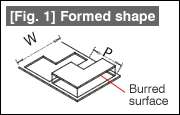
This is a blanking work of a special form. As is shown in Fig. 1, the formation is done by pushing from below to above. image

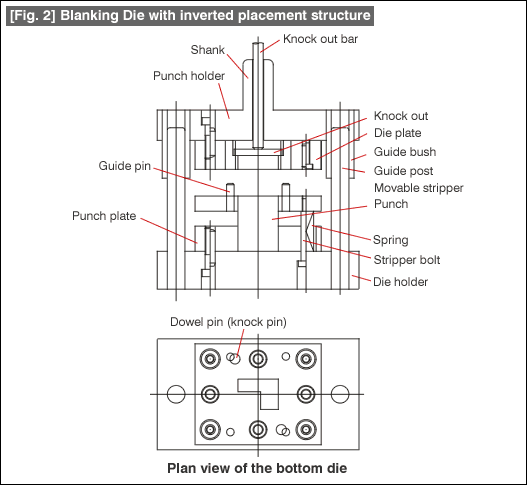
The structure of the die for this is shown in Fig. 2.

image

The product gets bent to some extent during blanking work. While this is due to the forces associated with the blanking operation and cannot be avoided, it is of course desirable that a flat product is obtained. This inverted placement structure was conceived as a countermeasure against the product getting bent.

The feature of the inverted placement structure is that the punch is placed as the bottom die and the die is placed as the top die. The blanked product enters the die. It will be necessary to discharge the product that has entered the die. The part for doing this is called the knock out. The knock out is linked to the pressing machine via the knock out bar.

The relationship between the blanking work and the knock out operation is as follows. The material is blanked near the bottom dead point of the pressing machine, and the product goes into the die. The die rises as it is, and near the top dead point of the pressing machine, the knock out bar of the die gets hit by the knock out part (called the knock out bar) of the pressing machine, the linked knock out gets pressed, and the product is discharged (ejected) from the die. A very common method of pushing away the discharged product is to blow it off using compressed air.

Using this type of structure for preparing flat products is because it is possible to reduce or suppress the bending that is caused during the blanking operation because the material is pressed down by the knock out. In the structure shown in Fig. 2, since the knock out has only penetrated into the die, the effect is small as a countermeasure against bending. In order to get much stronger effect, a spring is placed behind the knock out so that the knock out strongly presses against the material. In this case, since the product inside the die is pushed out due to the force of the spring, it is does not matter even if there is no knock out bar in the die. The product will be pushed back into the scrap. The product is then recovered by removing it from the scrap.

The method of moving the product that has once been blanked after pushing it back into the material in this manner is called a "push back method".

Since in the form of installing a spring behind the knock out inside the die, the material is pushed from a direction opposite to the direction of movement of the punch, this form is called the material reverse pressing (or simply reverse pressing). Reverse pressing is not for only the inverted placement structure, but even in a structure in which the punch is above and the die is below (this structure is called the upright placement structure), the pressing member that presses in a direction opposite to the direction of movement of the punch is called a reverse pressing member.

#027 Basics of Die Structure (2) Structure of Blanking Dies - 2

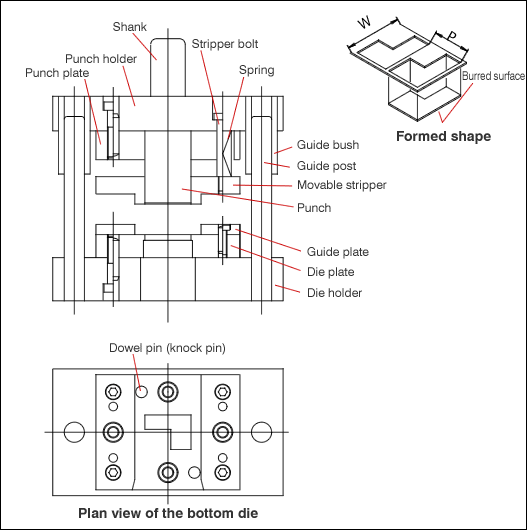
The purpose of blanking work is the same as that of a die of the fixed stripper structure. In the fixed stripper structure, since the fixed stripper is covering the die plate, some people say they do not like it because they cannot see the condition during working. Further, if a thick plate is blanked, gradually it may get warped making it difficult to carry out the work. Because of this, a movable stripper may be used because it is possible to press down the material. A blanking die of this type of structure is called a "movable stripper structure blanking die".

image

Compared to the fixed stripper structure, in the movable stripper structure, there are additionally the stripper bolt, spring, and the guide plate. Because of this, the cost will increase to some extent relative to the fixed stripper structure.

If a simple die is required, it is also possible to substitute the movable stripper by tying a urethane spring or rubber around the periphery of the punch. This is used very frequently in the case of small quantity production such as prototyping, etc.

The product gets bent to some extent in blanking work. This is due to the effect of the bending moment that acts on the material at the time of blanking. This cannot be eliminated in ordinary work. Although there are some people who use the movable stripper structure with the purpose of improving this bending, but that is wrong. The bending becomes somewhat larger in the case of the movable stripper structure.

The blanking chaff sticking to the punch is removed from the punch by the force of the spring of the stripper. The size of this force need only be about 3 to 5% of the blanking force when a standard clearance is used. This force is called "stripping force" or "chaff removing force". The stripping force can be made larger when the clearance is smaller, and on the contrary, it can be made smaller as the clearance becomes larger.

About this Archive

This page is an archive of entries from February 2010 listed from newest to oldest.

January 2010 is the previous archive.

March 2010 is the next archive.

Find recent content on the main index or look in the archives to find all content.