February 2011 Archives

#070 Method of Using Standard Components (19) Button Die - 1

A button die is used as a part inserted in a die plate (nested). It is used as an insert in a non-tempered die plate, and is used to make the preparation of the die easy, or to make the die maintenance easy, or to obtain a long life.

Fig. 1 shows the external view of a button die.
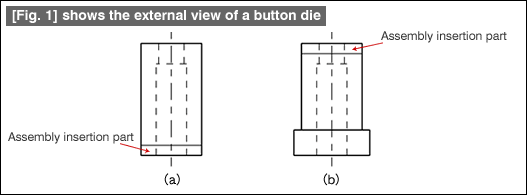
Fig. 1 shows the external view of a button die.

Straight type (a) is one that is used by lightly pressing inside the plate. An assembly insertion part has been provided in the part thereby making its assembly easy.
The type (b) is one with a flange. This shape can be said to be the standard type. The materials available for button dies are SKD11, SKH51, powder high speed steel, ultra hard alloys, etc.

Fig. 2 shows the cross section of the hole of a button die.
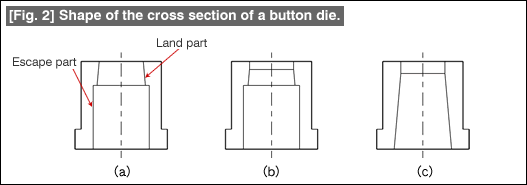
Fig. 2 Shape of the cross section of a button die.

The hole is constituted from a land part (cutting edge part) and an escape part. There are three basic types of the hole cross sections as shown in the figure.
(a) is a type with a land part having a taper. This is a shape considering the passage of the blanked material. The drawback is that the hole becomes slightly larger every time the die is re-ground.
(b) is a type considering the drawback of the type (a), and the part necessary for regrinding has been made straight, and this is the type in which there is no change in the hole dimensions due to regrinding.
(c) is a type in which the part below the land part is not made to escape in a big way, and that part is escaped entirely by a taper. This is used relatively frequently for small diameter holes. This can be said to be a type in which some considerations have been given to scrap clogging. This is also called an angular button die.

Fig. 3 shows the types of cutting edge shapes that are being provided as standard parts.
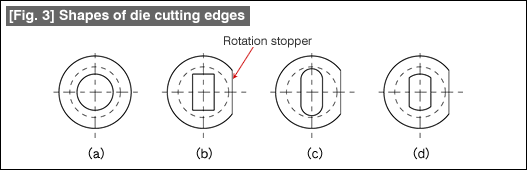
Fig. 3 Shapes of die cutting edges

Since the orientation of the hole is present in the types (b) to (d), there is no need for a rotation stopper. It is possible to specify in detail the different dimensions, the method of preparing the rotation stopper, etc. It is also possible to make changes in the details related to the cross section, and it is possible to make the shape most suitable for the pressed material and the plate thickness.
Punches and button dies have been standardized and made available at low costs, and hence it can be said that die preparation has become quite easy. Punches and button dies can be said to be parts in which the effect of standardization has been brought out in a big way.
#069 Method of Using Standard Components (18) Misfeed Detection Unit

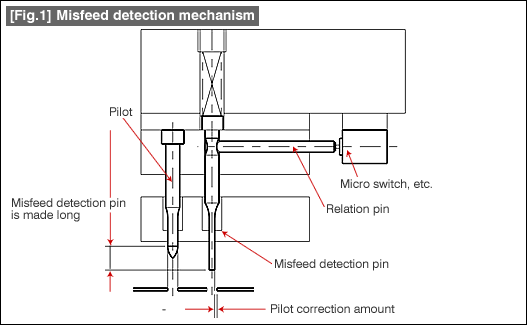
The relationship between the misfeed detection unit and the pilot is shown in Fig. 1.

Fig. 1 Misfeed detection mechanism

The misfeed detection is made to operate in the state in which the pilot cannot correct the position of the fed material. Therefore, since it is made to act earlier than the pilot, it has to be made longer and thinner than the pilot (within the correction amount of the pilot). The general form of a misfeed detection unit is constituted from a misfeed detection pin, a relation pin, and a micro switch, etc.

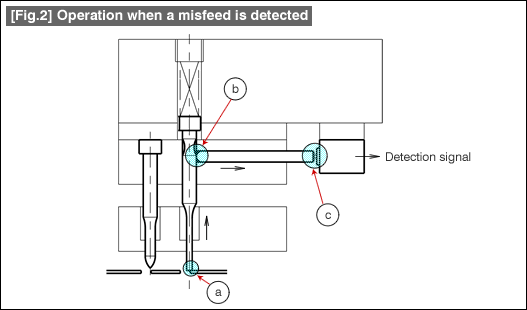
Fig. 2 shows the state in which a misfeed has been detected.

Fig. 2 Operation when a misfeed is detected

The operation is made in the following sequence

(a)
The misfeed detection pin climbs over the edge of the pilot hole of the shifted material.
(b)
The misfeed detection pin is pushed up.
(c)The relation pin set in the groove of the misfeed detection pin is pushed sideways and presses a micro switch, etc., outputs the detection signal, which stops the press machine.

After detecting a misfeed, although it is good that the press machine is stopped before the pilot contacts the material, in order to do that, it is necessary that the misfeed detection pin is considerably longer than the pilot. The conditions are very often difficult to realize, and it is often assumed that the machine stops after making one wrong press operation. In the case of a high speed press machine, even if a sudden stop is made, the machine stops after making two or three wrong press operations. In the method of misfeed detection explained using Fig. 1 and Fig. 2, there is some play in the movements of the misfeed detection pin, the relation pin, and the micro switch, etc. Since there is a delay in the detection time corresponding to this play in the movement, the stopping of the press machine becomes late, and the wrong press operations become more.

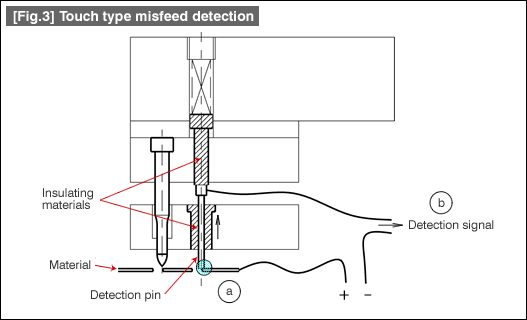
The mechanism in Fig. 3 has been made to operate electrically considering the problem of delay in the mechanical operations.

Fig. 3 Touch type misfeed detection

The example shown in the figure is merely one of the possible examples, and a form with many modifications is used. The principle of operation is that the detection pin is maintained in the insulated state, and a small current is passed between the material and the detection pin. Under normal conditions, no current flows because the detection pin enters the pilot hole without touching the material. If the pilot hole gets shifted as shown in Fig. 3(a) and contacts the detection pin, a current flows, and a detection signal is output stopping the press machine. Faster operation can be obtained compared to Fig. 1. The drawback is that the electrical lead wire of the detection pin is moving all the time during press operation. As a consequence of this, the lead wire is likely to get cut somewhere. If this happens, even if the detection pin detects an abnormality, the press machine cannot be stopped. Periodical checks cannot be avoided.

#068 Method of Using Standard Components (17) Pilot - 2

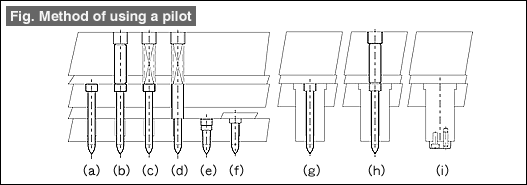
The different shapes shown in the figure are explained below.

Method of using a pilot

(a)This is the basic method of use. This is a form that is a modification of the basic method of use of a round punch. The tip of the pilot is proportional to the amount variable movement of the movable stripper. It is cumbersome to remove the pilot at the time of carrying out maintenance of the die.
(b)The function is the same as the basic method. The feature is that considerations have been given to the maintenance of the die and disassembling has been made easy.
(c)The material will be pierced by the pilot if wrong punching is done in the basic form. The die may break because of this. As a countermeasure for that, a spring is provided behind the pilot, and when a wrong punching is made and a large load acts on the pilot, the spring gets compressed thereby avoiding the material being pierced. If the spring is weak, it gets compressed even during the normal state and hence the positioning accuracy may become poor. It is necessary to take care about these aspects.
(d)In the basic method, the pilot punch is fixed to the punch plate. As a consequence, the penetration of the pilot into the die becomes deeper. If the penetration into the die becomes deep, the pilot will be scratching the material for a long time, and this may cause deformation of the pilot hole or pulling up of the material. This is a structure which avoids this phenomenon and also avoids the pilot piercing of the material when a wrong punching is made. The feature is that the stepped part of the pilot butts against the stripper surface. The precautions about the spring are the same as in the structure of (c).
(e)This is the basic form of a pilot fixed to the stripper. By fixing to the stripper, it is possible to maintain the amount of projection of the pilot at a fixed value. The fixing is done by a press screw. Since the screw can easily become loose, although it is better to use two screws, the disadvantage is that it is difficult to provide two screws because of space limitations.
(f)Although this is a pilot fixed to the stripper, this is a structure in which it is pressed from the back using a stripper packing. This structure has been made easier to prepare than the structure (e).
(g)Although this is a pilot fixed to the punch, this is a structure in which the attaching and detaching of the pilot has been made easy in order to make it easy to carry out regrinding of the punch.
(h)In a large punch, this is a structure in which the fixing on the punch is done using bolts and knock pins (dowel pins). The key points are that care needs to be taken about falling off of the knock pin and taking measures to make it easy to remove the knock pin at the time or detaching the pilot.

About this Archive

This page is an archive of entries from February 2011 listed from newest to oldest.

January 2011 is the previous archive.

March 2011 is the next archive.

Find recent content on the main index or look in the archives to find all content.