April 2011 Archives

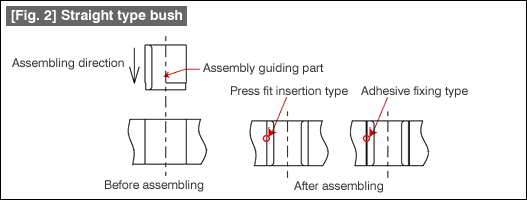
Stripper guide bushes can be divided into two types based on their external appearance. These are the type with a head (with a flange) and the straight type. Further, the changes in the sliding part are also included in the classification into types. In addition, as the method of assembly, there is the press fit insertion method and the adhesive fixing method. The adhesive fixing type can be further divided into the Loctite adhesive and the Devcon adhesive types. Devcon adhesive fixing has become considerably rare, and Loctite adhesive fixing has become the mainstream method. There are some difficulties with the press fit insertion method. When the degree of tightening in press fit insertion becomes large, distortion appears in the internal diameter of the bush after press fit insertion and can cause fusing, etc. On the other hand, the degree of tightening is made extremely small (light mating), and accuracy is increased by assembling with a force equivalent to that of pressing with the fingers. In this case, the machining of the hole becomes difficult.

The shapes and assembling methods of bushes are shown in Fig. 1 and Fig. 2.
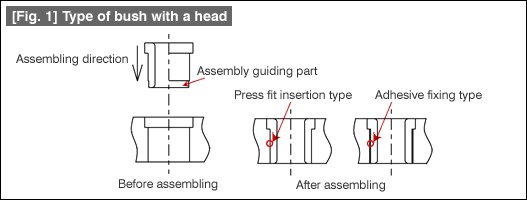
Fig. 1

Fig. 2

In the press fit insertion type of the straight type, the guide diameter becomes distorted if the press fit insertion is made strongly, and the bush can easily get detached if the press fit insertion is made lightly, and hence their use is less frequent. In the adhesive fixing method, there are bushes in which a groove is formed on the outer periphery of the bush, thereby making it easier for the adhesive material to enter.

Fig. 3 shows the changes in the sliding part.
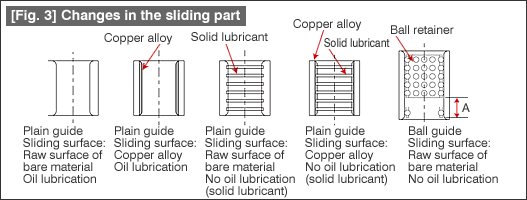
Fig. 3

The basic type is a plain guide with the raw surface of the bare material (bearing steel is used very frequently) is used as it is as the sliding surface. As a countermeasure for fusing, there are some types in which the sliding surface has been coated with a copper alloy.

The above is used with oil lubrication. When oil is not acceptable, a solid lubricant (molybdenum sulfide) is embedded in the sliding surface and the bush is used without any oil lubrication. This type wears out rather quickly compared to the oil lubricated type. The movement of the plain guide is rather sluggish (heavy), and since fusing can occur in such types of guides, there are types in which balls are placed between the post and the bush with the balls in rotating contact with the post and the bush. Although the movement becomes smooth and light, this becomes weak against eccentric loads. The container that supports the balls is called a retainer, and the retainer moved by about a half of the stroke (the part indicated by A in Fig. 3).

As has been described above, the combination conditions of bushes are many and although a bush is a part with a simple shape, one may find it difficult to make the selection.
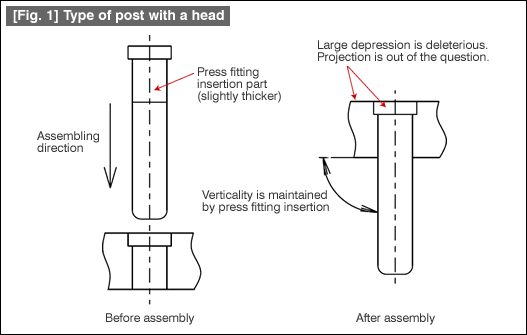
The stripper guide posts come in various shapes. Fig. 1 shows what can be said the basic type with a head (with a flange). This can also be said to be the basic shape of a post.

Fig. 1 Type of post with a head

The position and verticality are maintained by press fitting insertion of the post into the plate. Detaching is prevented by the flange part. Although the flange part sinks inside the countersinking hole in the plate, the ideal condition is that the end surface of the post and the surface of the plate are in the same plane. However, there will be some deviations from this ideal condition in actual practice. If the depression of the post inside the hole is too much, the post will move in the up / down direction and hence the verticality will be poor. This may also cause breakage of the flange part.

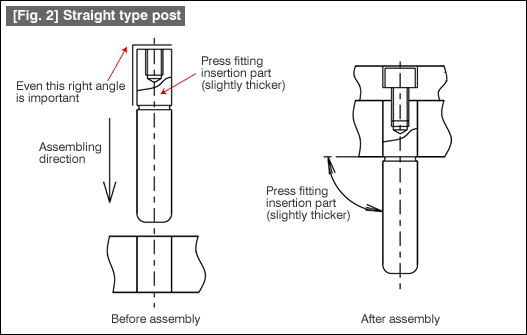
Fig. 2 is the type which is called the straight type.

Fig. 2 Straight type post

Detaching is preventing by a screw. Similar to the post with a flange, even in the case of this post, the verticality and position are maintained by press fitting insertion. In the press fitting inserted condition, as shown in the figure, detaching is prevented by fixing using a bolt. At this time, if the press fitting insertion part of the post and the end surface of the post are not at a right angle, a tilting force acts on the post when the post is pulled by the bolt, and this can cause the verticality of the post to be disturbed.

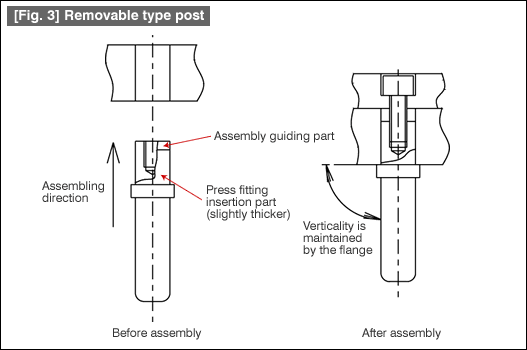
Fig. 3 shows a removable type post.

Fig. 3 Removable type post

The position of the post is maintained by the press fitting insertion part. The verticality is maintained by the flange part. The functions are slightly different for the above two types. Because of this, it is also possible even if the press fitting insertion part is short. Detaching of the post is prevented by a bolt. The removable type post has the purpose of making the detaching and attaching of the post easy at the time of maintenance of the punch and die, thereby making the work easy, or else to make easy the grinding or replacement of the post. In order to make detaching easy, it is a common method to make the press fitting insertion light.

These posts are fixed to the punch plate, and the common form is one in which bushes are plated in the stripper plate and die plate. In recent years, there have also appeared some forms in which the post is fixed to the stripper plate and bushes are provided in the punch plate and die plate.

A stripper guide is said to have the following roles.

1. Restricting the behavior of the stripper in order for the stripper to guide the punch.
2. Heightening the dynamic accuracy of the punch and die.
3. Making the assembly of the punch and die easy.
4. Making the maintenance easy, etc.

However, these can change depending on the method of assembling the stripper guide.

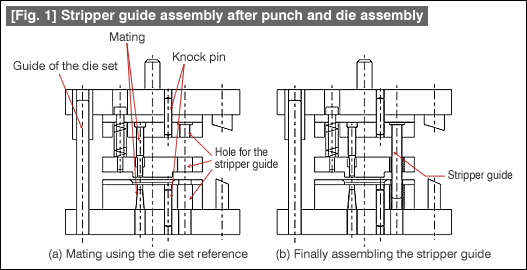
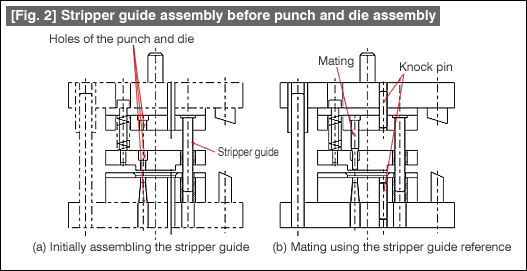
Some examples of these are shown in Fig. 1 and Fig. 2.

Figure 1 shows the method of assembling the stripper guide after mating the punch and die.

Fig. 1 Stripper guide assembly after punch and die assembly

This can be said to be the form used initially when stripper guides were started to be used. In the times when it was not possible to carry out high precision plate machining, after mating the die and the punch cutting edges, the bush is fixed using Devcon (adhesive). This is effective for behavior of the stripper, dynamic accuracy, and ease of maintenance.

The form shown in Fig. 2 may be said to be the form of punch and die assembly in recent times.

Fig. 2 Stripper guide assembly before punch and die assembly

The plate is machined to a high accuracy, initially the stripper guide post and the bush are made to stand on the plate, and the punch and die are mated taking the stripper guide as the reference. At this time, it is possible to mate the punch and die even if the plate has not been assembled inside the die set. Assembling in the die set is also carried out after mating the punch and die. All the roles of the guide indicated above are included in this method. However, there will be differences in the accuracy depending on the method of assembling the guide bush and the post. Techniques will become necessary matching with the required accuracy. For example, this is the difference due to selecting the method of fixing the bush either the press fitting method or the adhesive fixing method, etc. The reason that there are a large number of types of stripper guides among the standard parts is probably the result of pursuing parts to suit the quality expected from the punches and dies.

It is dangerous to judge the function of the stripper guide from its finished form, and it is necessary to consider from the method of assembling the stripper guide post and bush.

About this Archive

This page is an archive of entries from April 2011 listed from newest to oldest.

March 2011 is the previous archive.

May 2011 is the next archive.

Find recent content on the main index or look in the archives to find all content.