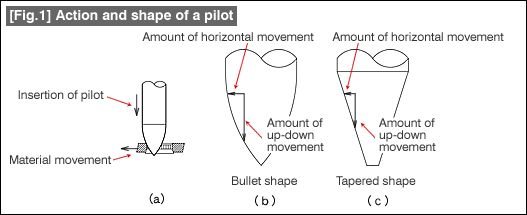
As shown in Fig. 1(a), the pilot carries out the final positioning of the material inside a die. Although the material is fed into a die by human hand or by a feeding device, there is always some error in feeding. It is required that this error is corrected to the extent that it does not affect the product. The correction of the position of the material is made by sliding the material along the inclined surface of the pilot. The shape of the inclined surface can be the bullet shape shown (b) or the tapered shape shown in (c). In the bullet shape, the amount of horizontal movement changes with respect to the amount of up-down movement. In the tapered shape, the amount of movement is always fixed. Earlier it was said that the tapered shape is good for precision machining, but at present no distinction is being made between the two shapes. In the case of precision products or when the plate is thin or is made of a soft material, the horizontal movement with respect to the up-down movement is made small, and there is the trend of making the horizontal movement larger as the plate thickness increases. The inclined surface against which the material slides is finished clean and smooth thereby reducing the sliding resistance.
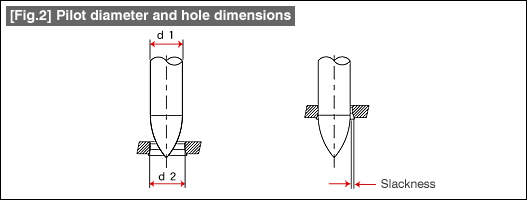
While usually a pilot is inserted in a hole for the pilot, care should be taken about the relationship between the pilot diameter and the hole shown in Fig. 2(a). Although the positioning accuracy becomes better as the "slackness" shown in Fig. 2(b) is small, if there is no slackness, the material will be lifted up when the pilot is being removed from the material. The relationship between the pilot diameter and the hole is determined considering the relationship between the accuracy of positioning and the problem of material being lifted up. Even in the case of precision products, the slackness (difference between the diameters) is about 0.01mm which is about 0.02 to 0.04mm in ordinary situations (when the plate thickness is roughly 1mm). Although the slackness appears as an error, when there are a number of pilots inside the mold, they interfere with each other increasing the accuracy. However, if the number of pilots is too large, the mutual interference becomes tight becoming a cause of the material being lifted up.
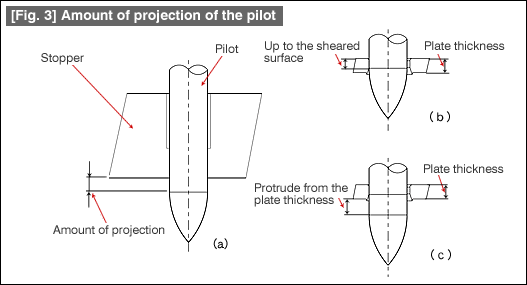
The pilot has to move before machining. Therefore, a form in used in a movable stripper structure in which the pilot projects from the stripper surface. If the length that is projecting is too much, it will become a cause for the material to be lifted up. See Fig. 3(a). While the amount of projection is determined considering the material plate thickness, it is desirable to make it as short as possible. The thinking is as follows. The blanking surface of the hole in which the pilot enters is constituted as "droop - sheared surface - fracture surface". The reliable surface is the sheared surface. The function is achieved if the pilot acts on the sheared surface part. If the plate thickness of the material is sufficient, there will be no problems even if the amount of projection of the pilot is made short as shown in Fig. 3(b). However, if the material plate thickness becomes small, if the form of Fig. (b) is used, the method fails unless the component accuracy of the pilot is very high. In view of this, as shown in Fig. (c), the amount of projection is made more than the material plate thickness. By making the amount of projection larger, it is possible to make rough the machining accuracy of the pilot. The problem of the material being lifted up will be present even if the amount of projection is made large, and hence a compromise has to be found.