January 2013 Archives

#142 Design of Hole Punching Dies (2) Design of Hole Punching Punches

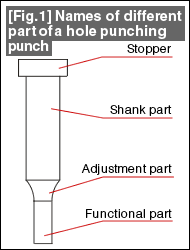
Fig. 1 shows the different parts and their name in a hole punching punch.
Since very often the punch is made from a single material, it may be not so common to think of the different parts separately.
However, when designing a punch, knowing what are the functions required will be far different from just designing somehow.
The functional part is the part that constitutes the life of the punch. The desired forming is done by this part. This part has the same shape as the shape to be formed. The shank part is for holding a thin punch. It is embedded in the punch plate.
The adjustment part is the part that connects the functional part and the shank part.
The stopper is the part for ensuring that the punch that has been embedded in the punch plate does not come off.
Fig.1

Fig. 2 shows the concept of the design of a punch.
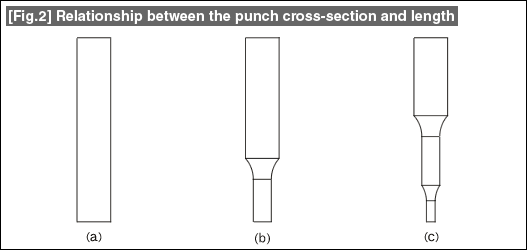
Fig.2

The figure (a) is the shape when the cross-section of the punch functional part is large, and when it is considered sufficient in terms of strength even if the shank part and the functional part are made of the same size. This is called a straight punch. This shape is ideal and is easy to prepare.
The figure (b) is the shape called a stepped punch in which the cross-section of the functional part is small, and when the limiting length of the punch is small due to strength considerations, a strong shank part is provided, and the shape is adjusted in the adjustment part, thereby acquiring the required length of the punch.
The figure (c) is the shape in which the functional part has become further smaller and weaker. The difference between this cross-section and the shank part cross-section being too large causes problems in the preparation and strength of the punch. Because of this, the countermeasure is taken of increasing the number of steps.

Fig. 3 shows the different types of punch stoppers.
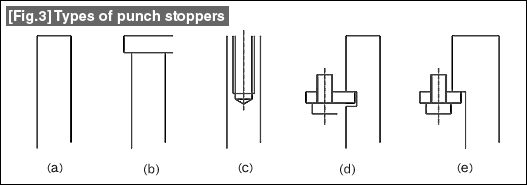
Fig.3

The straight punch of (a) is embedded in the punch plate and is fixed by caulking or using an adhesive.
The punch in (b) has a small flange which acts as the stopper. This type is used very frequently in the case of round punches, etc. It may be difficult to prepare the flange in the case of square or odd-shaped punches.
The punch in (c) is one in which the punch is prevented from getting detached using a bolt. This type is used frequently in the case of straight punches that are prepared using a wire cut discharge machine.
The punches in (d) and (e) have the key stopper structure. These are also selected depending on the shape, size, and material of the punch. At the time of selecting, for the same die, as far as possible the method used for preventing the punch from slipping out is unified thereby making it easy to assemble and disassemble the dies.
#141 Design of Hole Punching Dies (1) Structure of Hole Punching Dies

Hole punching dies can be said to be the dies that are used most frequently next only to blanking dies.

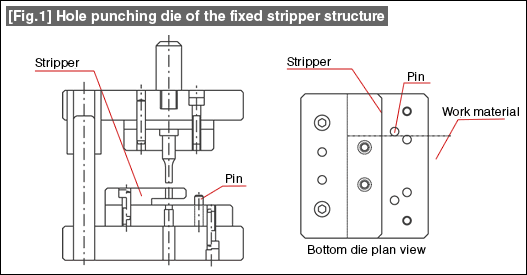
Fig. 1 shows a hole punching die having a fixed stripper structure. Since the structure of the die is simple, preparing the die is easy.
Since a die of this structure does not keep the work pressed, the flatness tends to become poor in the periphery of the hole. This type of die is used frequently when wanting to punch a hole at the end of a long shape.
In the example shown in the figure, although the guiding along the width direction of the work material is being done by a pin, it is also possible to use a plate.
The work material is processed while pushing it towards the deep end of the fixed stripper.

Fig.1

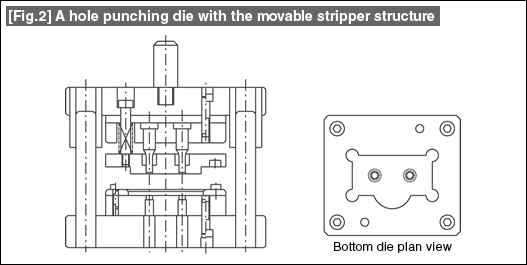
Fig. 2 shows a hole punching die with a movable stripper structure. This can be said to be the standard of a hole punching structure.
The work material is pressed by the movable stripper thereby aiming to prevent deformations such as warping, etc.
Since the work material is pressed between the die plate and the stripper plate, there is the drawback that it is easy for scratches such as dent marks to be made on the product.

Fig.2

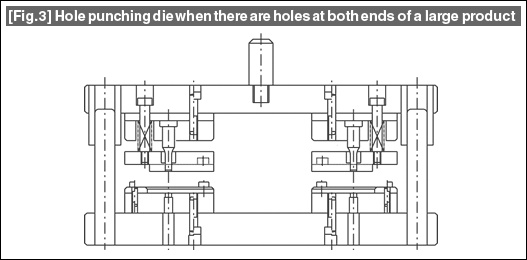
Fig. 3 shows the structure used when there are holes to be machined at the two ends of a large product.
When the entire unit is made from one plate, there will be a lot of waste and the weight will also be more. In addition, when a single process machining is assumed, there will be a feeling of pressure and the ease of press operation may be decreased. This is a structure in which only the necessary parts are prepared and placed which simplifies the die.
In the case of long products, if there are forming units at both ends, the middle part may sag. In such situations, it is stabilized by providing support at suitable parts.

Fig.3

The above are hole punching dies assuming that the work is a flat plate. It is also possible to punch holes on the sides of a drawn product, or to punch holes in a bent product.
The operation is done by making suitable alternations in the placement of the product, or else, it is also possible to punch holes from the side using cams.

#140 Design of Blanking Dies (13) Blanking Dies with Different Constructions

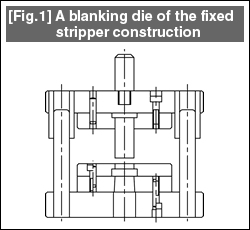
Regarding blanking dies, we have so far explained the fixed stripper construction taking the example of a very frequently used construction.
This is the construction in Fig. 1. This can be said to be the standard type of construction of a blanking die.
In this construction, the drawback can be said to be that the part being formed cannot be seen. There is also another point of concern. This is the change in the material while being processed.
The material on the die warps due to being hit by the punch. Although this does not matter much in the case of thin plates, this will become a problem in the case of thick plates.
Fig. 1

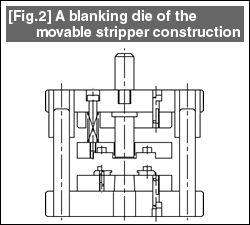
As a countermeasure for the part under formation not being visible and for the warping of the material, a blanking die with a movable stripper construction which makes it possible to use a material clamp as shown in Fig. 2 may also be used.
In this construction, the part being processed will be visible since the stripper is placed on the punch side.
Fig. 2

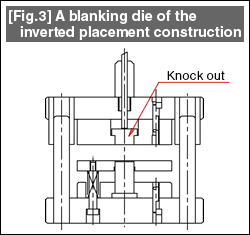
Since the number of components constituting the die becomes large, the cost of die preparation becomes proportionately higher. The construction as shown in Fig. 3 is also adopted for a blanking die. This type of construction is called the "inverted placement construction". The punch becomes the bottom die and the die becomes the top die. If blanking is done using this construction, since the product enters into the die, it will be necessary to discharge it. For that purpose, a component called a knock out is always necessary in the die.
The reasons for adopting this construction can be, wanting to minimize as far as possible the blanking warp, or when the push back method is used in which the material that has been processed once is pushed back. In the case of a push back, a spring is incorporated behind the knock out.
Fig. 3

About this Archive

This page is an archive of entries from January 2013 listed from newest to oldest.

December 2012 is the previous archive.

February 2013 is the next archive.

Find recent content on the main index or look in the archives to find all content.