July 2009 Archives

#004 Design of a punch and die for small diameter hole punching

Here, punching small diameter holes assumes a size of roughly less than 1.0 mm in diameter. Also, it is assumed that holes of about φ1.0 mm are punched in materials with a plate thickness of around 1.0 mm.

Design of the punch

For the sake of preservation, the tip of a punch for hole punching is guided (punch guide) by a stripper as is shown in Fig. 1 thereby preventing the punch from breaking. A guide for the relationship between the dimensions P and B of the punch is a maximum length B less than or equal to 10P (B ≤ 10P). In the case of small diameter punches, the dimension B becomes short and punch guiding becomes difficult.

Fig. 1

As a preventative measure for this, a two stage punch is used as is shown in Fig. 2. The dimension d above P will be d ≤ P + 2t. The reason for this is to avoid causing any deformations in the hole when the punch is withdrawing from the material. The length of the guide at the tip of the punch is - guide length ≥ punch diameter. Also, the gap between the punch and the stripper should be 0.003 or more at each side. The reason for this is that 0.003 is the minimum gap that does not cause the oil film to break. It may also be good to wrap the side surface of the punch and make it clean.

Fig. 2

Design of the die

The key point in die design is to make sure that no chaff gets clogged in the die hole. The reason for this is that the force for pushing down the chaff is quite large and the force for punching the hole becomes considerably large.

See Fig. 3

Fig. 3

As a countermeasure, make the length of the punch tip (A) as short as possible. Also, it is better to remove the punching chaff after punching each hole. Also, as a rule, the chaff dropping hole (d) should not be made too large with respect to the dimension P. At this time, as the dimension d is being made smaller, at the same time the length (L) of the die should also be made smaller. This is a countermeasure against clogging. The clearance should be made larger than normal. This is for reducing the punching force as much as possible. If the punching of small holes is done at a normal clearance, the shear surface will be drawn out longer. This is due to the fact that the punching chaff has gotten crushed.
#003 Chaff Rising Countermeasures in Punching Work (1)

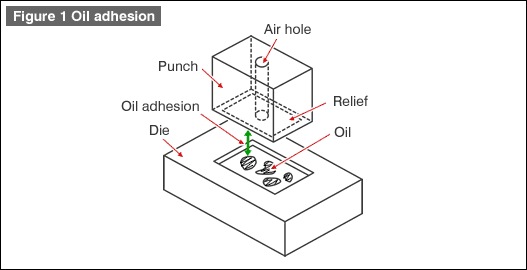
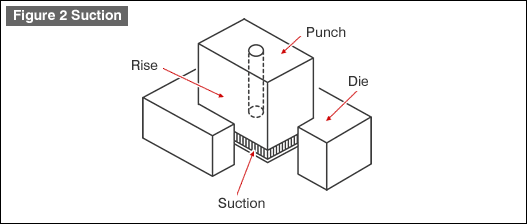
The chaff rising is a defect phenomenon in which the chaff does not remain in the die but rises along the surface of the die. Unfortunately, the fact that countermeasures against burrs have improved and the punching conditions have became better has decreased the frictional force between the punching chaff and the side surface of the die therefore making it easy for punching chaff to rise along the surface of the die.

Cause of chaff rising

Fig. 1 Oil adhesion

Fig. 2 Suction

The above figures show the main cause. Apart from this, although there are other causes such as magnetism or springing back, etc., their effects are small.

Cause of oil adhesion

The machining oil applied to the surface of the material makes the bottom surface of the punch come into close contact with the material, prevents the inflow of air from the periphery, and raises the material.

Oil adhesion countermeasures

 -The supply of oil to the material is made large on the side surface of the die and made small on the punch side.
 --A relief is prepared on the bottom surface of the punch (the surface that comes into contact with the material) thereby making the contact area smaller.
 -An air hole blowing weak air is prepared. (It is better to use this along with the above relief.)

Cause of suction

During the process in which the formation is complete and the punch is returning, the material inside the die becomes a base and the punch becomes a piston, the pressure decreases in the space between the material and the bottom surface of the punch and hence the material is lifted up.

Suction countermeasures

 -Since the pressure reduction is proportional to the punch speed, reduce the spm of the operation.。
 -Open an air inlet hole

*Placing a kicker pin and suppressing the rise of chaff forcibly is a countermeasure that is effective for all chaff rising irrespective of the cause. We have discussed here only other countermeasures that are possible.

#002 Life of press dies

In press formation, since the growth of removal burrs is the fastest, the time for die maintenance can be determined by the height of the burrs. Therefore, the precondition is the setting of an appropriate removal clearance, and by looking at the removed product, it is possible to judge to some extent the life of the die. Sharp corners on the removal shape are likely to cause chipping and burrs will appear faster. Rounding off corners is well known to be a countermeasure against burrs. The life of the dies increases in the order of the material of the punches and dies following SKS → SKD → powdered high speed steel → ultra hard alloy. With the same die material, the life increases if the surface roughness of the punch and die is better, and also there will be a difference depending on lubrication. The life becomes shorter if the manner in which the removal scrap falls is close to a state in which chaff gets clogged. Apart from this, the guide of the die set or the stripper guide (sub guide) also affect die rigidity and the dynamic accuracy of the die.

The life of a die can be either the maintenance life (grinding cycle) or the overall life. The overall life can be said to be the life after repeated maintenance lives, and depending on the structure of the die, it may also be difficult to judge. In the case of a solid type die, since the plate becomes thin every time re-grinding is carried out, it is possible to judge the life of the die at one glance. An insert type die is used by grinding only the insert part again and adjusting the level and only the insert part is replaced when the life of the die is reached. Similarly, even when the sub guide, etc., is worn out, only the worn out part is replaced. When this is repeated, it may appear as if the overall life of the die will not be reached for a long time. The method for judging the overall life of the die in such cases is to see the plate. The points to look for are the looseness of the insertion hole and the deformation of the plate. If there is deformation or wear out of the insertion hole, the life is over because it will not be possible to maintain the position accuracy of the inserted part. Regarding the deformation of the plate, during each press formation, the die gets elastically deformed although to a small extent. When the die is used for a long time, this deformation remains in the plate. When this condition happens, even if a new insert part is used, it will not be possible to produce the number of products as before. The overall life can be judged to have been reached if such a maintenance life after such maintenance cannot support production.

When the life of the plate is considered, when the life of the die is to be made longer, the plate should be made thick and it should be tempered, and if a shorter life is sufficient, although the plate is tempered it is made thin, or else, some change is made such as assembling an insert part in a plate that is not tempered. The same is true of the sub guide as well. When the life is to be made longer, a guide bush is used, and when the production quantity is small, the hole in the plate is used as the hole for the guide post.

Dies are used for manufacturing various quantities from very small quantities to very large quantities. It is very difficult to prepare dies with an appropriate life while maintaining the quality. In particular, since even the cost of preparation will be limited in the case of dies for small quantity production, it becomes more difficult to prepare the dies.

#001 Accuracy Judgment of Press Dies

In general the dimensional accuracy or the shape accuracy of the product is used as a "measure" of die accuracy. Products that require very strict tolerances, for example, lead frames or IC connectors, etc., are products that require very high accuracy, and dies for producing these are recognized as high accuracy dies. This is a point that no body questions.

Now let us consider where this high accuracy is found in such dies. Since the shapes of punches and dies are transferred to the products, the shapes of punches and dies are produced with high accuracy using multiple cutting and other methods employing profile grinding machining (PG machining) or wire electric discharge machining (W/EDM). Definitely one factor in judging die accuracy is the preparation of the shapes of punches and dies corresponding to the dimensional tolerances of the product.

The preparation of the shapes of punches and dies may also be necessary for maintaining clearances. As the material plate thickness of products becomes smaller, the removal clearance also becomes proportionately smaller. It is very difficult to maintain this uniformly. Therefore, even if the tolerance of the shape and dimensions of the product are large, because small clearances have to be maintained in the case of forming products from thin plates, it is necessary to maintain high accuracy when preparing punches and dies and the assembling position inside the die. It is also possible to say that even the plate material thickness is a "measure" for evaluating the accuracy of the die. Even the accuracy of the shape of products becomes bad with a small change in the mating if the plate thickness of the material becomes small. Of course, the preparation of the shapes of punches and dies becomes important.

Through the preparation of the shapes of the punches and dies, it is possible to obtain satisfactory parts. Since punches and dies are placed as a top die and bottom die, even the guide posts and bushes (guides) that determine the accuracy of the relationship between the top die and the bottom die have very important indirect roles in the die accuracy. Considering that a punch is made into a punch guide using a stripper, this is also related to the preparation of the stripper (inner guide), the stripper bolt, spring, etc.

It is not possible to discuss the accuracy of a die without clarifying what is to be the "measure" of accuracy. For example, one can think of how the inner guide should be. Depending on the accuracy required, even the part used and the method of assembling become different. A die that is prepared without clarifying the details of what is required, even if it looks like a real die, cannot be said to be a high accuracy die.

It is easy to understand once the preconditions have been made clear. For example, if a die is considered with the precondition that a thin material is to be formed, how the die should be formed becomes clear from following the thinking sequence of - small clearance → shape accuracy and surface roughness of punches and dies → die position accuracy → guide preparation.

The accuracy of a die can be said to be determined by the product irrespective of the number of formations of the product that is produced by press formation.

Introduction : Starting the Press Dies Technology Course

"Press dies" will always be there as long as industrial products are in our daily lives. Misumi has been selling the parts used in press dies for more than 40 years. The fundamentals of "manufacturing" are visible at the production site, and the fundamental technology is very important to us for efficiently manufacturing good products with good quality, or to carry out developments in new technology or products.

Further, with the manufacturing of dies in recent years, the pattern of coexistence and co-prosperity in which there is interlinking on a world wide scale has been confirmed, and the dependence on and mixing with overseas counterparts has become an important topic.

In view of this, wanting to become useful for all the technical persons involved in press dies all over the world, from now on Misumi will enlighten everyone to the technical know how that it has acquired while carrying out the sales of parts for press dies for the past 40 years and more. In these training seminars, it is our intention that you acquire a fundamental knowledge that is indispensable for "manufacturing".

Firstly, as an opportunity to understand the basic technical information related to press dies, we will be publishing a series on the "Press Dies Technology Course", and through this we aim to widen the base of industries active in fabricating press dies.

About this Archive

This page is an archive of entries from July 2009 listed from newest to oldest.

August 2009 is the next archive.

Find recent content on the main index or look in the archives to find all content.