October 2011 Archives

In the preparation of dies, the assembly and disassembly should be easy, and also there should be no fluctuations in the accuracy of the die even if the assembly and disassembly are carried out repeatedly. For example, although an inserted component such as that shown in Fig. 1 is very often pressed into a hole in the plate, if there is no assembly guiding part (which is an all round step of about 0.01 mm), the inserted part becomes slant with respect to the hole and pressing it inside cannot be done properly, and the inside surface of the hole may get damaged.
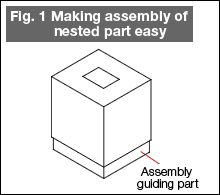
Fig. 1 Making assembly of nested part easy

Fig. 2 shows a countermeasure for component machining errors. It is very difficult to finish the machining of the hole and the inserted component accurately to their dimensions in the condition after inserting by pressing. A method that can be thought of is that of matching the actual items by first finishing the hole in the plate and then machining the inserted part while matching it with the hole, but this method cannot be said to be an efficient one. Fig. 2 is a design in which the dimensions from the reference surface are taken of both the hole and the inserted part, the remaining parts are finished with somewhat easier accuracy, and the realization of the pressed and inserted state and error adjustment are carried out using spacers. The efficiency of part machining will be increased. As a consequence of that, to some extent, the load on the die assembling department will increase.
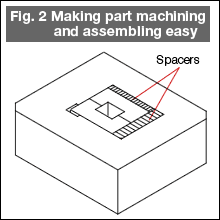
Fig. 2 Making part machining and assembling easy

Fig. 3 shows a technique of removing an inserted part that has been pressed inside. Threads are cut by tapping the hole for the bolt for fixing the inserted part, and at the time of removing the inserted part, a bolt is screwed inside this hole and the bolt is pulled to pull out the inserted part. More concretely, if the fixing bolt of the inserted part is of size M4, its hole diameter will be about 4.3 mm. In that hole, a thread of M5 is tapped inside that hole.
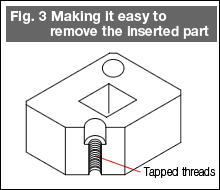
Fig. 3 Making it easy to remove the inserted part

Fig. 4 is a method of fool-proofing so that there is no mistaking the assembling direction of parts. When an assembly requires care to be taken about the direction, some day there will be a mistake in assembling. It is necessary to design so that the assembly can be made only in one direction whoever does the assembling. In a rectangular part, removing the chamfering at any one corner determines the direction of assembling.
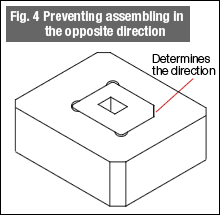
Fig. 4 Preventing assembling in the opposite direction

The above are some of the aspects to be cautions about. There are many other similar aspects. Take care to attempt to design the parts paying attention to all such aspects.
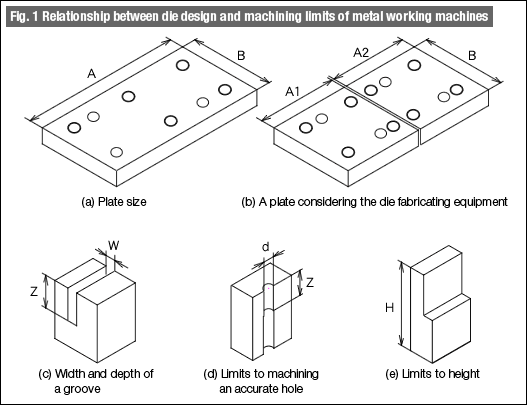
The size of the dies becomes apparent when the process design of product machining is completed. In general, dies are planned to be fabricated from a single plate as shown in Fig. 1(a). Although there are no problems if the dimensions A and B shown in Fig. 1(a) are within the machining limits of the machining equipment, if the design is made without paying attention, there will be problems that the dimensions exceed the limits of the machining equipment. In the machining of plates, it is possible to think of the involvement of various types of machines such as milling machines for rough machining, surface grinders for surface machining, milling machines or machining centers for machining holes, and wire discharge cutting machines, etc. Each of these machines has its own maximum working dimensions, or maximum load weight limits. Designing so that the size or weight of the plates constituting the dies are within the limiting ranges of the metal working machines makes it possible to fabricate dies that are easy to fabricate and maintain. If the maximum dimensions of the plate are determined, it is possible to carry out a design considering the position of division in the process design stage, and it becomes possible to fabricate dies that are well balanced as shown in fig. 1(b).

It is also necessary to pay attention to detailed and minute aspects. For example, in the case of a block component, when a groove such as the one shown in Fig. 1(c) is required, if machining using an end mill or a grinder is assumed, it is necessary to decide paying attention to the tools or the grinding wheel, etc. Similarly, there are also situations such as those shown in Fig. 1(d) and Fig. 1(e). In the case of the hole machining in Fig. 1 (d), if an accurate hole is required, the limit for the dimension Z is considered to be three times the dimension d in terms of economy. Awareness of such machining limits requires the knowledge of the economically required accuracy. It is important to machine the components safely.

Fig. 1 Relationship between die design and machining limits of metal working machines

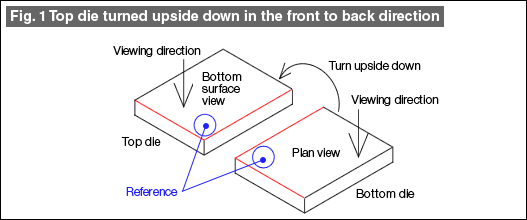
When expressing dies, the bottom die is expressed in the state in which it is viewed from above. This is the plan view in the drawing methods. The top die is very frequently expressed in the state in which it has been removed from the bottom die, turned upside down, and is viewed from above. This becomes the plan view in drawing methods. There are several methods of expressing the top die.

Fig. 1 is the method of expression when the top die is turned upside down in the front to back direction. This figure has been expressed using the double surface reference method. Although the dimensions do not change along the X-axis, the dimensions along the Y-axis are reversed from front to back. In the case of dies for successive feeding, this state can be said to be easy to understand because it matches with the movement of the material.

Fig. 1 Top die turned upside down in the front to back direction

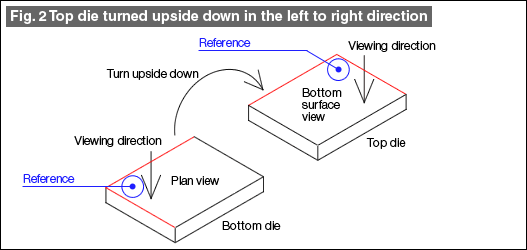
Fig. 2 is the method of expression when the top die is turned upside down in the left to right direction. Although the dimensions do not change along the Y-axis, the dimensions along the X-axis are symmetrical in the left - right manner. In the case of dies for successive feeding, it can be said that the relationship between the top die and the bottom die is difficult to understand.

Fig. 2 Top die turned upside down in the left to right direction

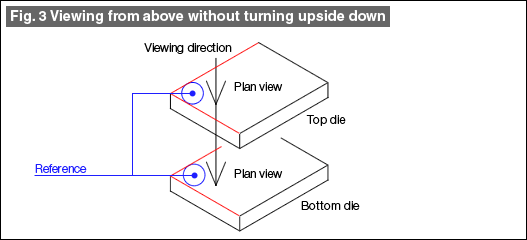
Since the dies are shown in the opened state in the methods of expressing in Fig. 1 and Fig. 2, they are in the same state as an actual die, and can be said to be a view that makes it easy to understand the inside of the dies. However, at the time of machining the plates, there is a difference between the plan view state and the bottom surface view, and care will have to be taken while machining the plates. A method of expressing considering this aspect is the one shown in Fig. 3. This is a method that makes machining of the plates easy. The method of expressing the top die makes it difficult to understand the structure of the dies.

Fig. 3 Viewing from above without turning upside down

The method of expressing the top die changes because of the differences in the method of expressing the top die. When only the plate drawing has been sent to the machining site, if the machining is done without being aware of this difference, the prepared plates will not be usable. Unify the method of expressing the top die so that there are no mistakes in machining the plates.

A reference is necessary for machining any item. Making the reference vague makes machining difficult, and the desired product may not be obtained. In the case of plates for constructing press dies, there are several methods of selecting the reference.
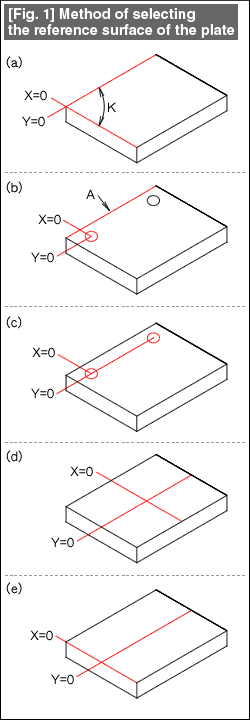
Although each of these methods has its own features, unless there is a unified reference, there will be a lot of confusion in the machine shop, and sometimes this can cause problems in assembling the dies. The types of machining references are shown in Fig. 1. Their features are described below.

Fig. 1(a): Double surface reference. This is the method in which a line parallel to the plate and a perpendicular line are obtained, and the machining is carried out taking the point of intersection between these two lines as the origin. When this origin is used, it is necessary to carry out surface grinding of the plate at two reference planes and to obtain a right angle between them, and the accuracy of these affects the machining accuracy of the plate.
At present, the machining of holes in the plate is done by determining the center by reading the graduations in the machine, and then machining the hole, but previously, marking was done taking two surfaces as the reference thereby obtaining the center of the hole, making a center mark using a center punch, and then machining the hole. The accuracy of the right angle between the two surfaces was reflected as it is in the hole position.

Fig. 1(b): Single surface-hole reference. A parallel line is obtained using one surface of the plate, and the machining is done taking the center of a hole as the reference. This method eliminates the tediousness of obtaining the right angle in the case of double surface reference. This is the method of selecting the reference which assumes that the machining is done after determining the positions of all the holes to be machined in the plate by the table movement of the machining center. Grinding is necessary on the surfaces used for obtaining parallelism. Sometimes, grinding is done on only two end surfaces.

Fig. 1 Method of selecting the reference surface of the plate

Fig. 1(c): Two hole reference. The lines parallel to the plate are obtained using two holes, and the machining is done taking the center of one hole as the origin. It does not matter what the shape of the peripheral surface of the plate is. For example, it can also be a cut surface as it is.

Fig. 1(d): Double centerline reference. There are two methods of using this reference. In the method of obtaining the coordinates position by marking, obtaining right angles between the four surfaces of the plate is necessary. A short line is marked at a position thought to be the center of the plate. Next, the same thing is done on the reverse surface by turning the plate upside down (this is called "flipping" in workshop jargon). As a result, if the two short marking lines match, that point becomes the center, and if they do not match, the operation is repeated aiming at the center of the shift between the two lines. Finally, the center is obtained. The reference positions of the X- and Y-axes are obtained by repeating this after rotating by 90°, and machining the hole is done by obtaining the position of the hole taking the point of intersection between the two as the origin. In this method, the errors in the width and length of the plate are distributed between the ends of the plate.
In the other method, a right angle is obtained between two surfaces, and the X- and Y-axes are determined by shifting the coordinates to a position considered to be the center (1/2 of the nominal dimensions), and machining is done taking the point of intersection between the X- and Y-axes as the origin.
This method of selecting the reference is used frequently in single-step type fabrication.

Fig. 1(e): One surface and centerline reference. The method of obtaining the center of the Y-axis is the same as that in the two centerline reference method. The end surface is taken as the reference for the X-axis. In the successive feeding type, the material is machined by placing it at the center of the plate. This method of selecting the reference is being used because it is easy to get used to, since the method of placing the material and the shift of machining matches with the shift of dimensions in the direction of the X-axis.

About this Archive

This page is an archive of entries from October 2011 listed from newest to oldest.

September 2011 is the previous archive.

November 2011 is the next archive.

Find recent content on the main index or look in the archives to find all content.