The die materials used for the main parts of medium-sized and large-sized dies are described here.
Although there are several types of die structures, explanations are given here are based on the widely used movable stripper structure. The plate configuration of the die shown in Fig. 1 shows the largest configuration of a movable stripper structure.
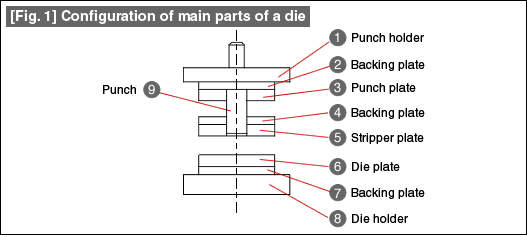
(1) Holder SS400, S50C (S55C), FC250, SKS3, and A7075
The punch and die holder are not only for fixing the die to the press machine but also for supporting the rigidity of the die. They also have the role of adjusting the die height and providing the space for springs, etc.
Usually, the materials used are SS400 or S50C. There is no big difference between the two. Among cast iron types, FC250 is used. This is the material used when cast iron die sets are used. When high rigidity is required for purposes such as high volume production, etc., SKS3 is used after heat treatment (to a hardness of about 56 HRC). When low weight is required, the aluminum alloy A7075 may be used.
(2) Backing plate SK3, SK5, SKS3, and S50C
Backing plates are used at three locations in a die. They are used for the purpose of backing up so as to prevent components such as small diameter punches, etc., from getting too deep inside the holder due to the force of press operation. Apart from that, backing plates are used for preventing the parts from getting detached (stripper backing plate) and for adjusting the height of the die.
For backing up, an SK material is used after heat treatment (to a hardness of about 56 HRC). The SKS material is used when high rigidity is required. Materials such as S50C, which is used without heat treatment, is used for backing up or preventing the detachment of parts such as a large-sized punch with a large pressure receiving area, or for adjusting the height.
(3) Punch plate SS400, S50C (S55C), SKS3, SKD11, pre-hardened steel
A punch plate is used for the purpose of holding a small punch. Usually, SS400, S50C, etc. are used without heat treatment. In the case of dies for high volume production, pre-hardened steel having a certain amount of hardness, or heat treated SKS3 or SKD11 may also be used. The SK material is rarely used. When the machining tolerance of SKS3 is of concern, the material SKD11 may also be used which is a decision based on the wire cutting characteristics.
(4) Stripper plate S50C, pre-hardened steel, SKS3, SKD11
While the main function of a stripper is to remove scrap, very frequently it is made to have important secondary functions of pressing the material or guiding the tip of the punch (punch guide).
When removing scrap in small volume production is important, materials such as S50C or pre-hardened steel are used which do not require heat treatment. When materials without heat treatment are used, although they are made to have the functions of pressing the material and guiding the punch, the plate may get deformed when there is wrong punching. When a punch guide or a material pressing member is added, a material such as SKS3 or SKD11 is used after heat treatment.
(5) Die plate SK materials, SKS3, SKD11
SK materials or SKS3 is used in dies for small volume production. The standard material used is SKD11. This trend has become established because preparation of dies using electric discharge wire cutting machines has become widespread.
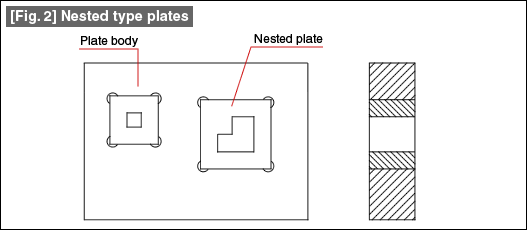
(6) Nested plates (see Fig. 2)
The descriptions given above assume single type plates. In dies, nested type (insert type) plates are used very often. Such plates are used for stripper plates or die plates. In the case of small volume production, materials such as S50C without heat treatment are sometimes used for the main plate. For medium or higher volume production, materials such as SKS3 or SKD11 are used after heat treatment.
The materials SKD11, SKH51, pre-hardened steel, and cemented carbide, etc. are used as the materials for nested plates. The selection of the material is based on ease of maintenance, accuracy, and operating life.
(7) Punch
The materials used for punches are SKS3, SKD11, SKH51, powdered high speed tool steel, cemented carbide, etc.
The standard material used is SKD11. SKS3 is sometimes used in the case of small volume production. SKH51 is used when the size is small, or when toughness is required. Powdered high speed tool steel or cemented carbide are used when wear resistance is required or for large volume production.
![[Fig. 1] Integrated cast structure (molded type)](http://www.misumi-techcentral.com/tt/en/press/images/091_01.gif "[Fig. 1] Integrated cast structure (molded type)")
![[Fig. 2] Integrated cast structure (trimming and piercing type)](http://www.misumi-techcentral.com/tt/en/press/images/091_02.gif "[Fig. 2] Integrated cast structure (trimming and piercing type)")

