March 2013 Archives

In the case of a product with a number of holes as shown in Fig. 1, there are problems such as that the die gets damaged if it is prepared in one shot. In such cases, the hole punching is done in several steps, and the precautions in such situations are explained below.
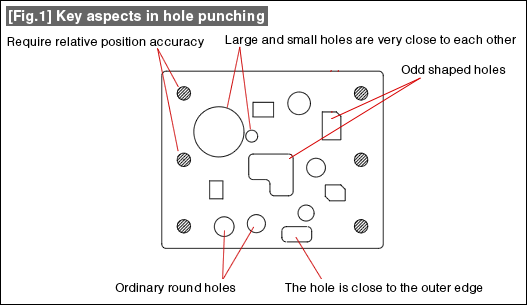
Fig. 1

When separating the holes for punching,

1. Punch similar (shape, accuracy, etc.) holes simultaneously.
2. Combine while considering the strength of the die (proximity, etc.)
3. Combine while considering the deformation during hole punching.

In concrete terms, the holes requiring relative position accuracy are punched as a single group. If they are punched in different groups, the relative position accuracy fluctuates.
Put similar shaped holes in the same group. Put all round holes in one group, all angular holes in one group. This is for making it easy to prepare the die.
In the case of holes that are close to the outer edge, the outer shape can get deformed due to hole punching. If a large hole and a small hole that are close to each other are punched simultaneously, there is the problem that burrs can get generated easily in the small hole due to the effect of vibrations, etc., of the large hole.
When punching holes in several steps, the holes requiring accuracy and the holes that are strict against deformations should be punching in the later steps.
#150 Design of Hole Punching Dies (10) Design of a Die Set for Hole Punching

The die sets used for hole punching (perforating or piercing) are explained below.

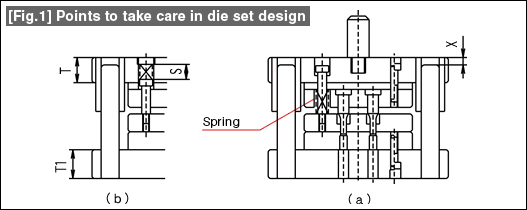
The parts that need to be taken care in die sets are shown in Fig. 1.

Fig. 1

Regarding the size (area), it is common to select a standard die set matching with the size, etc. of the die plate.
When fabricating an original die set, the size will be equal to the plate size plus the area required for mounting the guide post. In order to reduce the weight of the die, some unnecessary parts are scraped off. If there is no particular problem with the outer periphery, it can be left as it is when cut.
The thickness (T) of the punch holder and the thickness (T1) of the die holder are determined considering the size of the plate. The lower limit can be about 30 mm.
Care should be taken about the punch holder since there is also the relationship with the spring.
Care should be taken about the relationship between the length of the guide post and the die height (shown by X in Fig. 1), particularly in the case of a structure in which the die height becomes lower after regrinding.

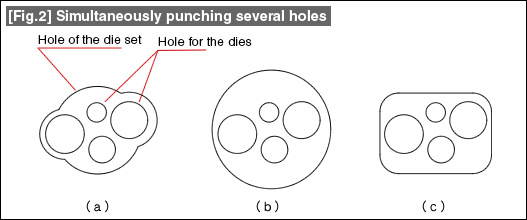
Fig. 2 shows the scrap dropping hole of a die holder. Several holes are punched simultaneously.
The machining of the die holder is made easy. The aim is to prevent clogging of the scrap. When there are several scrap dropping holes, as far as possible the design is made so that they can be machined using the same tool (end mill, etc.).
Considering the strength of the die plate, care should be taken so that a too large scrap dropping hole is not made.

Fig. 2

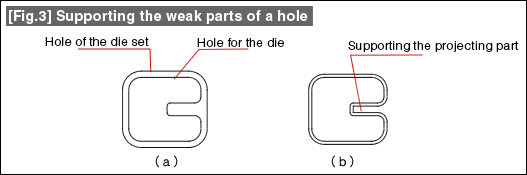
In the case of hole having a projecting part as shown in Fig. 3, the projecting part can easily get damaged if designed as in Fig. 3(a). Even if it is cumbersome, design the scrap removing hole so that the part below the projection is supported. It does not matter even if the receiving part becomes thin.

Fig. 3

#149 Design of Hole Punching Dies (9) Design of the Backing Plate

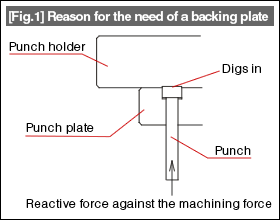
A force equivalent to the machining force acting on the punch is also generated on its back face. This force is received from the face of the punch holder, etc.

In the case of a punch with a small cross-section, as shown in Fig. 1, this force cannot be received sufficiently by the surface of the holder and the punch may dig in to the plate.
In the case of a punch with a small cross-section, as shown in Fig. 1, this force cannot be received sufficiently by the surface of the holder and the punch may dig in to the plate. In the case of a punch holder material such as S50C that is used without heat treatment, as a guide, when the average surface pressure on the back face of the punch (the load per unit area when the force is considered to be received by uniformly distributing the machining force over the surface of the punch flange) becomes more than 16Kg/mm2, the punch is likely to dig into the punch holder.
Fig. 1

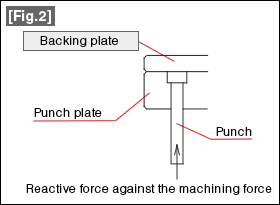
When the average surface pressure becomes close to or exceeds this value, a heat treated plate (about 56HRC) is placed at the back of the punch.
Such a plate is called a backing plate. It also called a back-up plate (this may be correct), a back plate, backing, etc.
Although we explained a backing plate taking the example of a punch, when an insert type structure is used for the die or stripper, very often there are insert components having small cross-sections. Similar to the backing plate of a punch, it is safer to use a backing plate for these also.
Fig. 2

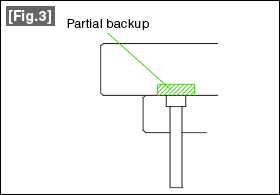
Although the common method of using a backing plate is to put a plate with the same size as other plates, it may be wasteful to put a plate over the entire area in the case of a large die or when there are only very small numbers of thin punches. In such situations, as shown in Fig. 3, the plate is put only for the required part.
In such cases, although a small backing plate is put in a pocket hole, it is good to make their top surfaces all in the same plane taking care about undulations and to design them to be on the thicker side since thin plates can break easily.
Although slightly different from the originally intended purpose, sometimes the height of the die is adjusted by adjusting the thickness of the backing plate.
Fig.3

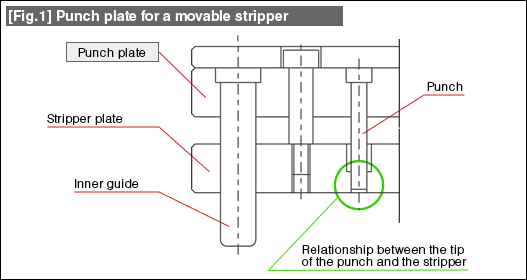
Some care should be taken about the design of a punch plate with the movable stripper structure.
It is a relationship with the stripper plate. See Fig. 1.

Fig.1

This is the relationship between the tip of the punch and the stripper. There is a difference between when the tip of the punch is made the guide of the stripper plate and when it is not made the guide.
When the punch is not made the guide, it is necessary to acquire the position and verticality of the punch using the punch plate. The design of the punch plate can be considered to be the same as that of a fixed stripper structure.
The following precautions will have to be taken when the punch is to be made the guide.
When the punch is lightly press-fitted into the punch plate and the tip of the punch is guided by the stripper plate, when there are several punches such as during hole punching, the problem is whether or not it is possible to create their relationships correctly.
In case that there is any error in the relationships between their coordinates, a punch may not be directly above its hole in the stripper plate. This is determined by the relationship between the diameter of the hole in the stripper plate and the punch diameter.
When any problem is likely to occur, make the hole in the stripper plate slightly larger than the punch so as to allow for the error.
By doing this, the assembling reference of the punch changes from the punch plate to the stripper plate.

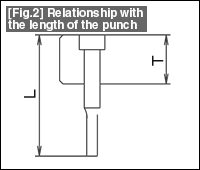
Fig. 2 shows the relationship between the length of the punch and the thickness of the punch plate.
In the case of the movable stripper structure, a guide for the thickness (T) of the punch plate is about 30% of the punch length (L).
Fig.2

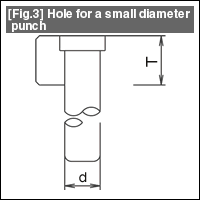
Fig. 3 shows the precaution about small diameter punches. The drilling of the hole becomes difficult when the diameter (d) of the hole to be drilled in the punch plate becomes less than 1/3 of the punch plate thickness (T).
In such cases, the depth (S) of the hole is made about twice the punch diameter (d).
Fig.3

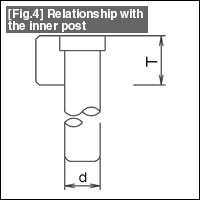
Fig. 4 shows the relationship between the diameter (d) of the inner post (stripper guide pin) and the thickness (T) of the punch plate. Here, d is made less than or equal to T. Fig.4

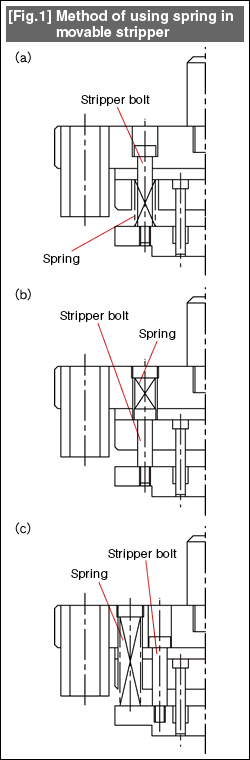
A movable stripper is held by a stripper bolt and a spring. Its movements are restrained by the stripper bolt, and a pressing force is generated by the spring.

The figure shows a typical method of using a spring and a stripper bolt.

Fig. 1(a) is a structure in which the spring is set between the stripper plate and the backing plate. This is used frequently when a moderate amount of deflection is to be obtained.
The spring is compressed by tightening the stripper bolt. There is a disadvantage that, to do this, unless the stripper bolts are tightened by small amounts alternatingly, the tightening of the stripper bolt becomes hard.
It is also difficult to mate the die and the punch because the spring is present in between.
The strength of the spring can be adjusted by placing a washer, etc.

This is used frequently in blanking, etc., wherein it is sufficient to have a small amount of stripper movement.
Since the spring is assembled after tightening the stripper bolt, it is not necessary to tighten the stripper bolts by small amounts alternatingly as described above (it is necessary to tighten them alternatingly, though).
The strength of the spring is adjusted by the amount of tightening the press screw (screw plug).

Fig. 1(c) is a method used when a long stroke is required. Since the spring and the stripper bolts are placed separately, the number of steps in the manufacturing of the die becomes large.
Using this method is very rare in the dies for blanking including hole blanking.
The adjustment of the strength of the spring is done by tightening the screw plug.

See Lesson No.58 "Coil springs (1)" and Lesson No.59 "Coil springs (2)" for information about the design of the spring.
Fig.1

About this Archive

This page is an archive of entries from March 2013 listed from newest to oldest.

February 2013 is the previous archive.

April 2013 is the next archive.

Find recent content on the main index or look in the archives to find all content.