May 2011 Archives

Pilots are used for the purpose of correcting to the proper state the material position before carrying out the press operation (see also, Pilot (1) of No. 95). In general, as is shown in Fig. 1, the pilot is pushed inside the hole thereby correct the shift. At that time, the amount of shift between the center of the pilot and the center of the hole is called the correction amount. The correction amount is proportional to the material thickness and the pilot diameter. The minimum actual dimension of the pilot diameter is about 1mm diameter.
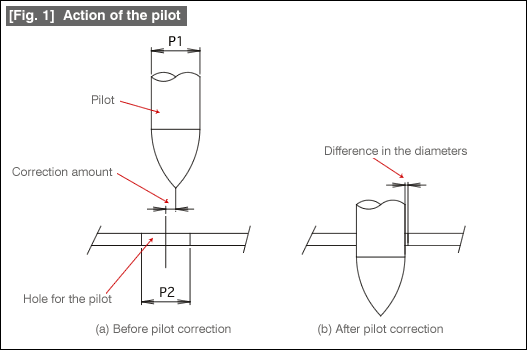
Fig. 1 Action of the pilot

The pilot diameter and the hole should not be of the same dimensions. This is because if they are the same, the pilot will pull up the material after piloting it to the correct position. In general, (see Fig. 1(a)) the pilot diameter (P1) is made at least 0.01mm smaller than the hole diameter (P2). When the plate thickness of the material is about 1mm, the diameter is made about 0.02 to 0.04mm smaller. This difference in the diameters becomes the positioning accuracy. As shown in Fig. 1(b), the pilot will be in a condition in which it butts against the hole and will never be at the center of the hole, and the difference in the diameters appears as a shift. This becomes the limiting accuracy of the product. However, it is very rare that only one pilot is used and since many pilots are used, these pilots interfere with each other and the error will be smaller than when one pilot is considered. However, if the number of pilots is made too large, due to the effect of the mold machining errors, etc., the material pulling up becomes frequency thereby causing problems.

The details related to material positioning are shown in Fig. 2.
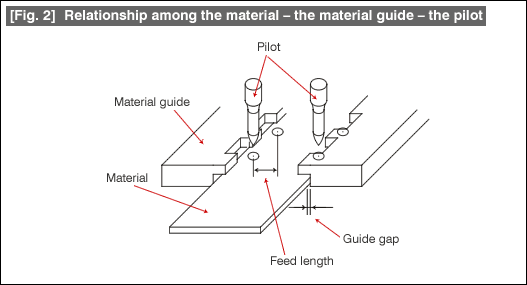
Fig. 2 Relationship among the material - the material guide - the pilot

The material is initially guided by the material guide. At this time, the relationship between the material guide and the material, that is, the guide gap is determined predicting the width tolerance, the sideward bending, etc., of the material. Even in the worst condition, it is ensured that the material passes through inside the guide. The guide accuracy at this time cannot be said to be in a state in which the product accuracy can be satisfied.

The feed length is set to the prescribed length in the feeding device, and the material is fed accordingly. The fluctuations in the feed length at this time are mainly the accuracy of the feeding device, and these fluctuations need not be within the product accuracy.

The role of the pilot is to correct the material which is in such a state to a state in which the product accuracy can be satisfied.

The material guide is a primary guide that supports the material within the range of the correction amount of the pilot, and thereafter the pilot takes over and can also be called a secondary guide for satisfying the product accuracy.
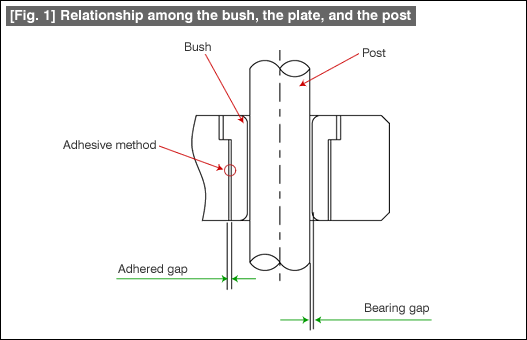
When using stripper guide bushes, it is necessary to take care about the two gaps shown in Fig. 1. These are the gap between the post and the bush (the bearing gap) and the gap between the bush and the plate (the adhered gap).

Fig. 1 Relationship among the bush, the plate, and the post

The bearing gap changed basically based on the viscosity of the lubricating oil, or on whether it is a no oil lubrication type. When used over a long time, this gap becomes wider due to wear. Periodic replacement is necessary in order to maintain the accuracy. This gap directly affects the accuracy of the relationship between the top mold and the bottom mold. In the blanking of thin plate materials, this means that this directly affects the blanking clearance. If this gap is made unduly small, it can cause fusing problems.

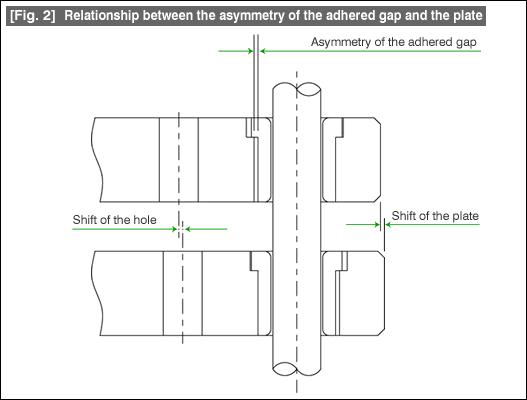
The adhered gap is very frequently determined by the characteristics of the adhesive material used. In an adhered type bush, very often the assembly is made taking the post as the reference. The assembled condition is as shown in Fig. 2.

Fig. 2 Relationship between the asymmetry of the adhered gap and the plate

It is not certain that the adhered gap is uniform with respect to the bush. It is very common that the gap is large in some places and small in other places. Therefore, there will be shifts between two plates. Since the shift is also linked to the holes in the plates, there will even be a shift in the relationship hole of the two plates. When a penetrating part (a punch, etc.,) enters this hole, it cannot maintain verticality and gets pushed to one side, thereby making the mold accuracy and life poor. Care should be taken about the relationship between the mold parts and the plate hole and the relationship with the estimated amount of shift of adhered gap with the blanking clearance, etc., and it is necessary to take measures regarding the method of assembling the bush and the mold.

Although extremely good results can be obtained when used correctly, the structure of the inner guide can get damaged when used wrongly. A major part of the problem is that of gap management. This point should be understood well, and techniques should be used in the method of use that match with the punch and die accuracy.

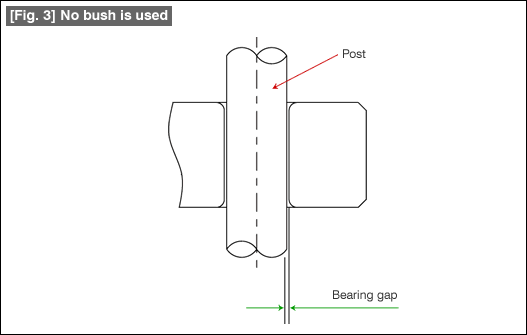
When the production volume is small but accuracy is needed, the technique shown in Fig. 3 is also used in the punches and dies.

Fig. 3 No bush is used

Although this decreases the cost, it decreases the number of gaps to be managed by one, and it can be used to aim at increasing the mold accuracy.

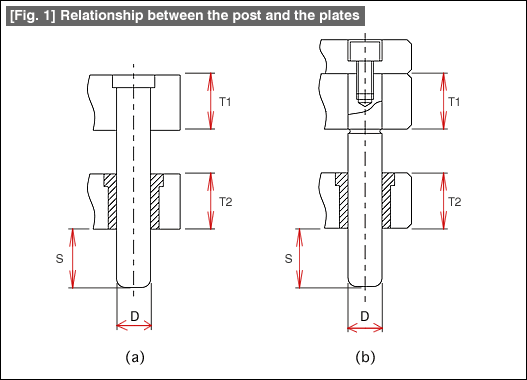
By the stripper guide post penetrating through the plates, the mutual relationship between the plates is restricted, and hence the relationship is maintained. It is desirable that the maintained relationship does not change even when the punch and die set is operating, and is maintained in the initial state. Because of this, it is necessary to take care about the relationship between the plates and the guide post. Their dimensional relationship is shown in Fig. 1.

Fig. 1 Relationship between the post and the plates

While (a) is a flange stopping type post and (b) is a screw type post, both are the same. In the relationship between the post and the plates, the minimum value of the plate thicknesses (T1 and T2) relative to the post diameter (D) is that they are equal (D = T), and usually the plate is made thicker than the post diameter. Although the maximum thickness is about 3 times the diameter of the post, usually the plates are not made this thick. The figure of "3 times" is a guideline so that it is possible to drill the hole economically and accurately. The relationship between the hole diameter and the depth is not only a problem with guide posts, but is the same with the holes for knock pins (dowel pins), etc. Deep holes requiring accuracy become harder to drill and are not good. There is also not much meaning in terms of accuracy.

One other problem is that of by how much is the tip of the post to be made longer than the plate. Usually, the post enters inside the hole in the die plate, thereby creating the relationship between the top mold and the bottom mold. At this time, the question is how deep should the post enter in order to maintain accuracy. Although there are some dies in which the post has been made quite small because the post can easily bite into the hole, this can be a method of use that ruins the function of the inner guide. It is good if the length of protrusion from the plate is as long as possible, and a guideline for this length is about 1.5 to 2 times the diameter of the post. In the case of a press machine with a short stroke length, it is good to make the length long enough so that the inner guide does not come out of the die plate even at the top dead point of the press machine. The purpose of making this long is to make it strong against eccentric loads. The above discussion is given assuming that there are four posts, and the effect becomes still higher when the number of posts is increased to, say, six or eight posts.

About this Archive

This page is an archive of entries from May 2011 listed from newest to oldest.

April 2011 is the previous archive.

June 2011 is the next archive.

Find recent content on the main index or look in the archives to find all content.