June 2011 Archives

Machining forces act on the punches and dies (tools) used in press molds. These machining forces are very close to shocks. Let us now consider the punch and die materials and shock.

(1)Toughness

Tools are expected to maintain their shapes for a very long time so that a large production can be made. This is that "the tool does not wear out and maintains the initial shape for a long time". Hardness has an important role in the wear of the tool.
When the properties of the material are considered, "hard" gives one the image that it resists wear, and "brittle" gives one the image that the material does not get deformed when a force acts on it but it just crumbles.
Also, "soft" gives us the impression that the material can get worn out easily and that it can extend easily (ductility). This is not a desirable property in a tool.
There is one more property of being difficult to get deformed or broken when subjected to a force. While this property is somewhat difficult to understand, this is described as "being tough". This is called "toughness". According to the glossary in JIS, toughness is described as "the degree of being tenacious and difficult to be broken by shock".
The key to the shock resistance of tool steel is the toughness possessed by the material.

(2) Hardening and annealing

It is not true to say that a material becomes tough when it is made soft, and if thermal refining (hardening and tempering) is done, the material goes into a state of being hard and strong against shock compared to an untreated material. Thermal refining is the operation of carrying out tempering at a relatively high temperature (more than 400C) after hardening. Care should be taken about the difference in the temperature compared to that of ordinary annealing (around 200C), There is something that needs to be paid attention to in tempering. It is temper brittleness. This is the reduction in the strength against shock due to tempering. Temper brittleness appears at some temperatures. It is the "low temperature temper brittleness" that appears around 300C, the "primary temper brittleness" that appears around 500C, and the "secondary temper brittleness" that appears at still higher temperatures.

Steel materials for dies and punches are required to have various properties. To start with, let us understand them.

(1) Wear resistance

According to JIS, wear is described as "the phenomenon of metal surfaces that are moving relative to each other getting worn out due to the surfaces scratching each other or due to metallic adhesion". Wear resistance can be said to be the property in which such a phenomenon is difficult to occur.

(2) Factor affecting wear resistance

1) Effect of hardness

A big factor affecting wear resistance is "hardness". In general, the wear resistance increases as the material becomes harder. The wear resistance shows a big change bordering a Rockwell hardness value of around 40HRC. The amount of wear is larger below 40HRC, and the wear is small above that hardness value. However, it is not correct to assume that making the material hard by tempering it, because it is better that the internal residual stress in the steel material is low in addition to higher hardness of the material. This is the reason why tempering and annealing are done together.

2) Effects of the constituents

One of the main constituents of steel materials is carbon (C). Tempering becomes easy as the amount of carbon increases. If the amount of carbon exceeds 0.6%, the tempered hardness becomes almost constant. Although when the hardness becomes constant, the wear resistance does not become stable at that point, but the wear resistance increases further as the carbon content increases. In addition, the wear resistance increase as the elements such as W, Cr, V, Mo, etc., are added to the steel material.
 The amounts of addition of these constituents increase in the sequence of - carbon tool steel (SK), special tool steel (SKS), and die steel (SKD). Compare the constituents by checking the JIS standards, for example, and then you will know the difference.

3) Effect of the structure of the material

When a steel material is tempered, iron (Fe) and carbon (C) bond together and the material changes into a martensite. This martensite is effective for wear resistance. However, in high carbon steel or high alloy tool steel (SKD, etc.), not all the material is converted into martensite by tempering and annealing, and about 20 to 30% of the material remains as austenite. This residual austenite is not good for wear resistance.
As a method of converting the residual austenite into martensite, there is the sub-zero processing. In sub-zero processing, by cooling the steel material up to -60 to -80C, the residual austenite is converted into martensite.

#081 Method of Using Standard Components (30) Urethane Spring

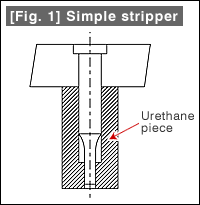
The method of using a urethane spring of providing it on the punch of a simple mold and using it as a substitute for a striper as is shown in Fig. 1 is relatively frequent. Fig. 1 Simple stripper

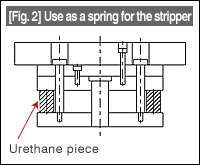
Fig. 2 is the form of using a urethane piece as a spring for the stripper. Fig. 2 Use as a spring for the stripper

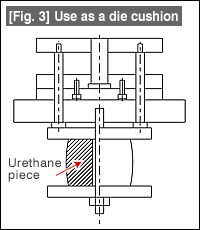
Fig. 3 is a method of use as a die cushion in drawing or bending operations. The urethane pieces used in the above forms are mainly pieces cut from a long round shaped material. Fig. 3 Use as a die cushion

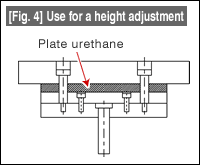
Fig. 4 is a special method of use, and the urethane piece is used by gripping it between the plates. This method of use is adopted when wanting to absorb the variations of the bottom dead point. A plate shaped urethane piece is used in this method. A large amount of compression cannot be obtained. Fig. 4 Use for a height adjustment

Urethane pieces can be classified broadly into two types. One type is that in the state of ordinary rubber (ordinary urethane), and the other is what is called the porous type. Porous type has the shape of a sponge.

When ordinary urethane is compressed and deformed, heat is generated due to internal friction. If this heat is accumulated inside, the pressure characteristics change, and the pressure generated decreases from the initially set pressure. This is a point that has to be paid attention to in using urethane. The amount of heat generated is proportional to the amount of compression (deflection) and the speed of compression. In the case of ordinary urethane, the limit to the deflection is about 20% of the free length of the urethane spring. At this time, the limit to the speed (spm) of the press machine is about 100spm. As the speed (spm) is increased, the amount of deflection of the urethane spring should be made smaller. For example, the limit to the amount of deflection will be about 14% at a press machine speed of 200spm.

When the porous type is compressed, the internal air bubbles get deformed and the spring gets deflected. Since the deformation of the material inside the urethane spring is small, the heat generation is small compared to ordinary urethane, and hence since even the heat accumulation is small, it is possible to increase the amount of deflection. It is possible to increase the amount of deflection to about 35% at 100spm. However, the generated pressure is small compared to ordinary urethane. This type is used when a large deflection is required.

Even when a urethane spring is being used within the specifications, it gets deteriorated and break by developing cracks. It is necessary to replace early.

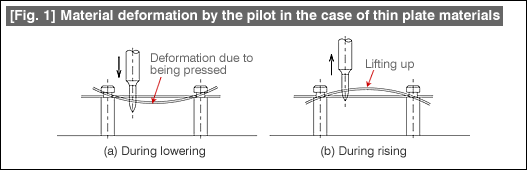
In continuous press operation, the material is lifted slightly up from the die surface and moved. Lifting up the material from the die surface is called "Lift up". The pilot provided in the top mold moves down and inserts the pilot in the material that is in the lifted up state. If the material has sufficient thickness, because of the strength of the material, it is possible for the pilot to enter the material without deforming the material. However, since instability is caused if the positions of the guide lifter and the pilot hole are separated far apart, the positions of the pilot hole and the guide lifter should be as close to each other as possible, thereby making the material deformation small. If the material becomes thin, even if the guide lifter is made to come close, the material gets deformed by being pressed by the pilot as shown in Fig. 1(a). If this happens, since the pilot does not enter into the hole properly, it can lead to wrong punching. Even if it does enter properly, as shown in Fig. 1(b), the material will be lifted up by the pilot during the returning operation after punching, and again this can cause more wrong operations.

Fig. 1 Material deformation by the pilot in the case of thin plate materials

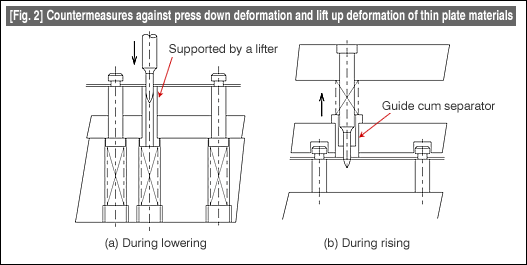
As a basic countermeasure against these problems, the surface of the pilot is polished well and the contact resistance is made low. A fundamental countermeasure is to strengthen the weak parts. A concrete example of this is shown in Fig. 2.

Fig. 2 Countermeasures against press down deformation and lift up deformation of thin plate materials

Fig. 2(a) is a measure of supporting from below due to being pushed down from above. A lifter is also used as a lifting up part. While a normal lifter functions for lifting up, if a hole is provided in the lifter and the tip of the pilot is made to enter in it, it becomes possible to use a lifter below a pilot, and since the material is supported without getting bent, it becomes possible to pilot the material in a stable manner. Such a lifter is called a "lifter with hole below the pilot".

Fig. 2(b) is a measure for preventing the lifting up of the material in the returning process. The pilot guide is placed inside the stripper. This guide is supported by a spring. In a normal pilot, a straight part should be coming out from the stripper surface. While the positioning is done using this part, even the lifting up of the material is done using this part. The pilot guide incorporated into the stripper is made movable (spring supported), and the tip of the guide is lowered to the guide part of the tip of the pilot.

By doing this, it is possible to prevent lifting up of the material. If the guide is lowered to the tip of the pilot, there will be problems at the time that the pilot enters the hole. Therefore, the spring supporting the pilot guide is made extremely weak. If this form is used in combination with the lifter with a hole below the pilot, the result will be perfect.

It is also important to change the surrounding conditions of a pilot to match the conditions of use.

About this Archive

This page is an archive of entries from June 2011 listed from newest to oldest.

May 2011 is the previous archive.

July 2011 is the next archive.

Find recent content on the main index or look in the archives to find all content.