April 2012 Archives

#122 Terminology and Surroundings (16) Names of Different Parts of Bending Shapes

Sometimes it is difficult to refer by names to detailed parts when investigating a product of bending. The names of some parts that are convenient if remembered are given below.

[Fig. 1] shows the names related to the product shape.
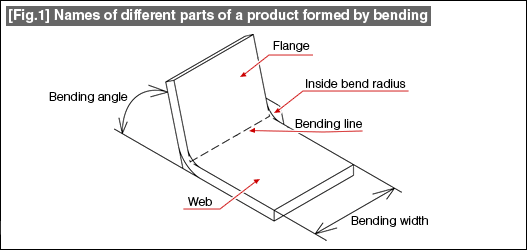
Fig. 1 Names of different parts of a product formed by bending

(1)Web: The shape of the part that is being pressed by a pad during L-bending or U-bending is called a web.
(2)Flange: This is the name for the part that is bent lifted upward. In the case of V-bending of the plate both sides will become flanges.
(3)Inside bend radius: this is the rounding generated on the inside of the bend. There is a minimum value for this since cracks will be generated if this is too small. This is called the minimum inside bend radius.
(4)Bending angle: This is the angle from the web surface. This is not the angle on the side of the bending radius. This bending angle is used while calculating the development.
(5)Bending line: This is the line of intersection between the web surface and the flange surface.
(6)Bending width: This is the width corresponding to the length of the bending line.

[Fig. 2] shows the names of different parts of a bending die.
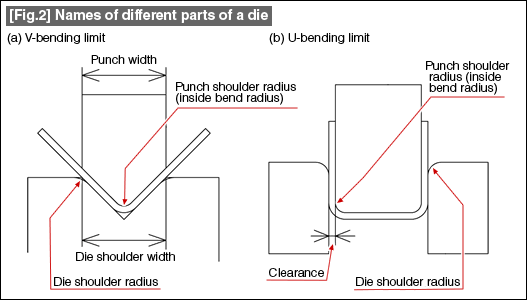
Fig. 2 Names of different parts of a die

In V-bending:

(1)Die shoulder width: The width between the lines of intersection of the V-shaped inclined surfaces and the top surface of the die.
(2)Die shoulder radius: This is the radius of the chamfer provided at the die shoulder. Normally this is made equal to the die shoulder width.
(3)Punch width: This is the width of the punch corresponding to the die shoulder width. Normally this is made equal to the die shoulder width.
(4)Punch shoulder radius: This is the radius of the chamfer provided at the tip of the punch. This will be the same as the inside bend radius of the product.

In U-bending:

(1)Die shoulder radius: This is the radius of the chamfer provided at the die shoulder. Normally, this is made equal to 2 to 4 times the blank plate thickness. The blank is bent while sliding along this surface.
(2)Punch shoulder radius (inside bend radius): This is the radius of the chamfer provided at the tip of the punch.
(3)Clearance: This is the size of the gap on one side between the punch and the die. Normally, this is made equal to the nominal dimensions of the blank plate thickness.

#121 Terminology and Surroundings (15) Economic Speed of Press Forming

A large number of people think that increasing the press forming speed (spm) increases the productivity in press forming operations. This is good if you are calculating the numbers while sitting at a table because the problems that occur are not considered, and the numbers come out fine.

However, there are various problems in actual practice. For example, when forming a connector, increasing the speed caused more frequent damages to springs or stripper bolts. The fluttering of the fed material becomes large, causing more frequent misfeeds into the die, which causes the die to break more frequently. Therefore, there will be such problems that were not present before increasing the speed. Since these problems are caused because the die is not suitable for that spm, they can be of course solved by making improvements.

If the spm is increased ignoring the production quantity, the production will be completed early, and hence the waiting period for the next job increases and there will be more frequent changes in preparations, causing the equipment utilization rate to decrease, and as a result there is also the problem that the productivity has not increased.

In addition, even the cost of peripheral equipment such as the feeding device or the uncoiler, etc. increases, the cost of the equipment including the press machine becomes high, and the cost per unit time increases due to the relationship with the cost of equipment depreciation, the cost reduction obtained by increasing the spm gets cancelled out, and the expected cost reduction may not be achieved.

In press forming, there is a state of good balance among the equipment, die life, and production quantity. This kind of state is called the economic speed of press forming. However, although progress will stop if too much importance is given to this state, but it is also necessary to understand that ignoring this and trying to speed up change can lead to obstructions to production. The economic speed should be found out from the contents of the respective press operations and it is important to aim at carrying out the work efficiently.

In the example of forming connectors, the economic speed is about 600 to 800 spm. The range of the spm value depends on the shape and the number of products per shot. There is no hard and fast rule.

In drawing presses, the speed of drawing the product from the material is limited by the spm of the press machine, and it is not possible to increase the spm profusely. Therefore, in progressive forming, the number of products per shot is increased to increase the productivity. Instead of the appropriate value of three in a row, the number of products per shot is made five or seven in a row. The problems do not increase in proportion to the number of products per shot, but there is a multiplication relationship. If stoppages increase due to increasing the number of products per shot, the effect of having multiple products in a row becomes less. Increasing the number per shot to meet a tight deadline can lead to a production in which several of the rows are to be thrown away. Such increases in the number in a row should be limited.

# 120: Terminology and Surroundings (14) Width of Blanking Bridges

The bridges in blanking are the feed bridge and the edge bridge as shown in [Fig. 1] The minimum values of common bridge widths in blanking operations are shown in [Table 1] The reason why the width of edge bridge is larger compared to feed bridge is the relationship with the material width guide. The material width guide is made slightly wider than the material width so that the material can move smoothly. Although the edge bridge width changes because of this, it is made wider than the feed bridge so that the minimum bridge width is maintained even in the most oblique state.

[Fig. 1] Bridge width

[Table 1] Standard bridge widths in blanking

When the bridge width becomes close to the limit to product formation or becomes so narrow as to exceed that limit as shown in Fig. 2, a constriction or twisting occurs due to the effect of bending or droop caused by a sideward pressure. This effect is large in soft materials. When this phenomenon occurs, the state of the cut cross-section will no longer be normal, and the external appearance of the blank becomes poor. In addition, the wearing out of the punch and die becomes faster speeding up the generation of burrs, and also shortening the maintenance interval of the dies.

[Fig. 2] Limits to the bridge width

However, there are also times when a narrow and long object is to be prepared by blanking. The phenomena described regarding the bridge width in blanking operations occur as they are in such situations. This means that we are expecting contradicting things from the point of view of blanking. The reason is the same phenomena that occur in the bridge width during blanking. It is effective to observe well the phenomena that occur in the bridge width, and to take countermeasures to prevent deformation. As shown in Fig. 3, it is most effective to make the material pressure pad stronger. It is also possible to think of restricting the blanked part in order to prevent slipping. In addition, it is also effective to use a smaller clearance than normal.

[Fig. 3] Restricting narrow blanked parts

Even the bridge width in blanking becomes useful for a different purpose depending on the viewpoint.

#119 Terminology and Surroundings (13) Selection of the Blanking Clearance

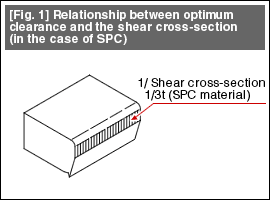
The discussion here assumes a soft steel material (SPC). In general, when blanking is done using an optimum clearance, a shear cross-section of about 30% of the plate thickness appears in the cut cross-section. The optimum clearance is about 6% to 8% of the plate thickness (Fig. 1). Optimum clearance is a condition that results in the best durability of the tool. Some times there are products in the case where we would like to make the length of the shear cross-section in the cut cross-section longer, or the shear droop smaller. In such situations, we adopt what is called the clearance for fine blanking. This clearance becomes smaller and will be about 3% to 5%. Fig. 1 Relationship between optimum clearance and the shear cross-section (in the case of SPC)

The above condition is the situation when blanking a shape having straight lines or gradual curves. At corners where two straight lines meet, even when the blanking is done using optimum clearance, the length of the shear cross-section extends to the entire plate thickness (Fig. 2). Under such conditions, there is the problem that the corner part of the punch wears out fast. If a rounding of 50% or more of the plate thickness is provided at the corner parts, the blanked state will be almost the same as in the straight line parts. When rounding cannot be provided at the corner parts, the clearance is made larger at the corners. This additional clearance is about 50% of the clearance used for the straight line parts (Fig. 3).

[Fig. 2] Shear cross-section of a corner without [Fig. 3] Relationship between a corner without rounding and the clearance

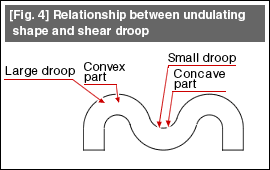
In the case of an undulating shape as shown in Fig. 4, if a uniform clearance is used, the shear droop becomes larger in the convex part and smaller in the concave part. When it is desired to make the shear droop uniform, the clearance is made larger in the convex part and smaller in the concave part, thereby making the resultant shear droop uniform. Fig. 4 Relationship between undulating shape and shear droop

The changes in the shear droop imply that there are changes in the bending moment and lateral force generated at the time of the blanking operation. Twisting and warping become matters of concern when blanking finely varying shapes. By changing the clearance to match the shape, it is possible to make some improvements. A greater effect can be obtained by combining with pressure pads.

About this Archive

This page is an archive of entries from April 2012 listed from newest to oldest.

March 2012 is the previous archive.

May 2012 is the next archive.

Find recent content on the main index or look in the archives to find all content.