July 2013 Archives

In punching operations, the processed material is separated into a part that remains on the die and a part that passes through the die and falls down. Every body will carefully handle the one that falls down if it is the final product, but very often people will handle it carelessly if it is just scrap. This frequently causes problems in making improvements. Fig. 1 shows the relationship between the die and the scrap in an example of hole punching operation. The scrap passes through the die and falls down.
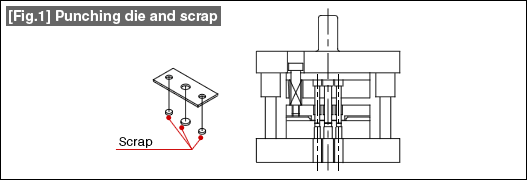
Fig. 1

Fig. 2 shows the bolster plate of the press machine.
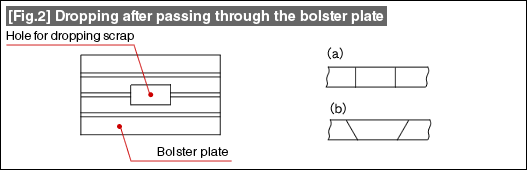
Fig. 2

The bottom die of the die set is fixed to this plate. In case there is no die cushion device in the press machine, a scrap dropping hole is opened as shown in the figure. The scrap or the product passes through here and gets collected in the collecting container. Although a square scrap dropping hole has been shown in the figure, round shaped holes are also used. Although it is convenient if the scrap dropping hole is large because then the scrap can fall easily, the support for the die becomes low and holding the die becomes a problem. In terms of holding the die, it is better that the scrap dropping hole is small. Normally, the scrap dropping hole has the cross-sectional shape shown in Fig. 2 (a). When the area where scrap is generated is large such as in progressive forming, etc., as a measure for dropping scrap while maintaining the strength of the bolster plate, there is the method is shown in Fig. 2 (b) in which the hole is made to have a tapered shape and the recovering area is made wider.

When the press machine is installed with a die cushion, since the die cushion comes at the part where the scrap dropping hole is present, it will not be possible to drop the scrap by passing through the bolster plate. As a result, as shown in Fig. 3, a space for collecting scrap is prepared below the die (collecting the product in some cases). At this time, the plate that is placed below the die is called a "Geta" (in Japanese, meaning wooden clogs) (also called a parallel block, spacer, etc.).
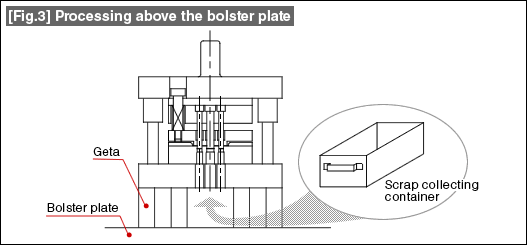
Fig. 3

The Geta has the purpose of supporting the die so that it does not become excessively deformed due to the force of forming, and the purpose of preparing a space for collecting scrap (it is also used for adjusting the die height which is the height of the die with respect to the press machine). The scrap that is collected in this space is processed by scraping out from between the Geta. Although this processing is easy if the scrap has a suitably large size, small scraps of hole punching remain on the bolster plate, and cause damage to the bolster plate or die at the time of replacing the die. Sometimes, such scrap gets dispersed in the surroundings creating a bad environment. Because of this, in operations in which the press operating time is long (production quantity is high), instead of scraping out the scrap, it is also taken out by installing a conveyor or a chute. In the case of small quantity production, there is the method of collecting scrap by preparing a scrap collecting container as shown in the figure. While this has the advantages of it being possible to collect hole punching scrap without the scrap being scattered around, on the other hand, if this is used in large quantity production, there is the danger that work is continued without noticing that the container is full, thereby causing breaking the die.

The methods of processing scrap are not uniform, but will have to be planned considering the relationship between the shape and size of scrap and the production quantity.

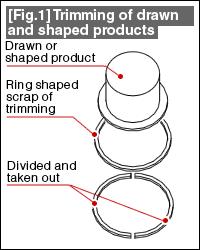
In drawing or shaping, it is common to prepare the shape while shrinking the outer periphery of the blank. Because of this, the flange edge part after forming will have changed from the shape of the original flange edge part and has an irregular shape. For example, if a cylinder is drawn from a circular blank, very often we see that the flange shape after drawing is not a neat circular shape but is a shape closer to a rectangle. The shape of the edge will be far from the edge shape required in the product and hence trimming will be necessary.

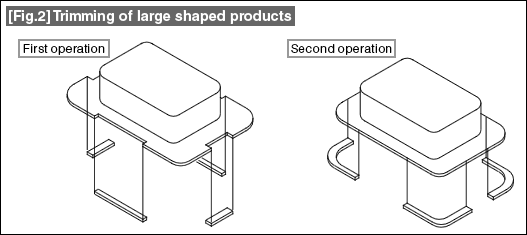
Fig. 1 explains trimming of drawn products. As shown in this figure, the scrap obtained after trimming has the shape of a ring. In this condition, the scrap gets stuck to the punch of the die and cannot be taken out of the die. In order to remove the scrap, it is necessary to divide the scrap into two portions. In the case of small products, the scrap is usually removed by dividing it into two parts. Fig. 1

If the operation is a single step operation (one shot operation), if the scrap is separated from the die, the processing thereafter is not particularly a problem although it is somewhat cumbersome. However, if the shape of the product becomes large or if trimming is to be done in an intermediate process in transfer forming, it is necessary that the removing of the scrap needs to be done without any problems.

If the product becomes large, the scrap will be too large and even if removed from the die by dividing it into two parts, very often the processing thereafter (recovering by sliding above the chute, etc.,) cannot be done well. It is good that the scrap is made into appropriate sizes that make their processing easy. Fig. 2 shows such an example. The size of the scrap is made small using two steps thereby making the processing easy.

Fig. 2

In shaping operations, attention is given strongly (of course, naturally) to the formed shape, and problems can occur if trimming and scrap processing is taken lightly. Care should be taken about these.

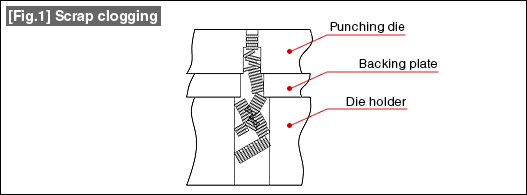
In punching operations, scrap rising and scrap clogging can be said to be a double-sided problem. While dent marks on the product caused by scrap rising is a problem, the problem of punching scrap getting clogged in the die will be as shown in Fig. 1.

Fig. 1

Normally, it is likely considered that each punching scrap passes through the die and falls down individually. However, many scrap pieces stick together in the form of a rod due to burrs or the oil used during punching and fall down as rods with some lengths. At this time, depending on the size of the holes through which the scrap falls, the joined scraps may fall inclined in the hole and get struck or stopped inside the hole thereby causing piling up and clogging of the scraps that fall thereafter. In the worst case, this can break the die. Since this cannot be seen from outside, very often one comes to know about the scrap clogging only after the die has broken.

Most often the cause of scrap clogging is due to continuing to punch in a state that is not normal and to use the die even after it has worn and the burrs have become large thereby leading to scrap clogging. While such use cannot be permitted, let us consider the causes and countermeasures. See Fig. 2.

Fig. 2

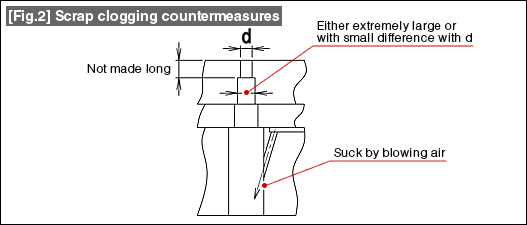
There are some people who think that by making the cutting edge portion of the punching die long it is possible to use the die for a long time even if regrinding is done during maintenance. In such dies, there is the phenomenon of scrap getting fused to the side wall of the die because the scrap rubs against the side wall of the die when it is passing through the die, which results in scrap clogging. It is better that the length of this part is short with a length enough for about 2 or 3 pieces of scrap to get collected.

Relative to the die hole diameter (d), it is said that scrap clogging can occur easily when the diameter of the escape hole below it is about two times d. The countermeasure is to make the diameter of that hole have a small difference with d. Good effect is obtained by making the cross-section of the hole tapered or stepped. On the extreme side, there is also the method of making the hole very large for the scrap to pass through.

It goes without saying that it is better when the side wall of the hole for the scrap to pass through is smooth rather than rough.

There is also the method of sucking out scrap. We frequently see people using a vacuum cleaner for this purpose. There is also the method in which an inclined hole is drilled in the hole for letting scrap pass through and the scrap is sucked out by blowing air through this inclined side hole. This method is also effective against scrap rising. The trick is to make the inclined hole as upright as possible and to make its diameter small. This is because the sucking force increases when the speed of flow of air is increased and not due to the pressure of air.

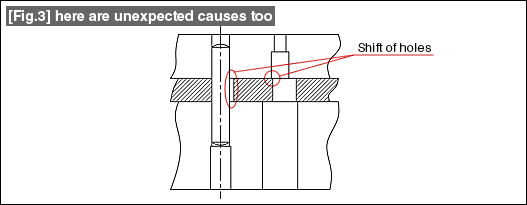
There are also some unexpected causes. Such an example is shown in Fig. 3.

Fig. 3

When a dowel pin (knock pin) is inserted in a part constituted by a die plate, a backing plate, and a die holder as shown in this figure, the hole of the backing plate is often drilled with a slightly larger diameter. When this drill hole gets shifted with respect to the dowel pin, scrap clogging occurs if the scrap passing hole of the punched part becomes as shown in the figure. If this is the cause, it is quite difficult to detect hence taking a long time to implement the correct countermeasures. Care should be taken about such problems.

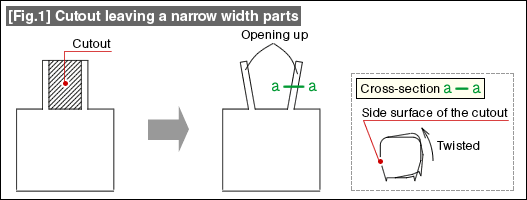
In a punching operation in which a part of the material with a width near the plate thickness remains, since it is difficult in terms of the strength of the die to punch both the left and right sides at the same time, the left and right portions are punched alternately. When this is done, frequently the shape shown in Fig. 1 is obtained.

Fig.1

During a punching operation, the punching force acting in the plate thickness direction, the sideward force trying to push out laterally, and a bending moment are acting on the material.
If the punching width is large, the sideward force is suppressed and there is no effect on the product after forming. If the width becomes narrow, the material bends because it cannot withstand these forces, and the tip opens up in the case of a cutout shape shown in the figure.
In addition, the cross-section gets twisted and the shape gets deformed as the effect of the bending moment during the punching operation as shown in the cross-section a−a.
As a countermeasure for these problems, the punching width is made wide to more than twice the plate thickness.

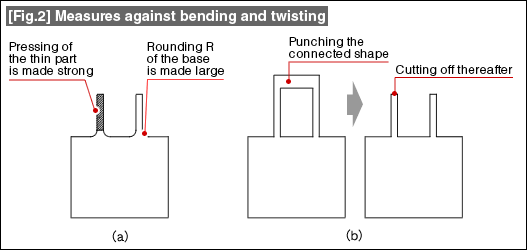
When narrow shapes are necessary, as shown in Fig. 2(a), as large a rounding R as possible is provided at the base of the narrow portions. In addition, another method is punching by making the blank holder strong at the narrow punching part. Caution should be exercised because making the blank holder strong can cause reduction in the plate thickness.
As shown in (b), there is also a method in which punching is done of a shape in which the tips of the thin parts are connected, and then the tip part is cut off.

Fig.2

When punching such shapes, the effect is increased if some of the measures are combined together rather than taking only one measure.

Although it was said above that it is not possible to punch the parts to the right and left of a narrow part at the same time, there is a method of punching simultaneously, but in this case the die structure will be special. Another measure is to change the clearance in different parts.

Increase the limits to punching of such shapes by combining various methods.

About this Archive

This page is an archive of entries from July 2013 listed from newest to oldest.

June 2013 is the previous archive.

Find recent content on the main index or look in the archives to find all content.