November 2010 Archives

#062 Method of Using Standard Components (11) Die Sets

Die sets are used for maintaining correct relationship between the top die and the bottom die as shown in Fig. 1.
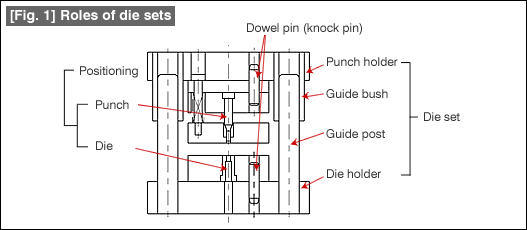
Fig. 1

A die set is a unit component constituted from a punch holder, a die holder, a guide post, and a guide bush.
If we consider the relationship between the punch and the die when the top die is taken to be a punch and the bottom die is taken to be a die, the relationship between the punch and the die is maintained by being conveyed by the dowel pin (knock pin) to the guide of the die set (see Fig. 1).

There are four forms of die sets as shown in Fig. 2.
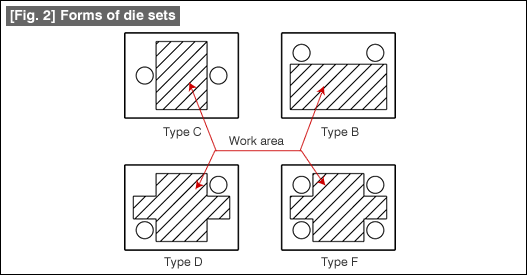
Fig. 2

Type C (center post) is suitable when the center of gravity of the die is at the center, and work can be done at its front and back. This type is used frequently for one shot forming such as blanking, hole punching, bending, etc.
Since the left, right, and front are free in the case of the type B (back post), this is a die set with a structure that is easy to use in one shot operations. In addition, in robot operations, since there is no obstruction to the passage of the feed bar or the arm, etc., this type is used frequently for such dies. The drawback of this is that since heavy parts are supported only on one side, the front tends to droop which can be a problem in terms of accuracy.
Type D (diagonal post) is a structure that is used frequently in automated types such as continuous feeding type dies that are relatively small.
Type F (four posts) offers the highest reliability of the accuracy of dies because the guides are placed on four corners. On the other hand, since the posts can become obstructions, the ease of working is decreased in dies for one shot type production, Therefore, this type can be said to be suitable for continuous feed type dies.

The forms of guides shown in Fig. 3 are the main ones.
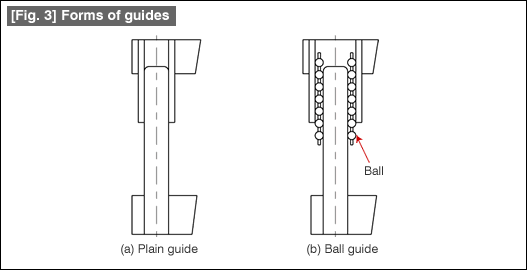
Fig. 3

Although plain guides or ball guides are used in small die sets, mostly ball guides are used in large die sets because of the force required for operation. This trend is due to the desire to make the movements smooth with weak forces.
Plain guides are superior in terms of accuracy. Ball guides are weak against pressure from the side. Recently, roller type guides have also appeared because of the desire to make smooth movements and also to have rigidity.
#061 Method of Using Standard Components (10) Stroke End Block (Height Block)

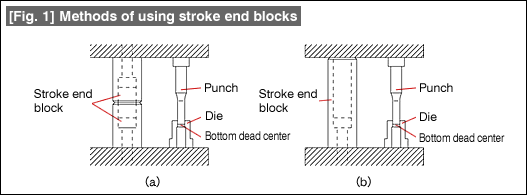
Stroke end blocks are used in forms shown in Figs. 1(a) and (b). The form (a) is used more often.

Fig. 1 Methods of using stroke end blocks

Although a stroke end block is a component for determining the bottom dead center of the die, it is not enough to decide once. Depending on the die, there are structures in which the die height changes due to regrinding. In such dies, it is necessary to adjust again in such situations.
A stroke end block is not used in one shot type dies, but is used very often in continuous feed type dies. The position of placing a stroke end block is very often the die set part on the outside of the plate constituting the die such as the die plate, etc. There is the danger of getting one's finger pinched due to carelessness during adjustment after setting up. This has been considered in the form shown in Fig. 1(b).
Caution about this matter is necessary when using a stroke end block of the form of Fig. 1(a).

The following are the two methods of using stroke end blocks.

1. Method of using for the purpose of determining the bottom dead center during setting up

This is the method of determining the bottom dead center by adjusting using the slide adjuster so that the stroke end block touches lightly.

2. Method of using for the purpose of suppressing fluctuations of the bottom dead center while carrying out press operations

This is the method of using for stabilizing the dynamic accuracy by always making the stroke end block butt after determining the bottom dead center using the slide adjuster. The press machine will be damaged if the butting is weak.

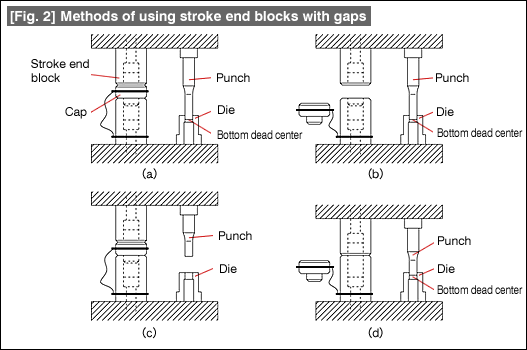
The stroke end block can be of the integral type (shown in Fig. 1) or can be of the type with a gap. Some methods of using the stroke end block with a gap for the purpose described in 1 above are shown in Figs. 2(a) and 2(b).

Fig. 2

Once the setting up is complete, since the role of the stroke end block is finished, so that the fingers are not caught in that part, in this method the cap is removed thereby creating a gap and thus achieving safety.
The methods of using shown in Figs. 2(c) and 2(d) are those in which a cap used to create a gap between the top die and the bottom die during storage, and during use of the dies, a stroke end block is made to butt thereby stabilizing the bottom dead center.

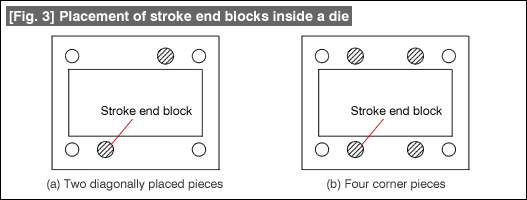
Fig. 3 Placement of stroke end blocks inside a die

Fig. 3

The method of using two pieces as shown in (a) is suitable for only determining the bottom dead center. In a method of use for stabilizing the bottom dead center, it is better to use four pieces as shown in (b).
When using multiple stroke end blocks, as far as possible, the height should be adjusted to be identical by carrying out simultaneous grinding.

#060 Method of Using Standard Components (9) Stock Guide

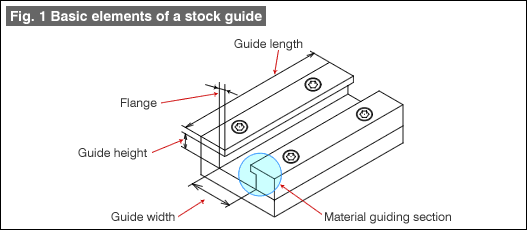
The basic elements of a stock guide ("Material guide unit" in the Misumi standards) are shown in Fig. 1.

Fig. 1

The width part of the guide is the part that keeps pressed the width of the material. This is determined considering the variations (tolerances) in the material width. Another factor is the horizontal bending (camber) of the material. This occurs due to the relationship with the length of the guide. The length of the guide should at least be equal to the width of the material, and if possible it should desirably be nearly twice the width of the material. The expected role of the guide, at the time of inserting the material inside the die for the first time, is to ensure that every time the material can be inserted in the die without clashing in the same state. Whether or not this condition is satisfied is determined by the guide width and the guide length.

The guide height varies depending on the content of press operation of the product. In other words, the amount of lift of the material during product forming determines the guide height. The guide height is determined to match with the amount of lift.

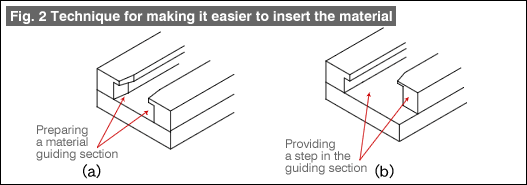
In the state of Fig. 1, it is very difficult for the material to enter the guide. As a countermeasure for this, a material guiding section is provided at the entrance to the guide as shown in Fig. 2.

Fig. 2

The form shown in Fig. 2(a) is an extremely obvious shape of an escape. Although there is no problem when the material width and plate thickness are of an easy-to-handle size, if the material becomes wider or the plate becomes thicker, which is a state referred to commonly that the material is oversized, working becomes difficult with the shape of (a). If a step is provided in the guide as shown in Fig. 2(b), it is possible to place the material first on the bottom plate of the guide and then to insert it in the width of the guide, and hence the work becomes easier.

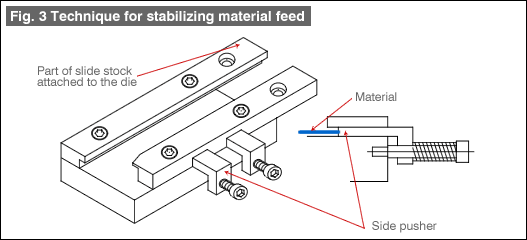
In Fig. 3, using a side pusher (called a "stock guide set" in the Misumi standards), the material is pushed to one side, thereby restricting the material from moving due to the variations within the tolerance of the material width.

Fig. 3 Technique for stabilizing material feed

This method is particularly effective in the case of continuous feed using a single sided carrier. If the material is pushed too strongly, it can obstruct the material feeding operation. In addition, it is also necessary to take measures to reduce the contact resistance of the receiving surface opposite to the side of the material facing the side pusher (such as making it point contact, etc.).

Although very often the stock guide is installed on the die set, the alignment straightness can sometimes be disturbed. By attaching the part for installing to the die with the shape shown in Fig. 3, it is possible to maintain the straightness easily.

About this Archive

This page is an archive of entries from November 2010 listed from newest to oldest.

October 2010 is the previous archive.

December 2010 is the next archive.

Find recent content on the main index or look in the archives to find all content.