August 2012 Archives

#135 Design of Blanking Dies (8) and Design of a Fixed Stripper (2)

In the last lesson, we discussed the required functions for a fixed stripper and explained that they had to be as shown in Fig. 1.
This shape is a basic shape of a fixed stripper, and as is shown in Fig. 1(a), this shape assumes that the blanks are punched in one row with a fixed width of the material.
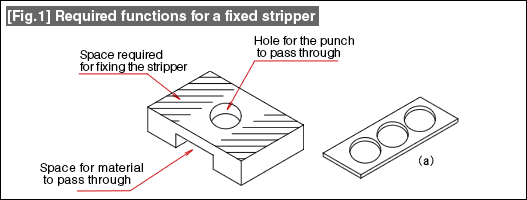
Fig.1

In contrast with this, there are times when the blanks are to be punched in two rows from a wide material as is shown in Fig. 2(b). In such cases, as is shown in Fig. 2(c), the stripper can also be made to have a single-side holding shape.
Although the strength becomes weaker, since the part that is being processed can be seen, there is the advantage that the operations become easy.
The disadvantage of a fixed stripper is that the part that is being processed cannot be seen because the stripper acts as a cap on it, and hence sometimes the operator may complain of uneasiness about the operations.
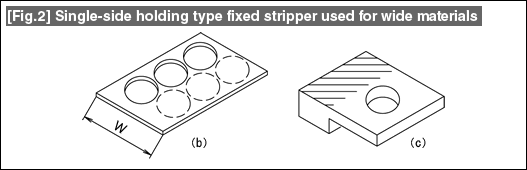
Fig.2

In order to eliminate this disadvantage, as is shown in Fig. 3, sometimes the unnecessary parts are removed thereby making the inside visible.
In the case of a relatively small stripper, there will not be much of a load even if parts of an integral stripper are cut away.
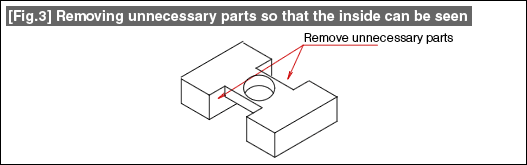
Fig.3

However, if the stripper becomes large, this becomes a problem. In such cases, as is shown in Fig. 4, the stripper is prepared by separating the parts of the stripper functions from the parts creating the space for the material to pass through.
Although the number of parts constituting the die becomes larger, preparing the parts becomes easier.
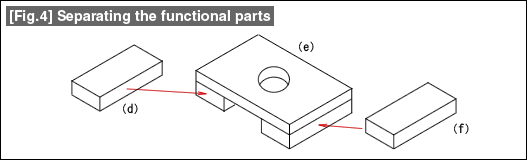
Fig.4

The decision of whether to form the stripper in one unit or in terms of divided parts should be made considering whether making the machining easy or the cost is important.
#134 Design of Blanking Dies (7) Design of Blanking Dies

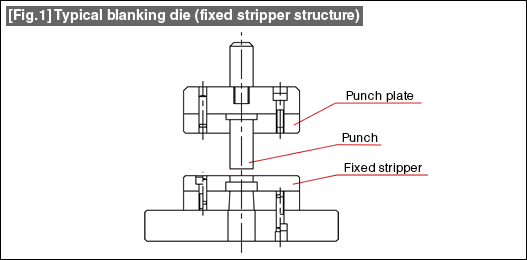
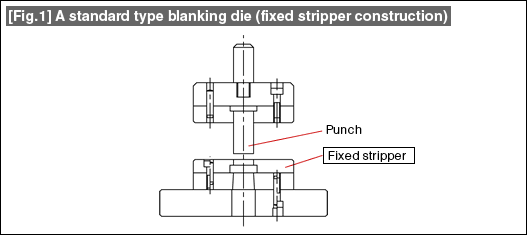
A blanking die of the fixed stripper type is shown in Fig. 1.
In this lesson, we will be looking at the role of the fixed stripper of this construction.

Fig.1

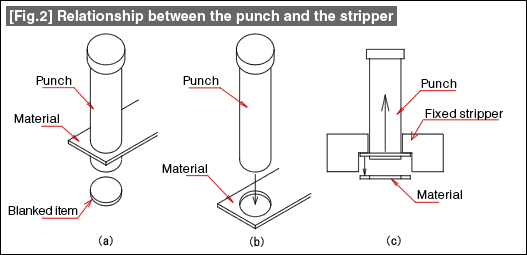
Fig. 2(a) shows the state after the punch has punched through the material. The "blanked item" passes through the die and falls down.
The material in which the punch has penetrated through will be in a state in which it is biting the punch. As is shown in Fig. 2(b), it is necessary for the punch to get detached from the material which is biting it.
Generally, the material would be biting the punch relatively strongly. The strength of this biting is said to be about 5% of the punching force.
It is necessary to remove the punch from the material efficiently. This is done by the stripper.
Fig. 2(c) shows an image of a fixed stripper.
Since it is easy to scrape off the material using a fixed part (stripper) through which the punch passes and since it is efficient, this is used frequently in blanking dies.

Fig.2

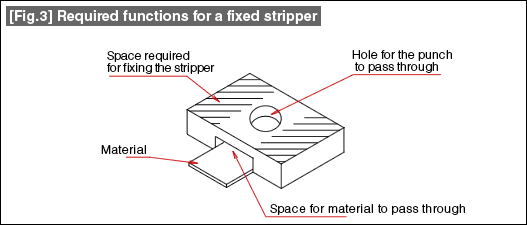
Fig. 3 shows the required functions for a fixed stripper. Firstly, it requires a hole for the punch to pass through. In general, the hole has a size so that the punch can pass through it easily, and it does not require much accuracy.
Below the hole for the punch to pass through, a space is required for the material to pass through. Although it is possible to allow for a large space, it is necessary to restrict the width of the material so as to suppress its sideward wavering thereby making the operations easy, and to determine the space in the up-down direction again so as to make the operations easy.

Fig.3

With the consideration of these points, some changes become necessary. These will be explained in the next lesson.

#133 Design of Blanking Dies (6) Design of Punch Plates

The designing of a punch was described in CourseNo. 129. At that time, it was explained that when the punch becomes small it becomes difficult to hold it independently, and that therefore the method is used of fixing it by embedding it in a plate. This plate that holds the punch is called a punch plate. Fig. 1 shows a typical construction of a fixed stripper type structure using a punch plate.

Fig. 1

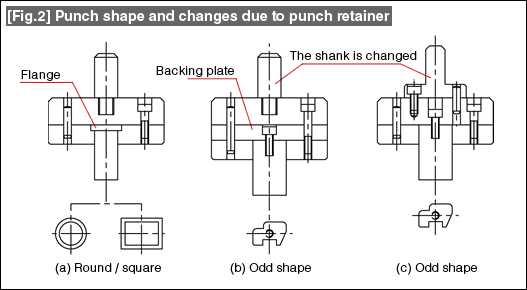
In the fixed stripper structure, the position and the verticality of the punch is provided by the punch plate. In this method, the punch is lightly press-fitted into a hole in the punch plate. Light press-fitting is driving the punch inside the hole by hitting it lightly. Hard press-fitting is not desirable because it causes the punch plate to get warped or deformed. It is also necessary to consider preventing the punch from coming out the hole and dropping off (punch retainer). The details of this in terms of the relationship between the shape of the punch and the punch retainer are shown in Fig. 2.

Fig.2

The method (a) is an example of punches with simple shapes such as round and square. Such punches are very often prevented from falling off by providing a flange in the punch as a punch retainer.
The method (b) is an example of an odd-shaped punch which is formed by electrical discharge wire-cut machining. Threads are cut in the punch and the punch is fixed to the punch plate (backing plate) using a bolt so that the punch is retained.
The method (c) is an example in which the cross-sectional area of the punch is relatively large. When the cross-sectional area of the punch becomes large, the backing plate is eliminated, and the punch is directly fixed to the punch holder. A method of fixing by bolts is shown here for retaining the punch. See the changes in the shank by comparing the figures (b) and (c). This example is shown here as one in which the method of attaching one component also affects other components and changes them.

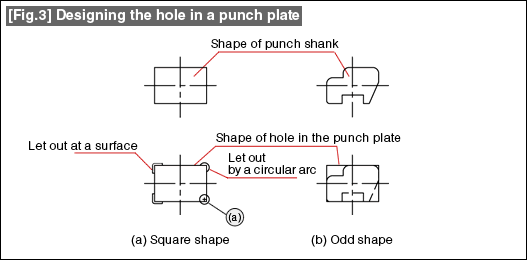
Fig. 3 is an example of designing the hole in a punch plate.

Fig.3

Figure (a) shows an example of a hole for a square shaped shank. The corner parts become problems in the case of a square shape. Although very often the corners get stuck and the punch does not enter the hole, sometimes due to unawareness of it, the plane surface part is widened thereby ruining the punch plate. In order to prevent this, this is an example in which the corner part is let out thereby making the assembling work easy. The part shown in (a) indicates that, when letting a corner out at a circular arc part, it is good to shift the center of the circular arc towards the inside.
Figure (b) is a technique used when driving an odd shaped punch in a hole. There is no need to match the shape of the hole exactly with the shape of the shank, but it is good to design the hole with a simple shape while taking care only about the key parts.

About this Archive

This page is an archive of entries from August 2012 listed from newest to oldest.

July 2012 is the previous archive.

November 2012 is the next archive.

Find recent content on the main index or look in the archives to find all content.