August 2010 Archives

#052 Method of Using Standard Components (1) Method of Using Stripper Bold

There are many types of stripper bolts as is shown in Fig. 1.
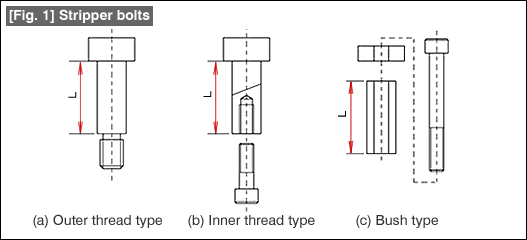
Fig. 1 Stripper bolts

The shapes shown here are the basic shapes, and considering fine applications, the Misumi standard components have been finely subdivided thereby widening the available choice. A stripper bolt retains the part by the length of the shaft (L) and makes the component movable. Because of this method of use, it is also called a hanging bolt, shoulder bolt, etc. Since the method of use of a stripper retention of a die with the movable stripper structure is very well known, the name stripper bolt has come into standard use.

(1) Shaft length (L)

Several stripper bolts are used for a movable stripper. If there are any fluctuations in the shaft length (L) at that time, while the head of a short bolt is contacting the head part seating surface the others will not be contacting, and hence the stripper becomes inclined thereby causing breakage of the stripper bolt. The stripper bolts used for the same part should ideally have small variations in the shaft lengths but are of the same shaft length. This is particularly important in dies for forming thin plates.

(2) Method of using stripper bolts

Figs. 2(a) and 2(b) show the methods of using stripper bolts.
The method of use shown in (a) is good. Although the form in (b) is such that the seating surface is at the bottom of the countersunk surface, it is difficult to machine accurately the Z dimension at the time of forming the countersunk, and hence fluctuations will be present. These fluctuations will have the same effect as when there are fluctuations in the shaft length. Figure (c) shows the precautions when using stripper bolts of the outer thread type. If the chamfering of the tapped part is too large, as is shown in the figure, the end part of the shaft gets into the chamfering part. Further, care should be taken because breakage of the stripper bolt may be caused if the tap for attaching the stripper bolt has been machined with an inclination.
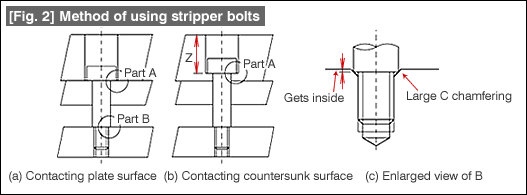
Fig. 2

(3) Special method of use

Depending on the die, sometimes there is no space at the top and at the bottom, but a need for making the amount of stripper movement large. In such situations, the usual method of using stripper bolts is not good. Fig. 3 shows an example of obtaining a long stroke in a narrow space by using in combination with a stroke extending retainer.
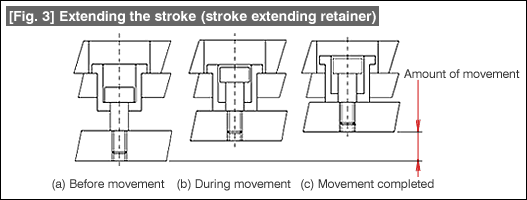
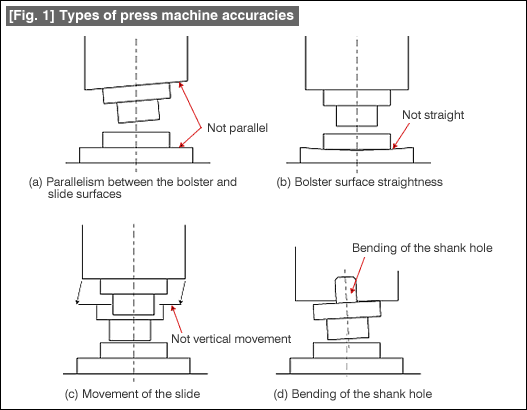
Fig. 3

#051 Relationship Between Press Machine and Die (9) Accuracy of Press Machines

The accuracy of press machines not only has adverse effects on the press formed products, but also shortens the life of the dies. The accuracy of press machines is of two types, namely, static accuracy which is the accuracy in the state in which no load is applied, and the dynamic accuracy which is the accuracy in the condition in which the products are being formed. Dynamic accuracy has not been stipulated in JIS. Therefore, the accuracy used at the time of purchasing a press machine is only the static accuracy. Dynamic accuracy is original to the manufacturer and there are fine differences between different manufacturers. The main static accuracies are the following.

Fig. 1 shows the different types of press machine accuracies.

Fig. 1 Types of press machine accuracies

(a) Parallelism between the bolster and slide surfaces

This is the parallelism between the top surface of the bolster plate and the bottom surface of the slide. Even if the slide is carrying out truly vertical movement, if the parallelism of this part is poor, it not only affects the bending angle and the suppression of wrinkles in drawing, but also reduces the life of the die.

(b) Straightness of the bolster surface

Since the bottom surface of the bottom die and the surface of the bolster plate are not in close contact, the pressing at the bottom dead center does not stabilize.

(c) Defective movement of the slide

Although the slide is only expected to carry out vertical movement, sometimes, it may move at an inclination or can move in the form of the letter 8 in the vertical direction. If such movements are made, the wearing of the guide post is speeded up. Of course, the product quality is also affected.

(d) Bending of the shank hole

In a small die, although sometimes the top die is installed using the shank hole of the slide, if the hole is not drilled vertically in the bottom surface of the slide, the die will be installed at an angle leading to the same problems as in (a) above.

(e) Overall gap

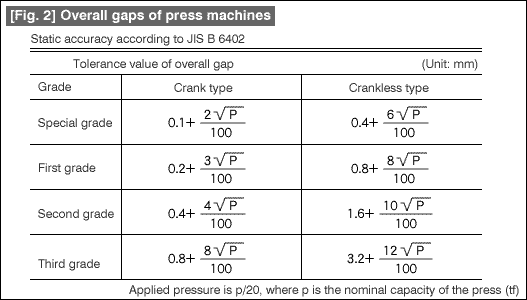
Various parts are moving in order to make the slide move up and down. There are very small gaps between the moving parts. This gap changes when a pressure is applied thereby causing the bottom dead center to be disturbed. When no pressure is applied, the parts become relaxed returning the gaps to the original larger values and hence large movements can be made. Such a deformation is called the overall gap. The amount of displacement is investigated when the slide is pushed up with a force equal to 5% of the nominal force. This JIS standard is shown in Fig. 2.

Fig. 2 Overall gaps of press machines

About this Archive

This page is an archive of entries from August 2010 listed from newest to oldest.

July 2010 is the previous archive.

September 2010 is the next archive.

Find recent content on the main index or look in the archives to find all content.