March 2010 Archives

#034 Basics of Die Structure (9) Basics of Bending Die Structures

The largest shape in press formed products can be said to be bent products. The basic structure of dies for bent products will be explained below.

(1) Bottoming bending (V bending)

This is a structure of forming a shape by pushing a punch towards a material held at two pivots. See Fig. 1. This is the simplest bending structure. The bending angle changes depending on the Stroke of the punch. The bending method of this form is called "free bending". In the case of free bending the die does not have to have a V-shape as shown in Fig. 1. By preparing the punch and die to have the shape that is to be formed as shown in Fig. 1 and transferring the shape of the punch and die to the material by pressing the material between the punch and the die thereby preparing the desired shape is called "bottoming bending". Since the typical shape made using this method of forming is the shape of the letter V, generally this is called V-bending.
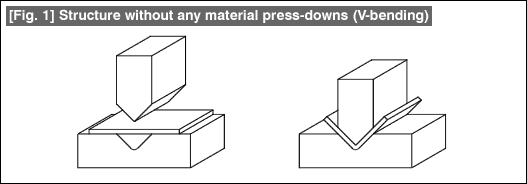
Fig. 1

(2) Press-down bending (L-bending)

This is the method of forming shown in Fig. 2. The bending is done after holding the material on the die using press-downs that press the material so that the material does not get shifted. The feature of this method is that the material press-down and the punch operate from the same direction. Since the material is pulled in the direction of the punch during formation, sufficient pressing area and force will be necessary.
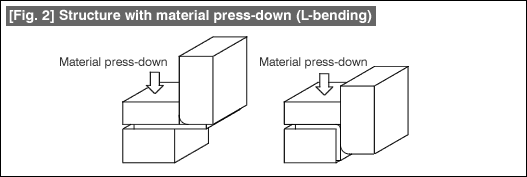
Fig. 2

(3) Inverted press-down bending (U-bending)

This is the method of forming shown in Fig. 3. An inverted press-down is incorporated into the die, and the material is formed by pressing the material using the punch and the inverted press-down. Since both ends of the material are bent, it is not necessary to worry about the material being pulled as in L-bending.
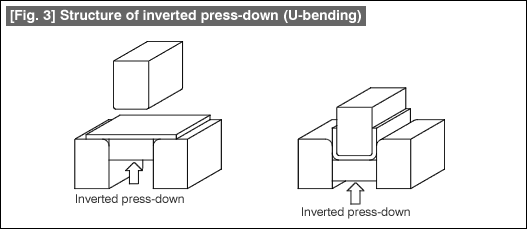
Fig. 3

The above three methods are the basic structures of bending. Very often the bending is also done from a direction opposite to the bending directions shown in Fig. 1, Fig. 2, and Fig. 3. The bending of different bend product shapes is carried out by devising techniques so as to make the bending according to these basic forms.

#033 Basics of Die Structure (8) Cutting Off Die

Cutting off work is a method of blanking work in which the material is cut by shearing into two parts without generating any scrap. If this method is used, the rate of utilization of the material (yield) can be increased to the maximum possible extent.

The basic structure of a cutting off die is shown in Fig. 1. The cutting is done in the condition in which the material is passed through the tunnel part of a fixed stripper and has butted against a block. This work is shown in Fig. 2.

 [Fig. 1][Fig. 2]

Since the burrs at the left and at the right after cutting are in opposite directions, they remain as they are in the products (see Fig. 2). This is the first problem. Another problem comes because the cutting off is done along a single line. The material on the die jumps up due to the bending moment generated during the operation, and on the contrary the tip of the material of the cut part falls down. Since the cutting off is not done with the flat condition maintained, the cut edge surface becomes inclined. This is the second problem.

There are no countermeasures possible for the different directions of the burrs.

As a countermeasure for the cutting edge surface becoming inclined, it is essential to set the cutting clearance smaller than normal. Even when the clearance is small, if the punch moves away because of being pushed by a lateral force during working, the clearance becomes large and the problem only gets worse. It is necessary to take measures to prevent the punch from moving away by providing a back up heel or a back up block so that the punch does not move away.

As a positive measure to prevent the inclination of the material during cutting off, it is important to provide a material pressing member inside the die (inverted pressing member) thereby gripping the material between the punch and the inverted pressing member thereby ensuring that the material does not get inclined during cutting off. In addition to putting an inverted pressing member on the die side, even changing the stripper from a fixed stripper to a movable stripper is a good countermeasure. However, this increases the cost.

Although the cutting off operation appears simple, it is quite difficult when the work has to be done neatly. Although the operating force becomes balanced if the cutting is done with a certain width such as in parting, since the cutting is made on one side, there is the problem that the operating force becomes unbalanced. It is necessary to consider this aspect at the time of designing the structure.

#032 Basics of Die Structure (7) Parting Die

In parting work, the material is sheared and separated using a punch having a certain width. Very often blanks are also prepared from sheet material or coil material by parting. Since the shearing is done using a punch with a certain width, the directions of burrs after parting will be the same at the left and at the right (if shearing is done by cutting off without generating any scrap, the directions of the burrs at the right and at the left will be opposite to each other). In addition, quite often a product that is bent or drawn is parted thereby getting two products.

Figure 1 shows the structure of a parting die used for such a purpose. Fig. 2 shows the conditions during operation.

[Fig. 1][Fig. 2]

By carrying out parting work it is possible to prepare products that are left and right symmetrical, or to prepare two products in the case of a non-directional product (of a shape shown by the example in this figure), and hence it is possible to increase the productivity.

Looking from a different point of view, in order to achieve a balance in the operation capacity of metal forming work, it is also possible to carry out left and right symmetrical formation work inevitably and then carry out parting work.

Although the shape shown in the example in the figure is a simple one, in practice, very often a very complex formed product is parted. In this kind of work, very often even the die has a curved surface to match with the shape of the product.

In parting work, since the product is divided into two products due to parting, there is no possibility of the formed material sticking to the punch, and hence there is the feature that there is little problem if there is no stripper. Depending on the product, as soon as the parting is done, the two products fly off to the left and right due to the sideward force during operation. This not only makes it difficult to collect the products but also can be dangerous and hence care will have to be taken. In order to prevent the products from flying off, it is safe to have a structure in which the products are pressed down by a light and simple stripper. When the pressing down by the stripper is removed, since the product after working get divided into two part and move simply to the left and right, it is possible to collect the products easily and even the operability of the press becomes relatively better.

#031 Basics of Die Structure (6) Structure of Compound Dies

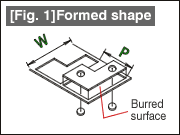
Compound blanking operation is that of carrying out forming outer shape and hole punching simultaneously. This operation is called "compound processing". Furthermore, this type of work is also called "combined processing." As shown in Fig. 1, the forming the outer shape is carried out upwards from below and hole punching is performed downwards from above.

This can be said to be a combination of an inverted placement structure outer shape forming die that forms the outer shape and a movable stripper structure die which punches the holes (this has already been discussed in a previous course as a method of preparing compound die structures).
Fig. 1 Formed shape

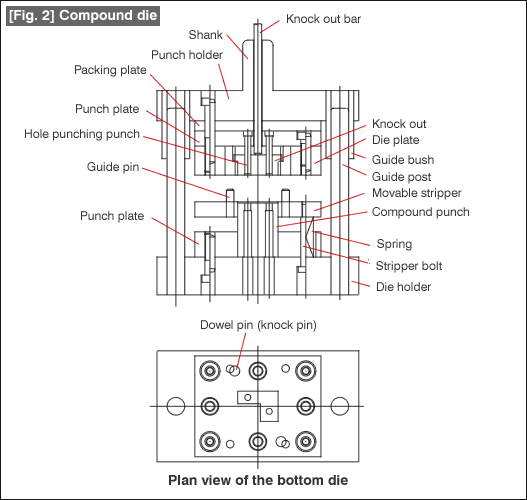
The basic structure of a compound die is shown in Fig. 2.

Fig. 2 Compound die

The features of compound blanking operation are - (1) It is possible to reduce the number of processing steps; (2) Since the accuracy of the relationship between outer shape and holes is determined by the die, the accuracy of the product becomes better; (3) The flatness is good because the work is done while keeping the material pressed by the knock outs and the punches; (4) The directions of the burrs of holes and outer shape are the same, etc.

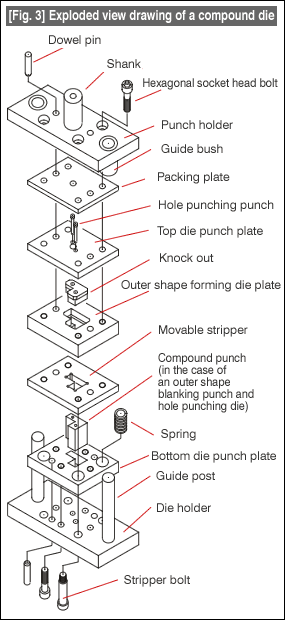
On the contrary, since the structure becomes complex, there is the drawback that the number of steps of preparing the die becomes large. For the sake of reference, an exploded view drawing of a compound die is shown in Fig. 3. It is obvious that the structure is quite complex. In this figure, the knock out and compound punch are compound parts arising out of combined processing operations. The knock out has the functions of ejecting the product and of a hole punching stripper. The compound punch is a combination of a punch for outer shape blanking and a die for hole punching. These two parts will have almost the same shape as that of the product. Therefore, the die does not function if these tow products become weak and break.

In compound blanking, the formed product is discharged into the die in the top die. Very often the method of recovering the discharged product by blowing it out using compressed air (air blowing off) is used. However, this air blowing off cannot be said to be efficient, and can be considered to be a disadvantage of compound blanking.

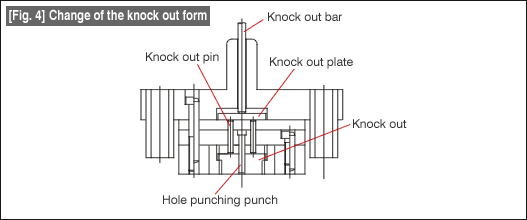
Although the discharge of the product from the die is done by the knock out, because of the hole punching punch it cannot be formed in the mode of Fig. 2, but very often it will have a structure of the form shown in Fig. 4. It can even be said that the form of Fig. 4 is the more standard one.
Fig. 3 Exploded view drawing of a compound die

Fig. 4 Change of the knock out form

About this Archive

This page is an archive of entries from March 2010 listed from newest to oldest.

February 2010 is the previous archive.

April 2010 is the next archive.

Find recent content on the main index or look in the archives to find all content.