November 2011 Archives

Lifters (including stock guide lifters) are parts used for maintaining the level of the work to be formed from the surface of the die. These are parts that are always used in combination with a spring and a screw plug. Therefore, it is easy to use if the relationship with the hole of the set of the lifter body, the spring, and the screw plug is properly adjusted.

Fig. 1 is an example showing the relationship between the lifter and the hole. This is explained below.
With respect to the shaft (D) of the lifter, the dimension of the hole (D1) is set so that there is not too much play between them. If there is too much play between the shaft and the hole, the shaft shakes and holding of the work to be formed becomes unstable. If the play is too small, the movement of the lifter becomes bad due to the penetration of very small debris. The lifter should be made to move smoothly even if there is some shaking.

Regarding the relationship between the head dimension (A) and the screw plug dimension (SW), the screw plug has been selected so that the diameter (D2) of the tap bottom hole for the screw plug is as close to the dimension A as possible. The spring (SP) has been selected to be of a size that is as close to the dimension A as possible.

For reference, the key point in using a lifter is in the method of selecting the spring. The lifter is a weak spring that can lift up the work to be formed. In addition, very often the amount of deflection of the lifter is also very large. If the spring is selected according to these conditions, very often the spring will be one with a large deflection. If the lifter is used with these conditions, the lifter does not stop immediately when it returns downward, but very frequently carries out a damping movement. If a damping movement is made the supporting of the work to be formed becomes unstable and can cause problems in press forming. The selection of the spring should be made so that its the supporting force is weak and so that the spring is strong enough to eliminate any damping movement.

[Fig. 1] Relationship between a lifter and its hole

There is a very close relationship between the stripper bolts, coil springs, and screw plugs. If the hole dimensions related to the respective parts are organized, die design and fabrication become easy.

Fig. 1 summaries their details which are explained below.
The key factors in a stripper bolt are the shaft dimension (D), the head dimension (A), and the thread size (M). Considering the balance with the plate size of the die, the selection is made taking the shaft dimension and thread size of the stripper bolt as the reference. At that time, consider any coil spring diameter that is desired to be used. After that, the coil spring diameter and the screw plug dimensions are determined from the relationship with the head dimension.
It is good to make the head dimension (A) and the coil spring diameter (SP) almost the same, and it is not good to make the SP dimension large or small.
The thread pitch has been unified to 1.5 mm for screw plugs of M10 or higher. With this as the key factor, if the smallest screw plug is selected with the dimension A + 2 mm or more, it is possible to finalize the minimum relationship between the stripper bolt and the screw plug. Fig. 1 has been prepared based on this thinking. The bottom hole dimension (d2) of the screw plug has been calculated as screw plug diameter -1.5 mm (thread pitch dimension). The dimension SP has been selected to be the largest dimension that can enter in the D2 hole.

If the method of determining the relationship between the part and the hole is unified in this manner, even the related parts will be decided. The die design becomes easy if this type of relationship is organized as component units.

As precautions, it is better that the dimension of the hole (D1) in which the shaft D enters is about that shown in Fig. 1. For the shaft D, stripper bolts are available that have been ground and finished to a high accuracy. If the hole dimension is made "intermediate fit" in an attempt to make this shaft D as the guide, when the stripper bolt is tightened the shaft can butt against the hole and the movement may become hard. The reason for this is the relationship between the thread part of the stripper bolt and the tapped hole. This is a phenomenon that occurs because it is difficult to cut the tapped part vertically without any bends. It is better not to think of this method of using the stripper bolt.

[Fig. 1] Relationship between stripper bolt, screw plug, and holes

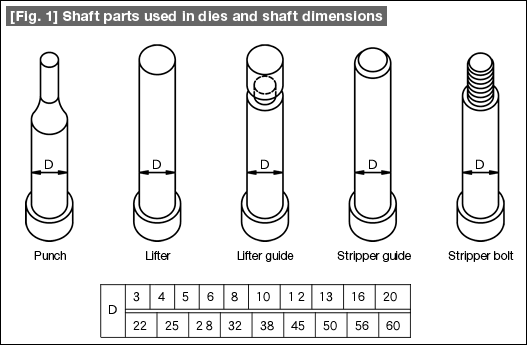
The round parts used in dies are very rarely prepared along with the dies, but are mostly procured as standard parts. Therefore, the dimensions of parts embedded inside the die plate (in this case, these are the shaft dimensions) are organized. The method of organizing is based on the standard size numbers in the Japanese standard (JIS Z 8610). There is a basic series of numbers such as R5, R10, R20, and R40 in the standard. In the case of round parts shown in Fig. 1, the shaft dimensions are determined based on the basic series of R20.
Irrespective of how these were determined, if one keeps these shaft numbers in mind, the design of dies often becomes easy. The die plate size is determined based on the size of the product to be produced by press forming. After that, although the different shaft components are placed in the space of the plate, the decision is made while achieving a balance between the size of the plate and the shaft dimensions. This task becomes easy.

Fig. 1 Shaft parts used in dies and shaft dimensions

Next, organizing the relationship between the parts and holes, the die design becomes still easier. The relationship between the shafts and the holes is "mating" which can be of the three types of - "a tight fit" (press fit), "a gap fit" (a loose condition in which the hole diameter is larger than the shaft), and "an intermediate fit" (which is a relationship between the hole and the shaft that is in between the first two). For example, when a round punch is to be press-fitted into a punch plate, the reliability of die design will not be stable causing problems if the "fitting margin" is considered each and every time.
If the hole dimension is decided to be shaft - 0.005 mm or shaft - 0.01 mm, not only the speed of designing increases, but also the tools for machining the holes and the machining procedures becomes unified. Carrying this out intentionally is called standardization. When preparing dies using CAD/CAM, if the hold dimensions are determined according to the application taking the shaft dimensions as the reference, the design and fabrication of dies becomes efficient.

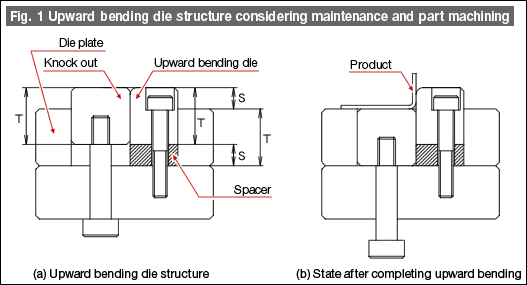
Fig. 1 shows the structure of the part of the die that carries out upward bending inside a progressive die. The parts (a) and (b) of this figure show the conditions before and after forming the metal. The upward bending die projects above the die plate surface (the dimension "s"). Instead of preparing in an integral manner, by inserting a spacer with a thickness of (s) as shown in the figure, it is possible to make the thicknesses of the upward bending die and the knock out equal to the thickness (T) of the die plate, and it is possible to make it easy to form the part. By doing this in the case of an integrated type die plate, it is possible to maintain the dimension (s) constant by removing the upward bending die during maintenance, taking out the spacer, inverting and replacing the upward bending die, and re-grinding, thereby making maintenance easy.

Fig. 1 Upward bending die structure considering maintenance and part machining

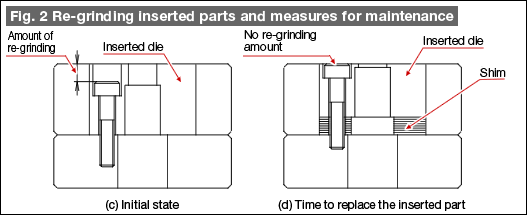
Fig. 2 shows a technique related to the life of inserted parts. In Fig. 2 (c), a new part has been inserted. The fixing screw of this part has been modified so that the bolt is inserted deeper by the amount of re-grinding. Although the level is adjusted by inserting a shim on the underside of the inserted part every time the inserted part is re-ground, it is possible to know that the inserted part has reached its life when the head of the bolt is almost at the same level as the die surface. The machining can be made so that it is possible to know the time to replace the part.

Fig. 2 Re-grinding inserted parts and measures for maintenance

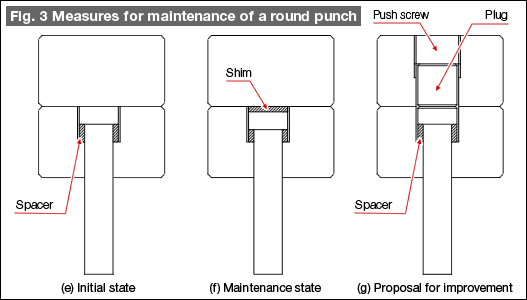
Fig. 3 shows the life management using the punch. As is shown in Fig. 3 (e), a spacer corresponding to the amount of regrinding is inserted. The spacer is ground to match with the amount of re-grinding of the punch, and a shim equivalent to the amount of grinding it provided at the head part. Fig. 3 (f) shows that state. The life of the punch can be said to have ended when the spacer disappears. In the case of the structure of Fig. 3 (e), it is necessary to separate the top die at the time of taking out the punch. If the structure is made like that shown in Fig. 3 (g) it is possible to eliminate the tediousness of separating and the preparation of the shim.

Fig. 3 Measures for maintenance of a round punch

Various techniques are possible if modifications are made paying attention to detailed parts. Use various techniques in part design in order to make it easy to use.

About this Archive

This page is an archive of entries from November 2011 listed from newest to oldest.

October 2011 is the previous archive.

December 2011 is the next archive.

Find recent content on the main index or look in the archives to find all content.