April 2013 Archives

#155 Design of Compound Punching Dies (4) Structure of a Compound Punching Die

The basic structure of a compound punching die is shown in Fig. 1.
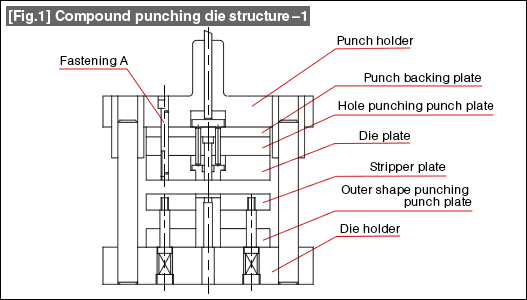
Fig.1

The compound punching die is used for compound forming operations (outer shape punching and hole punching). The method of preparing the structure of compound forming has been explained in Tutorial No. 8 "Method of Preparing Compound Die Structures". After that, "Structure of Compound Dies" has been explained in Tutorial No. 31. Please refer to these tutorials.
In this tutorial, explanations are given about further detailed items.

Depending on the die, the plate configuration that constitutes the die becomes extremely important. This is because it affects the cost of the die. The plate configuration of a compound die has seven plates (fig.1). The die plate becomes somewhat thick because it is necessary to assemble the knockout inside it.
When the punch is large, sometimes the punch plate is not used but the fixing is done directly to the die holder.

The structure of a compound die is the inverted placement structure. In the inverted placement structure, the punch is placed below and the die is placed above (for outer shape punching). Some of you may feel that there is something strange in the relationship between the punch holder and the die holder, but the holder that is attached to the slide of the press machine is taken as the punch holder, and the holder that is attached to the bolster is taken as the die holder.

When handling small product shapes, sometimes a backing plate is also used below the punch plate for the outer shape punching by the bottom die. Eliminating the backing plate for hole punching by the top die is very rare.
The materials of the respective plates are given below.
Punch, die holder, and punch plate: S50C or SS400
Backing plate: SK3 to SK5
Punch, die plate: SK33 or SKD11

Fig. 2 shows a plate configuration in which the die plate is divided into two.
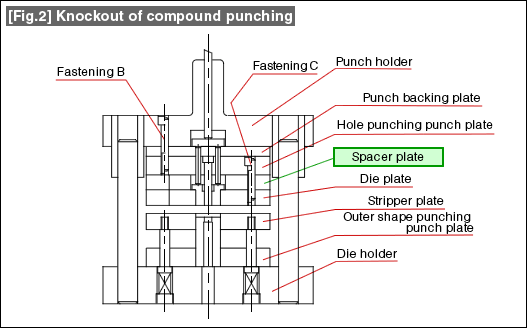
Fig.2

This is used when the underside counter boring for the knockout is cumbersome, or when it is wanted to save the material of the die plate.
Although the name of the plate produced out of dividing is called here as the spacer plate, it is also called by other names such as "play plate", etc. Since this plate is for making the knockout movable, the material used is S50C or SS400.
Since the number of plates becomes large in a die for compound punching, sometimes the die is prepared with some special techniques in its design. This is the method used when the die is prepared by wire cut electric discharge machining.
If the die plate is prepared by wire cut electric discharge machining, although the material inside the die is cut away, this material is used as the punch. With one single plate, it is possible to prepare the punch and the die. When the plate is thin, the die is prepared using taper machining of wire cut electric discharge machining.

Similarly, at the time of preparing the stripper plate, the material that is cut away is used as the knockout. If such techniques are used, while the die material can be saved, at the same time, even the preparation of the die becomes faster. This is suitable for the production of small volumes.
The number of plates becomes large in the top die of a compound punching die. Although this is a method of using bolts and dowel pins (knockouts) as was shown by "fastening A" in Fig. 1, the number of penetrating plates is large and hence one might feel that there are problems in reliability. This is more so when a spacer plate is used. As shown by "Fastening B" and "Fastening C" in Fig. 2, in some cases, the die plate and the punch plate for hole punching are integrated together, and the fastening as the top die is made separate.
While the dowel pin is the component that determines the positional relationship, the reliability becomes poor as the pin becomes longer. It is considered good if the number of plates that the dowel pin penetrates is about three.

The method of fastening and the work of assembling the die are related to each other. It is necessary to select the fastening considering the fastening of plates as well as the operation of pierce punch spotting of the die.
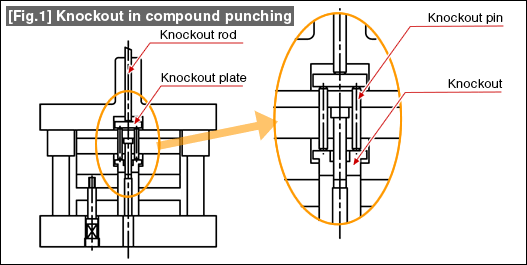
The die structure in compound punching is shown in Fig. 1. This is a structure in which the die for outer shape punching (blanking) is in the top die. This type of a structure is called an "inverted placement structure".
In the inverted placement structure, the product after outer shape punching enters the die in the top die. Since the top die is attached to the slide of the press machine and carries out up and down movement, if the product that has entered the die is not ejected well, it can lead to breaking of the die. The die component for ejecting the product that has entered into the die is called a knockout. This is a characteristic component of the inverted placement structure. Although the inverted placement structure is used quite often for drawing other than punching operations, the work of the knockout is the same.

Fig. 1

(1) Knockout structure of the die

Recently, the action of taking out a product from the die is very often called as "ejecting". However, this action is frequently called "knocking out" in press forming operations. Either way is acceptable. However, the die component used for this action is called a "knockout".
The structure of a knockout is explained using Fig. 1. The knockout is present inside the die. The knockout is prepared in almost the same shape as the die. A flange, etc., is provided to prevent it from falling off.
When the outer shape is punched from the material, the knockout is pushed up along with the removed material.
Near the top dead center, the knockout is pushed from behind, and returns to the shape before carrying out the outer shape punching, thereby ejecting the product.
The components pushing the knockout from behind are the knockout pin, knockout plate, and knockout rod. Depending on the structure of the die, sometimes the structure is such that the knockout is pushed directly by the knockout rod.
The press machine applies force to the knockout rod.

(2) Relationship between the knockout and the press machine

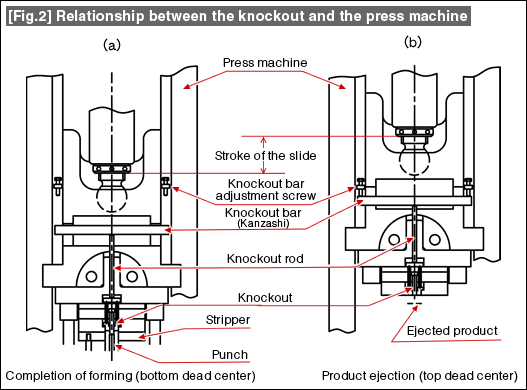
See Fig. 2. The components of the press machine related to the knockout are the "knockout bar" and the "knockout bar adjustment screw or rod". The field term for this part is ornamental hair pin, or "Kanzashi". Field terms are used in order to avoid the confusion between words such as knockout bar and knockout rod, etc.
The knockout that has been pushed up after the outer shape punching has been completed, pushes up the Kanzashi via the knockout rod (Fig. 2(a)). This position is the bottom dead center of the slide of the press machine.
The slide rises with the knockout in the pushed up state. Near the top dead center, the Kanzashi butts against the knockout bar adjustment screw and carries out the operation of returning the pushed up Kanzashi to its original position, hence the product is ejected (Fig. 2(b)).
The adjustment of the "knockout bar adjustment screw" is something that requires care to be exercised during the operation of the knockout. Near the bottom dead center, if it contacts the Kanzashi too soon, the pushing down length of the knockout becomes too long which can lead to breakage of the die or the knockout. In the case of a top die fixed to the shank, in the worst case, an accident of the top die falling off can occur.
When using the Kanzashi, the knockout bar adjustment screw is raised to the uppermost limit, thereby preventing danger.
The adjustment of the knockout is carried out from this state.
The product that has fallen is made to fly off from the die using means such as an air jet blow, etc.

図2

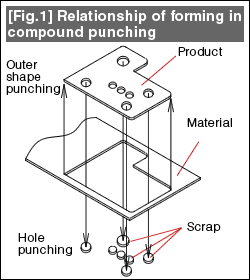
In compound punching, as shown in Fig. 1, the outer shape is punched from bottom towards the top. Hole punching is done conversely from the top towards the bottom. By doing this, the scrap of hole punching falls down. The (shape blanking) product is inserted inside the die which is in the top die. In compound forming such as compound punching, since it is very troublesome to carry out the operations if the scrap is taken up, very often the design is done so that it falls down. It is necessary to eject out the product that has entered into the die. This can be said to be a problem of compound punching. Fig. 1

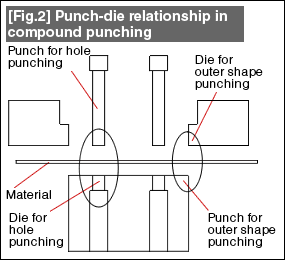
Fig. 2 shows the punch-die relationships in compound punching. The parts enclosed in ovals show the respective parts of such relationships. The punch for outer shape blanking is the same size as the product. The punch for outer shape punching is placed below and its die is placed above. The punch for hole punching is placed inside that die. The die for hole punching is prepared inside the die for outer shape punching. A part such as this punch for outer shape punching is called a compound part.
The outer shape is punched from below to above. At this time, a warp is generated so that it gets separated from the punch surface and rises upward, but since the punch for hole punching acts to press from above, in actuality the generation of a warp is suppressed.
Fig. 2

The parts shown here are the primary functional parts of compound punching. To these are added parts such as a stripper, or a part called a knockout which ejects the product that has entered into a die, and all these together constitute a die.

#152 Design of Compound Punching Dies (1) Features of Compound Punching

Regarding compound punching, the most basic structure of a compound punching die has been shown in Lesson No. 31. First see this Lesson No. 31. Then, get a mental picture of the die form and structure.

Compound punching means simultaneously carrying out both outer shape punching and hole punching.
This has several merits. Products punched using a press are prepared as copies of the die. If the die is prepared accurately, that accuracy is obtained as a copy in the product. In compound punching, not only the relationship between the outer shape and the positional accuracies of the holes, but also the shape accuracies of the holes and outer shape can be obtained as die dimensions.

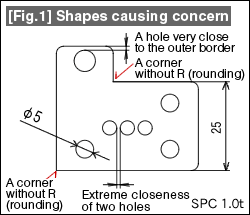
As is shown in Fig. 1, the points of concern in compound punching are the proximity between a hole and the outer border and the proximity between holes. The strength of the die is a concern. One would want to know the limits to these dimensions.
If we assume a material such as SPC with a thickness of about 1mm, if the hole is round it can come close by up to 50% of the material thickness. Although this would be a problem in ordinary situations, since the forming is done simultaneously from both sides in compound punching, it appears that the balance between the forces is prevents breakage.

Compound punching is a method of forming in which the outer shape and hole punching are combined together. It is necessary to pay attention to the precautions in both outer shape punching and hole punching.
For example, in the case of points like a corner without rounding (R) in Fig. 1, burrs are easily generated if the punching is done as it is. It is necessary to carry out an operation of providing rounding.
Fig.1

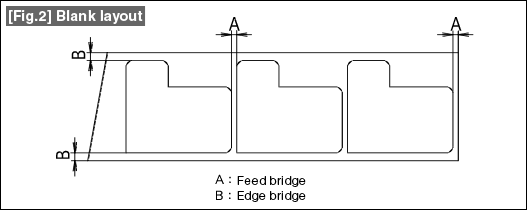
The blank layout is treated in the same manner as blanking as is shown in Fig. 2. However, it is safer to take the bridge width wider than in blanking.

Fig.2

About this Archive

This page is an archive of entries from April 2013 listed from newest to oldest.

March 2013 is the previous archive.

May 2013 is the next archive.

Find recent content on the main index or look in the archives to find all content.