December 2012 Archives

This is a summary of the key points of the design of a blanking die with the fixed stripper construction.

(1) Reasons for using a fixed stripper

In the case of a blanking die, the item obtained after passing through the die is the product. Therefore, the material that remains on the die plate is scrap. Since there is no effect on the product even if there is some deformation, it is sufficient to use a construction in which there is no need to keep the material pressed.

(2) Fixed stripper and stock guide

The role of a stripper is to pull away the material that has got stuck to the punch. It is useful if the stripper is firmly fixed. The space below the fixed stripper is the space through which the material passes. If a large space is created, the material moves inside the space and it becomes difficult to carry out the blanking operation. If the width and height of this space is restricted to match with the material, it becomes easy to carry out the blanking operation. By doing this, the space below the fixed stripper becomes a space in which the material is guided (= stock guide). It is good to take measures in the stock guide so as to make the press operations easy.

(3) The interior of the construction of the fixed stripper cannot be seen

When carrying out press operations, it is very uneasy if the working point cannot be seen. This is the drawback of the fixed stripper construction. Let us cut out the uneasiness and try to make the working point visible as far as possible.

(4) Mounting the die (die setup)

Since a die is used after installing it in the press machine, the punch, die, and the die holder are designed considering the method of mounting. Although a shank is a convenient means for mounting the top die, it can also be dangerous depending on the usage. It is good to consider a small die used in a press machine of about 30 tons or less.

(5) Dimensions of the punch and die

The blanking clearance has a very important role in blanking operations. This clearance is the gap between the punch and the die. The dimensions of the punch and the die vary depending on the amount of clearance. In blanking operations the die dimensions will be equal to the product dimensions. The punch dimensions will be slightly smaller than the die dimensions.

(6) By how much to insert the punch in the die

The material is blanked by placing it on the die and pushing in by the punch. Logically speaking, if the bottom surface of the punch reaches the top surface of the punch, the blank should separate from the material and should enter into the die. However, in practice, if the thickness of the material is about 1 mm, the punch is inserted in the die by about 1 mm.
The reason for doing this is that, even the press machine extends or shrinks slightly. The frame of the machine extends when the punch comes into contact with the material and starts applying pressure. While extending, it pushes the punch inside the die. As the forming progresses, the necessary blanking force decreases. When a certain limit is exceeded, the extended frame of the press machine suddenly returns to its original position. At this time, it moves beyond the original position. This reduction is called breakthrough. Apart from this, even the various parts of the moving section have their effect. The bottom dead center varies due to such reasons. Therefore, at the time of blanking operations, the punch is made to enter slightly inside the die.
#138 Design of Blanking Dies (11) Design of the Die Holder of a Blanking Die

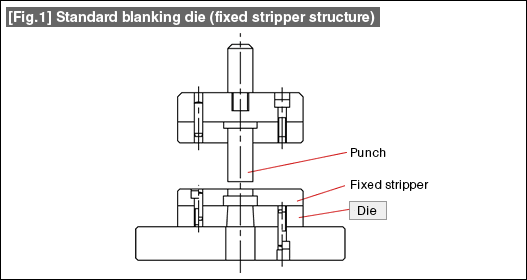
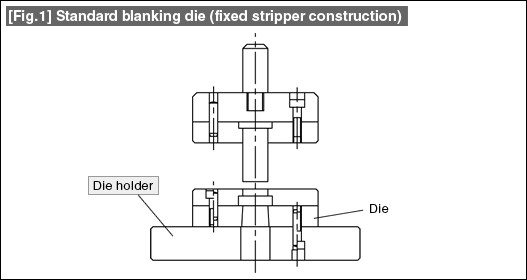
Fig.1 shows the construction of a standard blanking die. The die holder has the role of supporting the bottom die of a blanking die and becomes a clamp part for fixing the bottom die.

Fig.1

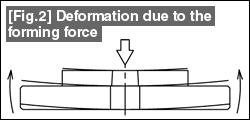
During blanking, a blanking force such as that shown in Fig. 2 acts on the bottom die. Naturally, the entire plate tries to warp in the opposite direction. Although it is not possible to eliminate this warp, a very small warp is desirable. Since eliminating the warp using only the die plate result in the need to use a large amount of an expensive material, which would be wasteful. The warp is made very small by making the die plate have the minimum necessary thickness and backing it up by the die holder. Fig.2

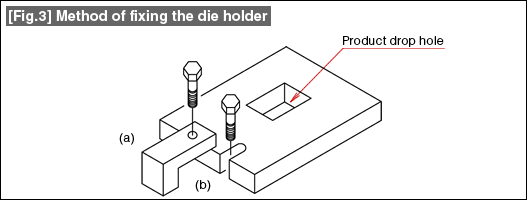
The die holder is also a part for fixing the bottom die. The methods are shown in Fig. 3.
(a) This is the method of fixing using a clamp. In this method, if the height (thickness) of the clamp is standardized, the setting up of the dies becomes easy.
(b) This is the method of fixing using a U-shaped groove. There will be the restriction that matching will have to be done with the position of the U-shaped groove of the press machine. The depth of the U-shaped groove should be about 2 to 3 times the bolt diameter.

Fig.3

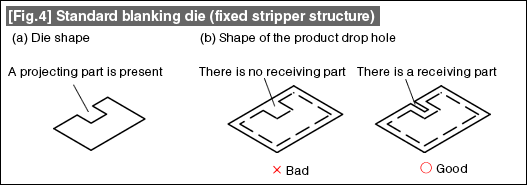
A product drop hole is also necessary in the die holder. While it is desirable that the drop hole is formed in a simple shape such as a round or a rectangle which is easy to machine, in the case of a die shape having a convex part such as that shown in Fig. 4(a), making the drop hole rectangular can cause the convex part to get broken easily (the shape indicated as "Bad" in Fig. 4(b)). Therefore, a projecting part is provided even in the die holder thereby backing up as shown in the shape indicated as "Good" in Fig. 4(b).

Fig.4

#137 Design of Blanking Dies (10) Design of a Blanking Die

Figure 1 shows the structure of a standard blanking die. A die is a very important part that creates the shape of the product.
The die hole machined in the die (die plate) is prepared with the shape of the product. In the case of a blanking die, the shape obtained after the material passes through the die hole becomes the product.

Fig. 1

■ One point Explanation: "Die" as a difficult to understand terminology

The word "die" is used in various ways. Some of them are the following.

1. Firstly, it is used to represent the entire press forming die set, e.g. blanking die.
2. As is being explained here, the part with a shape that receives the punch is also called a "die". This is the meaning when we say, "the die cutting edge tip is worn".
3. Sometimes a "die" may also refer to the plate that constitutes the above mentioned shape. This is the meaning when we say "grind the die because it has worn", etc. Actually the plate from which a die is constituted ought to be called a "die plate".
4. Apart from these, there is also a word called "insert die". This implies a part that is assembled inside a die plate and constitutes the die shape. Even the word "button die" has a similar meaning.

A person who can understand the different meanings of this word "die" can be said to have understood press forming quite well.

Coming back to the main topic, when determining the dimensions of the die, it is necessary to consider the blanking clearance. SeeLesson No. 5in which this blanking clearance has been explained.

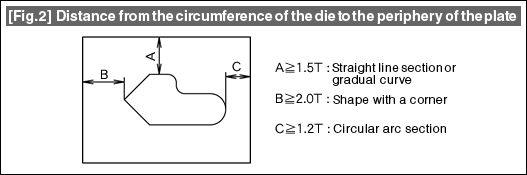
In a blanking operation, a sideward force acts during blanking. The die plate breaks (cracks) if the distance from the circumference of the die to the outer periphery of the plate becomes small. Fig. 2 gives a guideline for the distance from the circumference of the die to the periphery of the plate.

図2

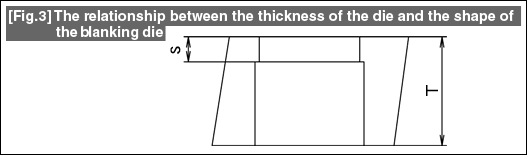
While the above applies to the planar shape, it is also necessary to consider the cross-sectional shape (the shape as viewed from the thickness direction of the die plate. When the material is passing inside the die, it is good if it does not scrape against the inner surface of the die for too long. As an example, the cross-section of a die becomes as shown in Fig. 3. It is better that about three or four products stay inside the part of the die indicated as "s" and any additional products fall down.

図3

There are several types in the method of preparing the cross-sections of such dies. This has been explained in detail in Lesson No. 6 about the shape of blanking dies.

About this Archive

This page is an archive of entries from December 2012 listed from newest to oldest.

November 2012 is the previous archive.

January 2013 is the next archive.

Find recent content on the main index or look in the archives to find all content.