May 2012 Archives

#125 Press Forming Force (2) Blanking Sideward Force and Scrap Removing Force

(1) Sideward Force (F)

As shown in Fig. 1, the sideward force is the force that is generated in a direction at right angles to the forming force. When the remaining width of the material is small, the material is pressed by the sideward force and can get deformed.
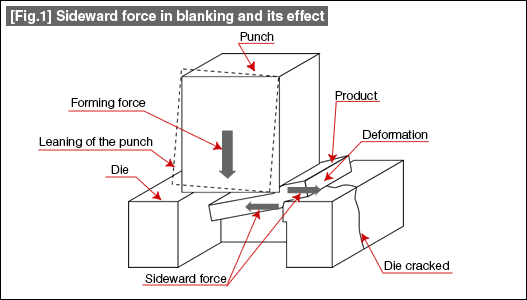
Fig. 1 Sideward force in blanking and its effect

The effect on the punch is that it is pushed to one side, and the clearance changes thereby changing the blanking state. The die can break if its cutting edge part is weak. The sideward force increases in proportional to the blanking process. It also changes depending on the size of the blanking clearance. The sideward force is expressed as follows.

   P = Kf * P (kgf)
     F: Sideward force (kgf)
     P: Blanking force (kgf)
     Kf: Coefficient for P

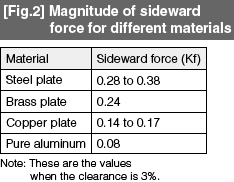
Fig. 2 shows the coefficient (Kf) of the sideward force when the clearance is 3%. In the case of a soft steel plate, care should be taken because this can become even larger than 30% of the blanking force. Fig. 2 Magnitude of sideward force for different materials

(2) Scrap Removing Force (Ps)

This is also called the stripping force. This is the force required to detach the material that has got stuck to the punch. (See Fig. 3.)
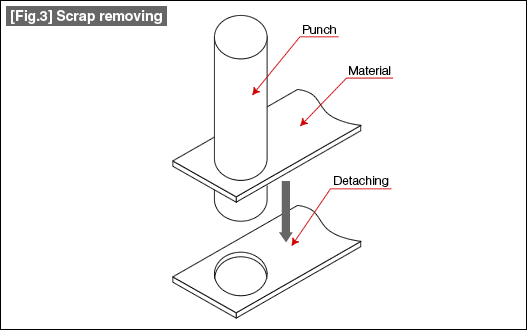
Fig. 3 Scrap removing

This force is indicated as follows with respect to the blanking force (P).

   Ps = Ks * P (kgf)
     Ps: Scrap removing force (kgf)
     P: Blanking force (kgf)
     Ks: Coefficient with respect to the blanking force

The scrap removing force varies between 0.03 and 0.08. The scrap removing force changes greatly with the clearance. This force becomes large as the clearance becomes small and becomes a minimum at a clearance of about 20%.
In the case of a movable stripper type die, this scrap removing force is required to determine the strength of the spring. When flatness is obtained by pressing the material using a movable stripper, the above value of Ks is insufficient, and it will have to be made much larger. The value of Ks in this case will be about 0.1 to 1.0. The more frequently used value of Ks is in the range of 0.1 to 0.3.
#124 Press Forming Force (1) Blanking Force

Knowing the forming force necessary for carrying out a press blanking operation (shearing operation) is indispensable for selecting the press machine and for carrying out the die and punch design.

The blanking force (P) is obtained using the following equation.

■Equation 1
 P = L * t * S
     P: Blanking force (kgf)
     L: Forming circumference (mm)
     t: Plate thickness (mm)
     S: Shear resistance (kgf/mm2

However, when it is difficult to know the shear resistance (S), it is substituted by a value equal to 80% of the tensile strength (Ts) of the material. The equation in this case will be as follows.

■Equation 2
 P = K * L * t * Ts
     P: Blanking force (kgf)
     K: Coefficient = 0.8
     L: Forming circumference (mm)
     t: Plate thickness (mm)
     Ts: Tensile strength (kgf/mm2

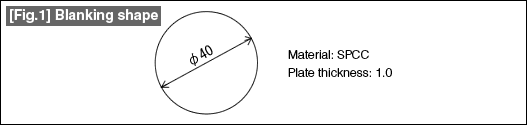
Taking the example of Fig. 1, the blanking force will be as follows. In this case the tensile strength of SPCC is taken as 30 kgf/mm2.

P = 0.8 * n * 40 * 1 * 30 = 3014.4 (kgf)

Fig. 1 Blanking shape

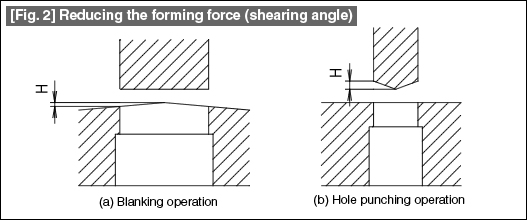
As a method of reducing the blanking force, there is a method of providing a shearing angle as shown in Fig. 2. The shearing angle is provided in the die in the case of blanking operations and in the punch in the case of hole punching operations. Most often the shearing angle is provided so that the dimension H is roughly equal to or more than the plate thickness. By the way, the blanking force can be reduced by about 30% when the dimension H of the shearing angle is made equal to the plate thickness.

Fig. 2 Reducing the forming force (shearing angle)

Sometimes it is difficult to refer by names to detailed parts when investigating a product of drawing. The names of some parts that are convenient if remembered are given below.

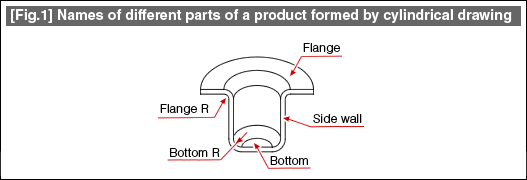
[Fig. 1] shows the names related to the shape of a product formed by cylindrical drawing.

Fig. 1 Names of different parts of a product formed by cylindrical drawing

(1)  Flange: The part of the blank that is remaining on the surface of the die after blank has been drawn. The edges of the flange will become thicker than the original plate thickness.
(2)  Flange R: This is the rounding (chamfer) provided between the flange and the side wall. This corresponds to the die shoulder radius (die R) of the drawing die.
(3)  Side wall: This is the part that has risen with respect to the flange when the blank is pushed inside the die by the punch.
(4)  Bottom R: This is the rounding of the part corresponding to the punch shoulder radius (punch R). This name has come to be used because this is the rounding of the bottom of the drawn container.
(5)  Bottom: This is the surface constituting the bottom of the container. Instead of being called the bottom, it is sometimes referred to as the roof, but recently the name bottom seems to be used more frequently.

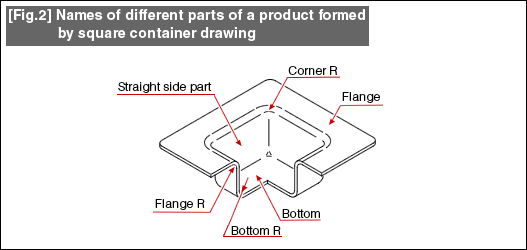
[Fig. 2] shows the names related to the shape of a product formed by square container drawing.

Fig. 2 Names of different parts of a product formed by square container drawing

(1)  Flange: The part of the blank that is remaining on the surface of the die after blank has been drawn. There is a big difference in the function of the material of the flange part at the straight side part and at the corner R part.
(2)  Straight side part: This is the side wall part formed in the straight line part of the square container drawing. When investigating the forming operation, the forming is done thinking of this part as a bending part.
(3)  Corner R: This is the part constituting the rounding of the corner of the side wall part. When investigating the forming operation, this is treated as a part of a cylindrical drawing operation.
(4)  Flange R: This is the rounding of the part constituted by the flange and the side wall part. Although as a product we would like to have the same rounding all around the circumference of the product, in terms of the forming operation, it is desired that the rounding of the straight side part is made smaller and the rounding of the corner R part is made larger.
(5)  Bottom: This is the surface constituting the bottom of the square container.
(6)  Bottom R: This is the rounding of the part at the intersection between the side wall and the bottom surface. In general, this is frequently made the same as the Corner R.

About this Archive

This page is an archive of entries from May 2012 listed from newest to oldest.

April 2012 is the previous archive.

June 2012 is the next archive.

Find recent content on the main index or look in the archives to find all content.