October 2010 Archives

#059 Method of Using Standard Components (8) Coil Springs - 2

The major methods of using coil springs (hereafter referred to merely as springs) are explained here. Fig. a to Fig. f show the major methods of using springs.

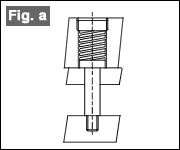
Fig. a is a method of using a spring when the amount of movement of the stripper is small. The spring is placed behind the stripper bolt. There is no undue stress because the spring pushes along the same axis. Since it is not possible to use a long spring, it is not possible to obtain a large deflection. Fig. a

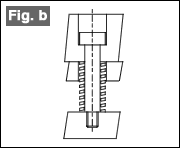
Fig. b is a method of using a spring in which it is placed in the shaft part of the stripper bolt. It is possible to obtain a larger deflection than in the method shown in Fig. a. This method is suitable for the operations of bending, etc. In this method, the deflection of the spring is made by turning the stripper bolt. Therefore, turning the stripper bolt becomes heavy due to the load of the spring. This is a drawback of this method of using springs. Fig. b

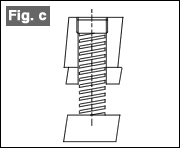
Fig. c is a method of using a spring by providing a hold dedicated to the spring. This is suitable for drawing operations that require large amounts of deflection. It is possible to use the longest springs. Fig. c

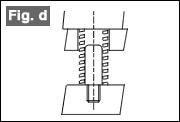
Fig. d shows a countermeasure for preventing tilting or bending of springs. A spring for a normal die is prepared so that it can be guided using the internal diameter. This figure shows one example and there are various other shapes. Fig. d

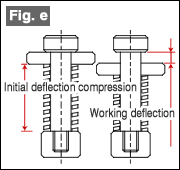
Fig. e shows a method of use in which the spring is set in the initial deflection state. In the case of an ordinary spring, the setting of the initial pressure is set again by tightening the screw plug, etc., every time a die is disassembled and assembled again. This takes considerable time and labor. The method of use (e) is selected in order to solve this problem. This is given as the flange for the spring unit (WUNT) in the catalog "Face". Fig. e

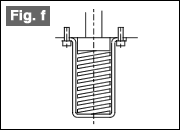
Fig. f is the method of use when the spring cannot be placed completely inside the die. The spring is placed inside an auxiliary case and is set in the form shown in the figure. In this method of using a spring, it is possible to use considerably long springs. This is given in the catalog "Face" as the spring case unit (SPRC). Fig. f

#058 Method of Using Standard Components (7) Coil Springs - 1

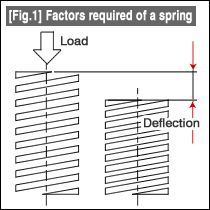
What are expected of springs in dies are load and deflection as shown in Fig. 1. For a coil spring (referred to merely as a spring in the following) that supports the lifter spring used in a die, not much load is necessary, but a certain amount of deflection is required. The load is the main requirement in a movable stripper. Sometimes, both load and deflection may be the necessary requirements. Fig. 1 Factors required of a spring

The items required of springs can be many. In order to meet those requirements, springs with various spring constants (in a spring, the force obtained when the deflection is 1mm is called the spring constant) such as springs in which a large deflection is obtained, springs in which extremely strong forces are obtained, and springs in between these. It has become very convenient for die manufacturing. However, load and deflection are inversely proportional to each other, and it can also be said that it is difficult to satisfy requirements of both load and deflection.

Fig. 2 shows the precautions in using springs.
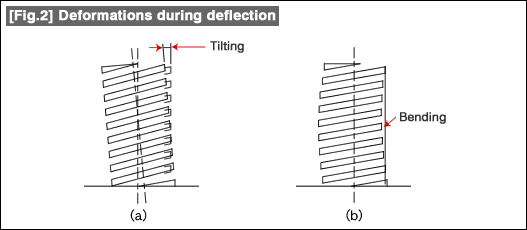
Fig. 2 Deformations during deflection

If there is any tilting of the spring as shown in Fig. 2(a), the outer periphery of the spring rubs against the side wall of the hole which reduces the life of the spring. The cause of tilting can be that the processing of the end surface of the spring is bad, or the seating surface of the hole in which the spring is inserted is not good. A spring easily tends to get tilted if placed in a hole that has merely been drilled. Fig. 2(b) shows the phenomenon that occurs in which the spring bends when compressed. This is a problem that can occur easily in springs with large free lengths. Similar to tilting, this also reduces the life of the spring.

Fig. 3 explains the basic method of using springs for compression.
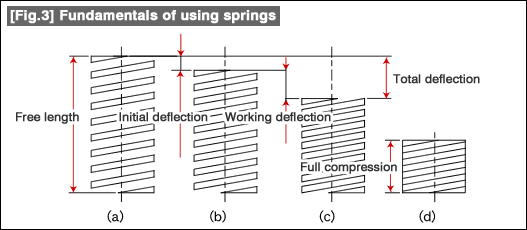
Fig. 3 Fundamentals of using springs

The length of the spring before it is deflected is called the free length (Fig. 3(a)). A spring is not used at its free length. It is compressed at least by 1 to 2mm.
When a prescribed load is required, the amount of deflection is obtained from the relationship with the spring constant, and the spring is compressed from its free length by the amount of this deflection. This amount of deflection is called the "initial deflection" (Fig. 3(b)
The material is pressed using the load obtained from the initial deflection, and the operations of punching or bending are carried out. The spring is further compressed by the punching or bending operation and goes into the state shown in Fig. 3(c). The amount of deflection at this time is called the "working deflection".
The sum of initial deflection and working deflection is the total deflection. The maximum total deflection is the deflection when the spring is in the fully compressed state shown in Fig. 3(d). If the spring is completely compressed, compression force is applied on the spring material itself, and this drastically decreases the spring life. Therefore, normally a spring is not used in this manner. Even though the spring is not fully compressed, the life gets decreased if the amount of deflection exceeds 30% of the free length. Normally, using at a total amount of deflection of 20% of the free length is good for the life of the spring.
#057 Method of Using Standard Components (6) Screws Plug

Screw plugs have been unified to have coarse thread pitch for sizes of M8 or less and a pitch of 1.5mm for M10 or more. This is for the purpose of making it easy to understand the relationship between the screw diameter and the spring when the screw plug is used as a cap screw for a spring, and also because, when the screw pitch becomes large in proportion to the screw diameter, it is also necessary to make the thickness of the screw plug larger in proportion to the screw diameter. If the screw pitch is the same, it is possible to make the thickness uniform. The screw plug standard has been prepared from this point of view.

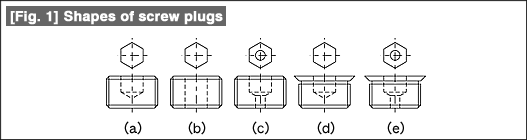
There are five types of screw plugs used in dies as shown in Fig. 1. A screw plug is operated using a hexagonal bar spanner (referred to simply as 'spanner' in the following).

Fig. 1 Shapes of screw plugs

The basic shape is the one shown in (a) in which the spanner hole is not penetrating. The shape (b) has a penetrating spanner hole. The shape (c) is the basic shape with a penetrating round hole provided at the end of the spanner hole.

The shapes (d) and (e) are with a flange, and the two are different in the type of spanner hole.

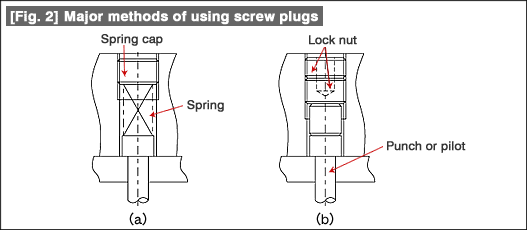
The method of using a screw plug is shown in Fig. 2.

Fig. 2 Major methods of using screw plugs

The method of use as a cap screw of a spring is shown in (a). This is the method of use when it is desired to adjust the strength of the spring by the extent of tightening the screw plug.

Care should be taken while using this method to make sure that the spring is compressed at all times. If the spring is not compressed, it shakes inside the hole, and consequently there is the danger that the screw plug becomes loose.

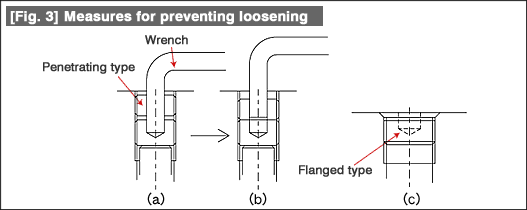
The method of use as a lock nut is shown in (b). A lock nut is a method of using the opposing forces of two screws to prevent the screws from becoming loose. The method of use is shown Fig. 3(a) and (b). An ordinary screw plug and one with a penetrating spanner hole are combined together.

Fig. 3 Measures for preventing loosening

To lock a lock nut, first the spanner is inserted and operated as shown in Fig. 3(a) until the nuts are tightened. After that, the spanner is lifted up as shown in Fig. 3(b) and only the screw plug with a penetrating spanner hole is tightened thereby preventing them from becoming loose. The screw plug with a penetrating spanner hole was developed for use as a lock nut.

Another method of preventing loosening is the flanged type screw plug. Elastic deformation occurs when the flange surface is strongly pressed against the hole. This is a type of screw plug in which loosening is prevented using this force.

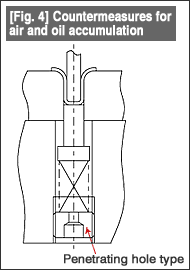
Figure 4 shows a shape that occurs frequently in dies. This figure shows and example of a step in a drawing operation. Drawing oil is used in a drawing operation. The drawing oil enters the hole of the spring by passing through the gap of the die. If it does not have an escape path, it gets collected at the bottom leasing to accidents (the accumulated oil cannot be seen from outside). As a countermeasure for this, there is the method of using a screw plug for a lock nut, and the method of using the penetrating hole type shown in Fig. 1(c). Fig. 1(c) is the type prepared for the purpose of removing air or oil. Fig. 4 Countermeasures for air and oil accumulation

About this Archive

This page is an archive of entries from October 2010 listed from newest to oldest.

September 2010 is the previous archive.

November 2010 is the next archive.

Find recent content on the main index or look in the archives to find all content.