July 2010 Archives

Figure 1 shows the relationship between the material feed and the stroke in a press machine.
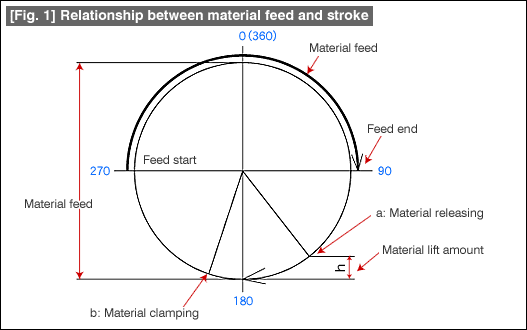
Fig. 1 Relationship between material feed and stroke

The slide of the press machine starts moving down from the top dead center (0° ) and reaches the bottom dead center (180° ). Material feed is started from the mid point (270° ) of the return process, and completes the feeding at the mid point (90° ) of the lowering process (typical timing). The feeding device not only does this kind of simple movement, but also carries out a little more complex movement.

Some feeding error occurs during material feeding. This feeding error does not become a problem if it is a product that is finished in one stroke such as a blanking operation. However, during successive forming, a product gets completed only after several strokes. In such forming, feed errors are not permissible and corrections become necessary. This role is played in a mold by a pilot. A pilot moves the material finely by entering into the pilot holes made in the material thereby correcting the feed errors. If the feeding device is clamping the material at this time, the pilot cannot move the material and correct the error.
It is necessary that the feeding device releases the material at timings matching with the movement of the pilot. This movement is called "material releasing". Usually, material releasing is matched with the position at which the material is lifted in the die (material lifting position). The end of material releasing (material clamping) is done after the slide has passed the bottom dead center.

There are two typical forms of material feeding devices, namely, roll feeder and gripper feeder.

Fig. 2 shows the principles of operation of a roll feeder.
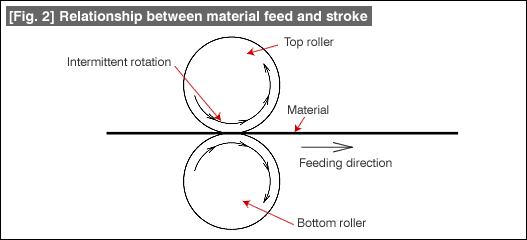
Fig. 2 Roll feeder

This feeder is made up of a top roller and a bottom roller. The rollers feed the material by intermittently rotating by a distance equal to the feed length.
Unidirectional clutches, various types of cam mechanisms, and servo motors, etc., are used as the means for carrying out intermittent rotation.
Usually, the bottom roller is fixed, and the top roller is pressing against the bottom roller by the force of a spring, etc. For material releasing, the top roller is pushed up using a lever, etc.

Fig. 3 shows the principles of operation of a gripper feeder.
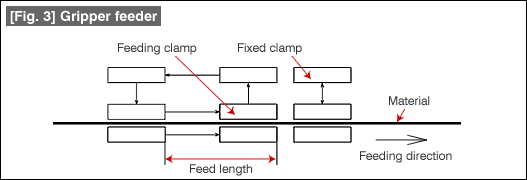
Fig. 3 Gripper feeder

This feeder has two clamps, namely, a feeding clamp and a fixed clamp. As can be understood from the figure, the feeding clamp repeats the operations of opening >> returning >> closing >> feeding. The fixed clamp goes into the open state when the feeding clamp is carrying out the feeding operation and will be in the closed state during all other operations of the feeding clamp. Next, at the time of material releasing, both the feeding clamp and the fixed clamp carry out the opening and closing operation simultaneously.
The movements of the gripper feeder can be operated using air by switching some valves, or can be carried out using some mechanisms such as cams, etc.
During the operations of material feeding, the position of releasing the material changes depending on the amount of material lift. It is necessary to adjust the timing of releasing to match with those changes.
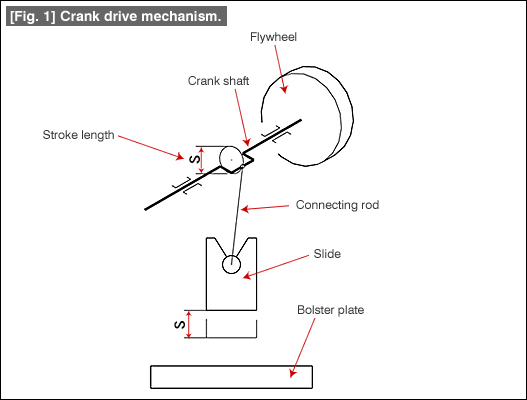
The crank type press machines (crank presses) that are used most frequently among all types of press machines have a structure such as that shown in Fig. 1.

Fig. 1 Crank drive mechanism.

The structure of this type is simple and this type is used widely because it is easy to manufacture. There is a form called eccentric shaft among crank shafts, but recently there is no particular preference being given to any shape of the shaft (because the completeness of the press machine becomes high and since it is possible to confirm that the required functions are being satisfied by checking the specifications).

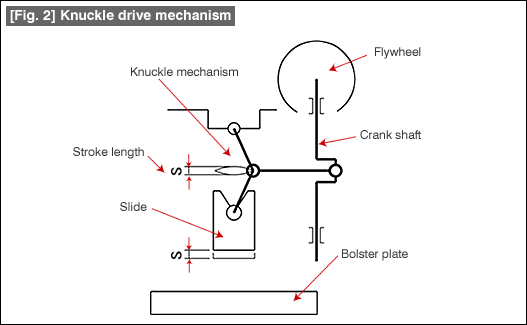
Another typical mechanism is the knuckle mechanism in a press machine. This type of structure is shown in Fig. 2. This is a machine in which the slide is being driven by adding a link to the crank mechanism.

Fig. 2 Knuckle drive mechanism

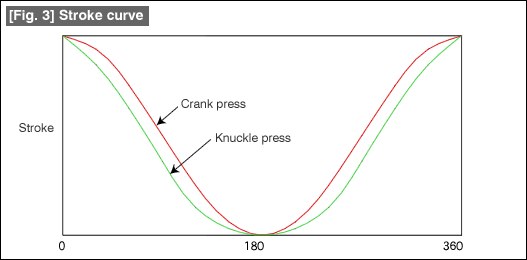
The reason why press machines are manufactured by changing the mechanism is the stroke curve shown in Fig. 3.

Fig. 3

In a crank press, as soon as the slide reaches the bottom dead center, the returning step is stared immediately. In press forming, if there is a slight pressing time at the bottom dead center, there is the characteristic that the formed shape becomes stable. Modifications are made to the drive mechanism in order to exploit this characteristic. The stroke curve of the knuckle mechanism in Fig. 3 becomes more gradual near the bottom dead center compared the stroke curve of the crank mechanism, from which it can be seen that the pressing time is longer than in the case of the crank press. It can be said that this mechanism is one that was prepared for obtaining this forming curve.

Because of this characteristic of the knuckle press is used frequently in the case of forming that includes crushing or when countermeasures are to be taken against spring back of bending, etc. Its disadvantages are that it is difficult to prepare long strokes, and that, since the number of joints becomes large, the overall gap is likely to become large, etc. However, high precision modified press machines of this type are being manufactured at present.

Apart from the above, there is also a type called link press. This type is prepared with the intention of obtaining gradual movement at the bottom dead center and fast returning. In addition, by changing the mechanical details, there are machines in which changes have been made in the motor. This type is called a servo motor press. The press machine of the mechanical type assumes a constant rotation of the crank shaft within one stroke. If it is possible to change the rotation of the shaft, it will be possible to prepare any stroke curve freely. Perhaps the manufacturing of molds may become somewhat easier.

The stroke length of a press machine is selected depending on the details of the job at hand. In blanking formation, the stroke length is short being on the order of 10 to 80mm. In bending or drawing work, it is necessary to select the stroke length taking care about the formed height of the product.
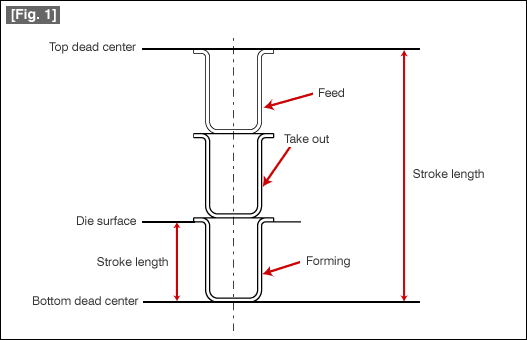
An example of drawing work is described below. See Fig. 1 below.

Fig. 1

The drawing formation starts at the die surface and ends at the bottom dead center. The bottom drawn part of a completely formed product comes above the die surface making it easier to take it out. In addition, unless there is some additional margin, the working becomes difficult. Therefore, in manual operations, a stroke length of more than 2.5 times the product height becomes necessary. When carrying out automatic forming, since time is required for material movement, a stroke length of more than three times the product height can be said to be a safe stroke length. However, caution should be exercised because too long a stroke length decreases the working efficiency. With a short stroke, there are the problems that it is difficult to see inside the die and that it is difficult to take out the product, which also reduces the work efficiency and is dangerous at the same time.

In the relationship with the number of strokes per minute (spm), there is an inversely proportional relationship between spm and stroke length. When spm becomes large, the inertial energy of the slide becomes large, which affects the vibrations, noise, and machine rigidity. Because of this, the stroke is made shorter thereby avoiding these effects. It can also be said that a limit is placed on spm by the stroke length. In a high speed press exceeding 600 spm, the stroke length is about 10 to 30mm. When the stroke length exceeds 200mm, in most cases spm will be less than 50.

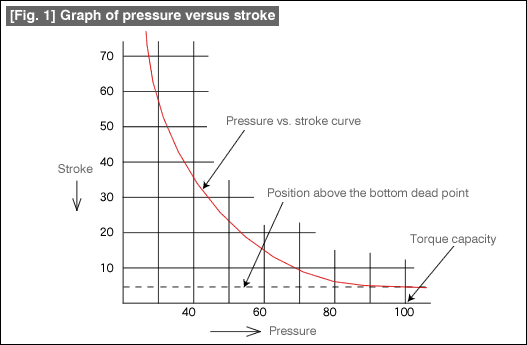
In machine presses such as crank presses, etc., the pressure generated changes depending on the position of the stroke. This point is a big difference from fluid presses such as hydraulic presses in which the pressing force does not change at any position of the stroke. Fig. 1 shows a graph of pressure versus stroke of a crank press.

Fig. 1

This indicates that the pressure generated becomes higher as the stroke position of the slide gets closer to the bottom dead point. Theoretically, it is possible to get infinite pressure. In the indication of the capacity of a press machine, the position of the bottom dead point is determined, and the capacity is indicated. This is called "Torque Capacity".

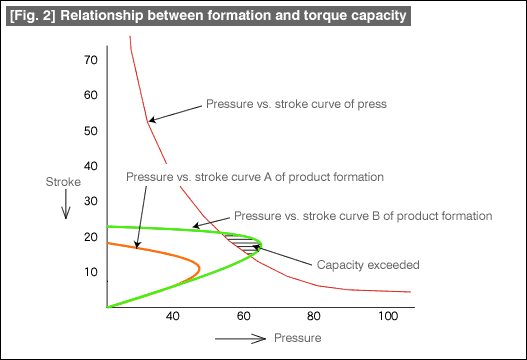
In press formation, the formation starts from a certain position above the bottom dead point, and ends at the bottom dead point. The change in the forming force between the starting point of product formation until the completion of formation is called "the curve of pressure of product formation versus stroke". Fig. 2 shows the pressure versus stroke curves for the product and the press machine superimposed on each other.

Fig. 2

Two curves A and B have been shown for product formation. The product formation curve A is inside the curve for the press machine. If the condition is like this, it indicates that there is no problem in press formation. However, the product formation curve B is intersecting the curve for the press machine. The part indicated by "Capacity exceeded" in the figure indicates that the torque capacity of the press machine has been exceeded. Since the possibility increases of abnormality occurring in the movement transmission parts such as the crank shaft, etc., of the press machine, it will be necessary to use a press machine with a higher capacity.

In actual practice, since it is difficult to know the pressure versus stroke curve of the product formation, the formation will have to be made by judging based the maximum formation pressure. While the maximum formation pressure occurs a little after starting the formation, it should be confirmed that the pressure generated by the press machine at the formation starting position is exceeding the product formation force. If this is done, it is possible to carry out the work with some leeway in the capacity. It is necessary to take particular care in drawing operations because very often the formation starting point comes above.

About this Archive

This page is an archive of entries from July 2010 listed from newest to oldest.

June 2010 is the previous archive.

August 2010 is the next archive.

Find recent content on the main index or look in the archives to find all content.