September 2009 Archives

#012 Basics of Blanking Work (2) Hole Punching Work

Hole punching is another type of basic blanking work. It is good to know the setting of conditions and the problems when carrying out this work.

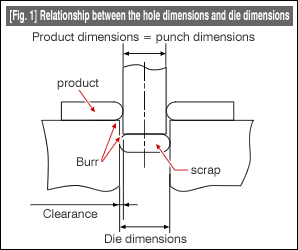
Although hole punching is the same as blanking work, the settings of the conditions of the die are different. The details of this are shown in Fig. 1. The punch dimensions are made equal to the dimensions of the hole to be punched. Further, a clearance is given in the die. This is the opposite of the settings in the blanking operation. The product remains above the die. The scrap passes through the die and falls down. In general, in order to make sure that the product does not warp due to hole punching, very often the die is made with a movable stopper structure. This is done in order to allow the material pressing member to move. Fig. 1

Care should be taken during the hole punching operation when the condition is as shown in Fig. 2. This is because the problem shown in Fig. 2 can occur. When there is some effect on the product such as deformations, etc., it is necessary to take precautions in order to avoid these. It is desirable that the problems shown here are avoided by taking countermeasures with the dies.
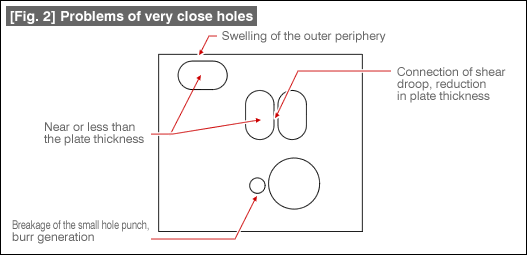
Fig. 2

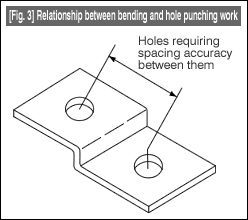
If the accuracy of the relationship is necessary in the position with a bend in between as is shown in Fig. 3, if the work is done before bending, the dimensions will vary causing problems. The process is designed so that the sequence is "Blanking → Bending → Hole punching" thereby eliminating the cause of variations. Fig. 3

In a similar manner, quite often it is not possible to do all the work simultaneously, such as when there are a large number of holes. In particular, the following precautions should be taken in such cases - (1) Making all the holes requiring relationship accuracy to belong to the same group; (2) Separate when there is the possibility of breakage due to very close holes; (3) Carry out the work in the sequence of "rough holes → holes requiring accuracy", etc. The reason for punching holes requiring accuracy after rough holes is to make sure that the hole does not get deformed due to the effects of the sideward force during hole punching when the holes are very close.
#011 Basics of Blanking Work (1) Blanking Work

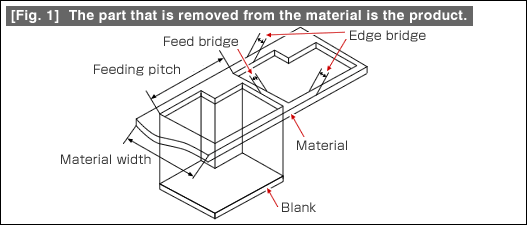
The basics of blanking work are blanking using a press. In blanking work, very often the contour shape of the press fabricated product is formed. The work of forming the contour shape is called external shape forming or blanking work. This is shown in Fig.

Fig. 1 The part that is removed from the material is the product.

The material is made a little larger in order to prepare blanks. The part by which the material is made larger is called the "bridge". Bridges are of two types, namely, the "feed bridge" and "edge bridge". A guideline for the minimum value of the width of a bridge is as follows. - Feed bridge = 1.5t or 0.7mm, - Edge bridge = 1.5 x feed bridge.

In the case of shapes that are circular or with short straight line parts, it is also possible to make these a little smaller than the above. If the bridge width is made too small, it may not be possible to blank properly, or the wearing out of the punch and die becomes more rapid causing the generation of burrs. The feed pitch and the material width are obtained by adding the feed bridge and the edge bridge to the dimensions of the blank. The bridge widths are adjusted so that these two become integer numbers.

The relationship between the blank dimensions and the dimensions of the die is very important. Making a mistake in this can have very serious consequences. This relationship is shown in Fig. 2.

[Fig. 2] Relationship between the die dimensions and product dimensions

In blanking work, the blank (product) dimensions are made the die dimensions. The punch will be made smaller by the amount of the clearance. The blank enters inside the die. The method of taking out the blank that is inside the die can be either taking it out by making it pass through the die or by taking it out from where it entered by pushing from inside the die. A part of the die that pushes the blank is called a knock out. Take care also about the direction in which burrs are generated during blanking work. (See Fig. 2.) Depending on the product, very often it is required to make the direction of burrs the same in the outer shape and the holes.

The arrangement of blanks during blanking work is called the blank layout (how blanks are taken from a plate). Some examples of this are shown in Fig. 3. The rate of utilization of the material differs depending on the arrangement. The arrangement is selected so that the material is not wasted.

[Fig. 3] Blank layout

#010 Change in Die Structure Depending on the Guides

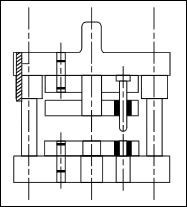
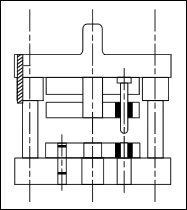
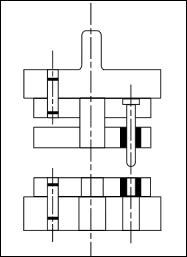
The die for press work is made of a top die and a bottom die. If the relationship between the top die and the bottom die is not correct, either the press work cannot be made properly or repairs will become necessary early on. This relationship is created by what are called guides. Such guides are called die matching guides or cutting edge matching guides. The well known form of such a guide is a die set. However, a die set is one form of a cutting edge matching guide. The various forms of guides are explained below while referring to the figures.

Structure of Dies: Change in Die Structure Depending on the Guides

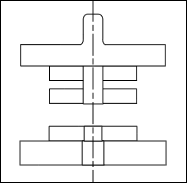
(1) Structure without a guide
Although is it may appear strange that this structure appears in the explanation of guides, there are dies with a structure in which the relationship with the die is created directly by the punch. Further, this structure shows the basic form of a die. Guides are secondary structures. Because of the presence of guides, it becomes easy to install the die in the pressing machine, or the assembly of the die becomes easy, or the accuracy during press operation (the dynamic accuracy) becomes better. The die can be used even if there are no guides and the pressing work can be carried out.

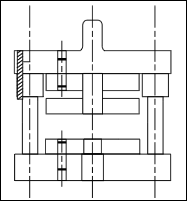
(2) Outer guide structure (die set structure)
This is the most basic guide structure. This was developed for the purpose of making the assembly of the die and the installation of the die in the pressing machine easy. This structure is called the outer guide structure because the guiding is done on the outer side of the plate. The relationship between the punch and the die is established by a coupling using a dowel pin (knock pin). The accuracy of the relationship between the punch and the die is determined by how the dowel pin is inserted.

(3) Additional inner guide structure
This is a structure that is a die set structure to which an inner guide (sub-guide) has been added. A guide that is inside the plate and guides the movement of the die relative to the punch is called an inner guide. The inner guide restricts the movement of the stripper plate and increases the accuracy. The inner guide determines the relationship between the punch and the die. The accuracy increases because the relationship between the punch and the die is maintained without needing a coupling through a dowel pin. On the other hand, it is difficult to manufacture. Since a dowel pin is present in this structure, there may be problems due to interference between the outer guide and the inner guide.

(4) Structure without a dowel pin
Interference with the dowel pin may occur if an inner guide is added to a die set structure. In order to avoid this interference, it is better to remove the dowel pin, and hence this is a structure in which the top or the bottom dowel pin has been removed. It is very common to remove the dowel pin from the top die.

(5) Inner guide structure
A guide is a part that establishes the relationship between the punch and the die. A dual structure is one in which the guiding is done by both an outer guide and an inner guide. The inner guide structure is one in which there is only one guide that is the inner guide that can guide directly while eliminating the outer guide. This structure is suitable for small dies. In a large guide, separating the top and the bottom is very difficult.

(Additional) Quick die change unit

There is a quick die change unit that is used in single preparation stage, etc. This structure can be considered to be one in which only the inside of the die set of the die is a unit that is exchanged. Since a dowel pin having some looseness is used, it cannot be used for dies with small clearances (but can be used if there is an inner guide).

A guide does not function completely if it is only put there for the sake of its form. Guides should be used considering the accuracy of the die and the purpose of using the guides.

#009 Plate Constitution and Plate Form of Dies

Plate constitution is one of the elements that determine the structure of a die. The plate constitution has a deep relationship to the method of preparing the major plates of a die. The details are explained using [Fig. 1]

[Fig. 1] Method of preparing compound die structures (example of a compound blanking die)

The maximum number of plates constituting a die is 8 (excluding compound dies or shoes, etc.).

The basic constitution has the five plates of - (1) punch holder, (3) punch plate, (5) stripper plate, (6) die plate, and (8) die holder.

When the punch is big, it is also possible to omit the punch plate and the punch holder and to attach the punch directly to the shank. In this case, the constitution will consist of the three plates of the stripper plate, the die plate, and the die holder. Even the stripper plate is not necessary in dies such as bending dies, etc., and the constitutions can have only two plates. However, such plate constitutions are a minority and most have a constitution of five plates and possibly an additional backing plate. While the main function of a backing plate is that of backing up the punch, etc., it is also used for fixing nests, or for adjusting the height, and sometimes as a bottom touching plate.

A factor that decides whether or not a packing plate is necessary is the form of the plates. Packing is not necessary, as can be understood from the figures, in the cases of the solid type, pocket type, or yoke type. Among these three types of plates, recently the solid type is being used more frequently. The other two types are not used as frequently.

In the case of the insert type, since a different part (nested part) is assembled inside the plate, it is necessary to fix the nested part or to back it up, and a backing plate becomes necessary.

As is clear from the above explanation, the plate constitution will have a larger number of plates and very often 8 plates in the case of dies using insert type plates such as the die or stripper plates, that is, in the case of the so called precision type dies.

When the plate constitution has a fewer number of plates, naturally, it is possible to prepare the die cheaply. The plate constitution is determined by judging the method of using the die (whether the number of pressing operations is large or small) or the accuracy of the die.

About this Archive

This page is an archive of entries from September 2009 listed from newest to oldest.

August 2009 is the previous archive.

October 2009 is the next archive.

Find recent content on the main index or look in the archives to find all content.