June 2013 Archives

#163 Problems in Punching and their Countermeasures (2) Bending due to Punching

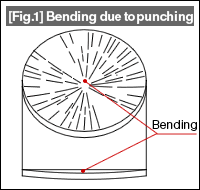
Bending (also called warping, but here, the term bending is used to imply deformation only in one axis which is different from bending along the entire circumference) occurs in blanking operations (blank punching, outer shape punching) as shown in Fig. 1. Fig.1

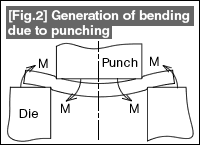
In the initial stage of a punching operation, the material gets deformed into a shape as shown in Fig. 2. A force (bending moment) acts on the punch and the die so as to bend the material at the clearance. Because of this, the material gets twisted and gets bent.

If this bending stress does not exceed the elastic region of the material being formed, when the blank is separated from the die it returns to its original shape. If the bending stress exceeds the elastic region of the material and gets into the plastic region, the bending remains even when the blank is separated from the die.

The bending becomes large as the clearance becomes large. This is because the distance between the two points increases where the force operates to twist the material. In a similar manner, this also occurs even when the cutting edges of the punch and the die wear out and become rounded.
Fig.2

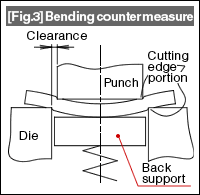
The clearance is made small as a countermeasure in order to make the bending small. Carry out regrinding of the punch and die earlier thereby reducing the forming using worn cutting edges. This can be said to be the countermeasure in the common dies. (See Fig. 3)

As a more positive countermeasure, since it is good if the bending is suppressed, there is the method of incorporating in the die a back support such as that shown in Fig. 3.
Fig.3

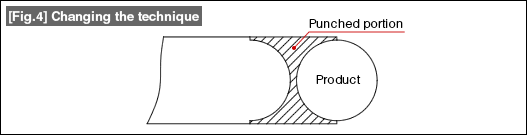
The metal forming method of punching can be said to have a die structure with which it is easy for bending to occur. In the technique shown in Fig. 4 in which the part that becomes the scrap is removed and the product is left on the die, since it is possible to carry out the forming while constantly pressing the material, it is possible to make bending small (in this case, even warping can be made small). This method is being used widely in the case of products in which a high degree of flatness is required.

Fig.4

#162 Problems in Punching and their Countermeasures (1) Punching Burrs

In common punching operations, the cut surface is formed in the material in the sequence of droop → shear cross-section → fracture cross-section → burr, as shown in Fig. 1.
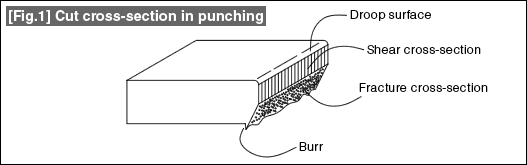
Fig. 1

When a soft steel plate (SPC steel) which is used most frequently in press forming is cut with a standard clearance, the length of the shear cross-section becomes about 1/3 of the material plate thickness, and the height of the burr becomes about 0.03 to 0.05. In case this amount of burrs is considered to be within normal tolerable range, this was called "return" thereby distinguishing it from abnormalities.

However, due to the product liability laws in recent years, even a small burr is considered to be a cause of scratch injury to hands or fingers, and it is being required more and more frequently that the burrs be removed by surface flattening.

Burrs should be made extremely small. Depending on the material being formed, the manner in which burrs appear differs. Burrs can occur easily in the case of soft materials because their elongation is large. Therefore, the punching clearance is made small. Since hard materials can break easily (brittle), there is no problem even if the clearance is made larger (the punching force becomes smaller as the clearance becomes larger). In the case of brasses, increasing the amount of zinc makes the elongation smaller and the material more brittle. The amount of zinc is controlled as a countermeasure in punching.

Burrs become small when an appropriate clearance is used. Therefore, the clearance is set so that it becomes uniform for the shape being punched. This is the basic attitude when preparing a punching die. However, even if a uniform clearance is set, there are shapes in which burrs appear quickly. As shown in Fig. 2, this is pronounced at the apexes of sharp projection or recess parts, which are followed by corners that do not have rounding.
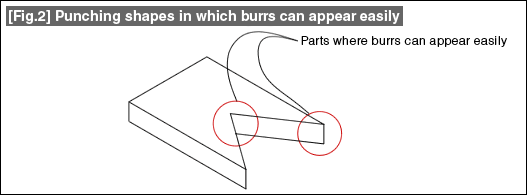
Fig. 2

The cause of this is the chipping of the corners of the punch or the die. Chipping occurs due to combined effects of the shape and the punching conditions. Even when an appropriate clearance is used, the punching conditions are bad in the corner parts (the punching conditions will be similar to when the clearance is small), and the cut surface will not be normal. The countermeasure is to make sure that the punching conditions are the same as in the straight line parts. There are two methods for this, one of which is to round the corners (corners with an R of 1/2 of the material plate thickness or more), and the other is to increase the clearance.

Burrs are also generated due to the relationship between the punch and the die. This is shown in Fig. 3.
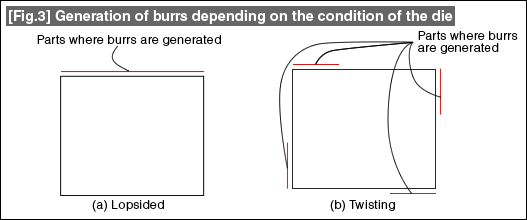
Fig. 3

Lopsided and twisted clearances are the commonly found phenomena.

The checking of the clearance of a punching die can be made by punching a paper or vinyl sheet. A paper or vinyl sheet is placed on the die, the punch is stopped just when it has entered into the die by a very small amount, and the condition of punching of the paper or vinyl sheet is inspected. The parts that have been cut neatly are the parts where the clearance is small. The clearance is large where the fibers of the paper are remaining uncut or where the vinyl sheet has been cut so that it is stretched. Adjust so that the cutting is uniform.

Apart from the above, there are other causes of burr generation. The above are only the typical causes of burrs.

#161 Design of Compound Punching Dies (10) Stripper and Material Guide

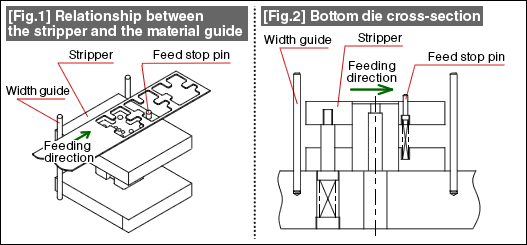
The material guide in a compound punching die is discussed in this tutorial. Fig. 1 shows the state in which forming is being done using a compound punching die. The cross-section of the corresponding bottom die structure is shown in Fig. 2.

Fig. 1, Fig. 2

The material moves above the stripper plate. The width guide of the material is frequently constituted by a round rod, etc., placed only on one side. This is in order to be compatible with changes in the material width and because it would be convenient while taking out the product.
In specific terms, in the case of forming with fixed length materials and when the product is large and falls down after being ejected from the top die above on to the material on the bottom die, the product on the material is blown so that it falls outside the die and can be collected. Since this type of operation becomes difficult to carry out if the material width is firmly guided, it is common to guide the material along the width direction only on one side.
There is also the intention of eliminating the need to put a hand inside the die to take out the product.
There is no problem even if the material is firmly guided along its width if the product has a size that makes it possible to be blown away by an air blast.

The positioning in the feeding direction is done by a stop pin. A stop pin is not necessary when forming using a feeding device that feeds a coil material for forming. But a stop pin is necessary when fixed length material is being worked manually. A stop pin is placed at a position where the shape is stable. Very often the stop pin is made of the movable type.

In compound punching, measures are taken so that some slight variations in the positioning do not cause any problems by having a slightly wider bridge than in blanking.

The stripper surface is made about 0.5 mm to 1.0 mm higher than the outer shape punching punch surface so that the material feeding is not obstructed. The hole in the stripper in which the punch for outer shape punching passes through is not matched exactly as in the relationship between the die hole and the knockout, but escapes are provided in some parts thereby ensuring that there is no occurrence of fusing of biting of the punch for outer shape punching and the stripper.

The stripper has the functions of both stripping and lifting.

#160 Design of Compound Punching Dies (9) Design of a Knockout - 4

A compound punched product is in the state in which it has been pushed inside the die and is pushed up by the knockout, but is staying inside the die due to the force of friction with the die. In Tutorial #154, we have explained the relationship between the press machine and the knockout. Please refer also to that tutorial and read the following.

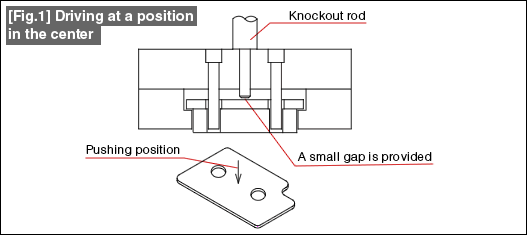
In the shape shown in Fig. 1, since there is a gap at the center of the knockout, it is possible to press the knockout directly with the knockout rod. If it is possible to adopt this method, it is possible to simplify the die structure.

Fig. 1

If the knockout rod is stepped and is pushed too abnormally, the knockout is prevented from being affected because the step in the knockout rod receives that abnormal push. In addition, even when there is no abnormality, a slight gap is provided between the knockout and the tip of the knockout rod so that the knockout is not pushed more than necessary. The size of this gap is less than the length by which the knockout comes out of the die surface (see Tutorial #158).

The precaution in this method of pushing at the center is that even the positions of the holes in the product should be balanced. A lopsided placement of holes wherein the holes are more in some parts is not good because then a force will always act to make the knockout get tilted. In such shapes, it is necessary to adopt the method shown below.

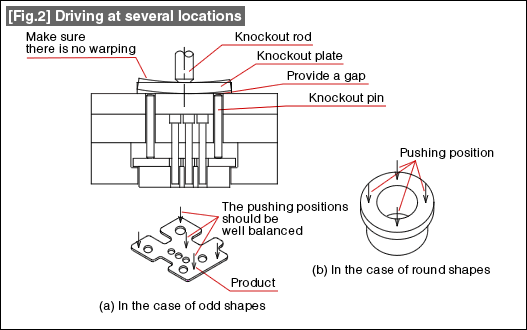
Fig. 2(a) shows the most commonly used structure for driving a knockout. Several knockout pins are provided considering the balance between the shape of the product and the placement of holes so as to push down the product in a balanced manner. In Tutorial #160, even in the method of supporting the knockout by suspension bolts, the placement of the suspension bolts is also made as per the above description.

Even in this case, the knockout pin is made slightly short thereby ensuring that the knockout is not pushed too much.

The knockouts will be placed in a circular fashion when forming round shapes such as washers, etc, and three or four pins are positioned as shown in Fig. 2(b).

Fig. 2

The knockout pin transfers the force of the knockout rod via the knockout plate. The knockout plate can get warped if it is too thin. Take care about this.

It goes without saying that the lengths of all knockout pins are the same.

About this Archive

This page is an archive of entries from June 2013 listed from newest to oldest.

May 2013 is the previous archive.

July 2013 is the next archive.

Find recent content on the main index or look in the archives to find all content.