April 2010 Archives

A blanking and drawing die is a compound die that combines blank punching and first drawing.
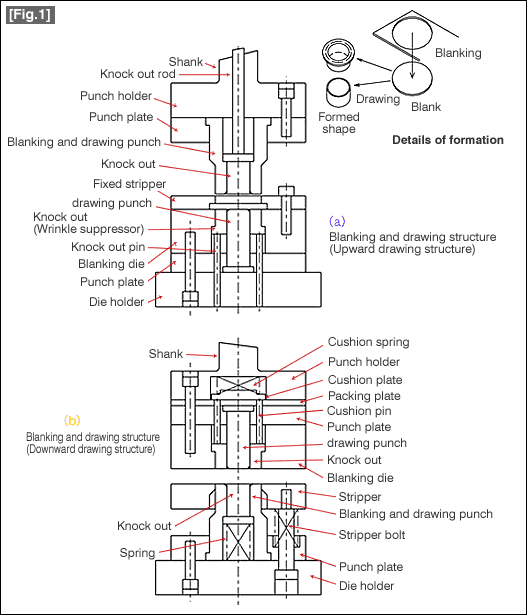
Fig.

The upward drawing structure is shown in Fig. (a).  While a fixed stripper structure has been shown in this figure, it is also possible to have a movable stripper structure in which the stripper is provided in the top die. The content of forming is shown in the figure marked "formed shape". The blank is punched using the blanking and drawing punch (compound part: this is the punch for blanking as well as the die for drawing), and subsequently, drawing is done by the continuing stroke. The drawn product is ejected from the top die by the knock out mechanism near the top dead point.

The knock out in the bottom die has the function of making sure that the product does not stick to the punch and of wrinkle suppression.

The downward drawing structure is shown in Fig. (b). This is not suitable for longer product drawing because of the spring space.

In the case of shallow drawing, it is possible to make this a drawing and dropping structure by removing the knock out and spring in the bottom die and opening a hole in the die holder for letting the product pass through it.

The drawback of the blanking and drawing structure is in maintenance. Maintenance will have to be carried out when burrs start appearing because of the cutting part of blanking is worn out or damaged. Although the damaged part is ground again and the cutting edge is created again, since even the rounded part of the drawing die is ground, it will be necessary to reconstruct the rounded part of the die. Every time maintenance is carried out, if the reconstruction of the die is not made with the rounding of the same shape, there will be changes in the drawing thereby causing defects in drawing. In addition, since the structure is weak, if any mistake is made in the press operation, the die breaks immediately. This is also another drawback.

Although this type of compound structure has drawbacks, its attraction is that the process can be made short. If an upward drawing type blanking and drawing structure is used, it is possible to carry out compound forming operation of blanking → drawing → hole punching.
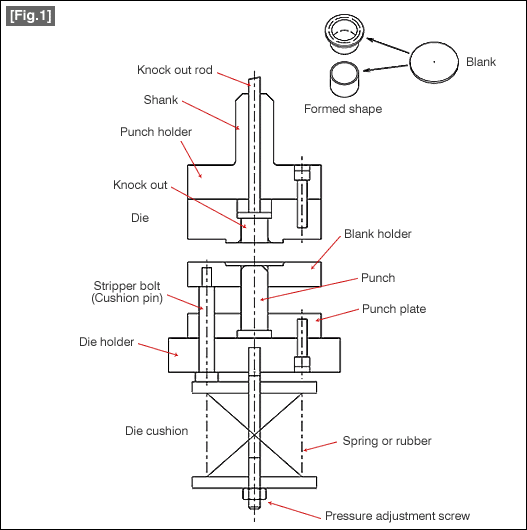
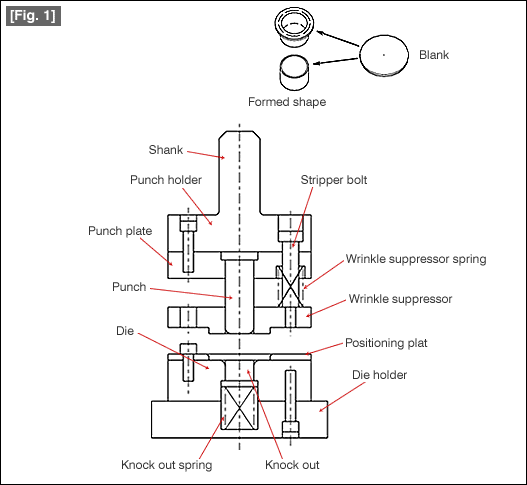
This is a drawing die structure in which the placement of punch and die is inverted. This die structure is shown in Fig. 1.

Fig. 1

This die structure is used extremely frequently for drawing operations. The wrinkle suppressor is very often called the blank holder. This is because the blank positioning part has been prepared in the wrinkle suppressor. The material to be formed is placed on the blank holder, the drawing is done upwards from below, and the product enters the die. The product that has entered the die is ejected from the die by the knock out at the top dead point, and is blown away to outside the die by compressed air, etc.

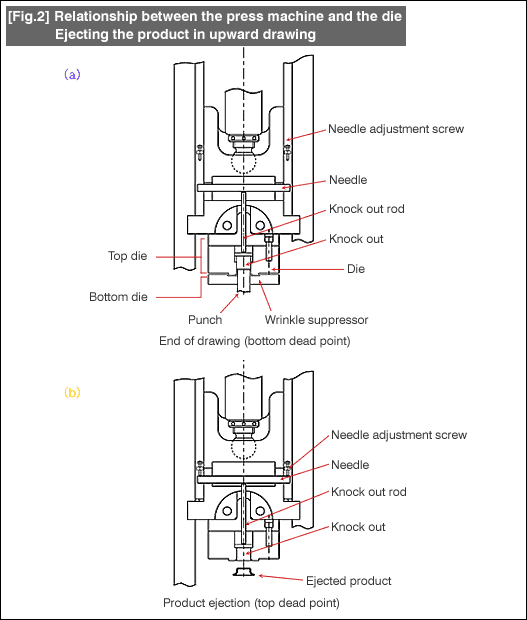
The method of knocking out is shown in Fig. 2

Fig. 2 Relationship between the press machine and the die

The state at the bottom dead point after completion of drawing is shown in Fig. 2(a). The product that has been drawn by the punch of the bottom die is present inside the die. The knock out is pushed up by the product. Along with the knock out, the knock out rod and the needle of the press machine are pushed up together. From this condition, although the slide of the press machine rises towards the top dead point, the product that has entered the die remains as it is in the die. After rising to near the top dead point, the needle hits against the needle adjustment screw. When this happens, the needle is lowered and lowers the knock out via the knock out rod, and ejects the product to outside the die. Fig. 2(b) shows the condition when the product ejection has been completed. The fearsome thing in this knock out structure is that of adjusting the needle. If the needle adjustment screw is lowered too much by mistake, the knock out rod will get bent. In the worst case, the top die gets detached from the slide and falls down thereby leading to accidents. When the knock out is not used or before adjusting the knock out, the needle adjustment screw should always be unscrewed up to the topmost position.

Returning to Fig. 1 let us pay attention to the die cushion in the bottom die. (This figure is showing a small die. In a large die, the die cushion will become an accessory apparatus of the press machine.) The die cushion is extending downwards after passing through the bolster hole of the press machine. Therefore, a considerably long spring can be used. This implies that it is possible to carry out the forming of even a considerably long drawn product. This makes it possible to form difficult products that can not be formed using downward drawing. Since it is sufficient to merely place the blank on the blank holder, the operability of press operation is much better than that of downward drawing. This can be used for forming shapes from blanks even when the product has a flange as well as when the product does not have a flange.

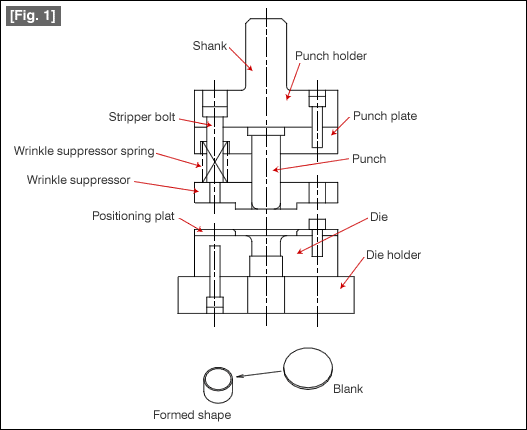
This is a structure in which a knock out is incorporated in a die of the drawing and dropping type structure with movable wrinkle suppressor. This structure is shown in Fig. 1

Fig. 1

This structure can be used for both drawing of cylindrical shapes with flanges and drawing of cylindrical shapes without flanges from blanks. In addition, since the forming is done while gripping the material between the punch and the knock out, the flatness of the bottom of the drawing object is quite good. The knock out has the two functions of pressing down the material and of ejecting the product.

The drawback of this structure is that it is not suitable for deep drawing. The reason for this is that there is some restriction on the length of the spring that can be incorporated. Considering the top die, the punch becomes longer in proportional to the depth of drawing. At the same time, it is necessary to make even the spring for the wrinkle suppressor longer. If the length of the spring is determined from the amount of deflection of the spring, a longer space than the punch may be required, and hence the top die becomes large thereby it becomes difficult or impossible to realize the structure because of the balance relationship with the bottom die or because of the die height,

The same can be said of the knock out spring of the bottom die.

Because of the spring space, this is a structure that is used frequently for relatively shallow drawing operations.

When this die is seen from the point of view of press operations, this structure cannot be said to have ease of operation. In specific terms, the material is inserted in the positioning plate in the lower die. The drawing is done when the upper die comes down. Although the formed product is ejected from the die in the condition in which it is gripped between the knock out and the wrinkle suppressor of the top die, since the product is being pressed down by the wrinkle suppressor, the product will remain on the die. This product is removed by the operator and the next material is inserted inside the die. Since the operator will have to carry out the two operations of inserting the material into the die and of taking out the product from inside the die, the efficiency of operation goes down compared to merely inserting the material inside the die which is then drawn and dropped.

The most important parts of a die for drawing are the punch, the die, and the wrinkle suppressor. When drawing a cylindrical shape without a flange from a blank, a die of the drawing and dropping structure such as the one shown in Fig. 1 is used. The material to be formed is placed on the positioning plate, and after that material is drawn by the punch, the product is made to pass through the die and fall down. Even the die structure is simple and easy to prepare, and the die structure can be said to be one offering efficient press operation. The drawback is that the bottom part gets bent and it is difficult to make it flat.

image

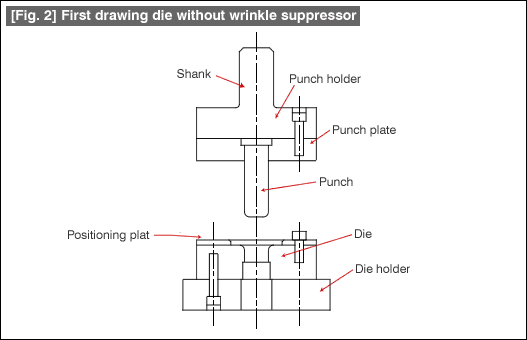
The wrinkle suppressor in cylindrical drawing is used for the purpose of preventing the generation of wrinkles because of the material getting buckled due to the compression in the circumferential direction during drawing of the blank. The generation of wrinkles can be known roughly from the value of the material thickness divided into the diameter of the blank (expressed as a % value, and called the relative plate thickness). When the relative plate thickness is 3 or more with the drawing ratio (m) being about 0.6, it is possible to draw even without a wrinkle suppressor. As is shown in Fig. 2, the structure of the die can also be much simpler.

image

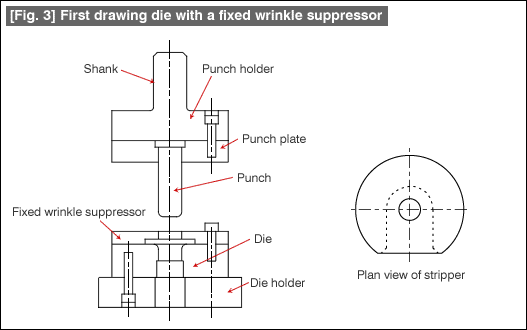
The purpose of the wrinkle suppressor is to suppress the buckling of the material. It is sufficient to prepare a gap so that the material to be drawn can move, and also wrinkles are not formed, and hence there is also a die structure using a fixed stripper as shown in Fig. 3.

image

Although this structure is easy to prepare compared to the structure of Fig. 1 using a spring, it is difficult to carry out manual press operation. This is used for simple type die for small volume production when used for manual operations. For mass production, the suitable structure is one in which automatic forming is done using a pusher feeder (an apparatus that carries out automatic forming by inserting into the die one sheet at a time from a pile of blanks that are pushed out by a plate shaped part carrying out reciprocating movement). Since quite a large force acts on the wrinkle suppressor, it will get warped if it is too thin. It is necessary to design it with a slightly larger thickness.

Although movable type wrinkle suppressors are very common, depending on the conditions, it may not even be necessary. The structure of a die should not be determined shortsightedly and in haste, but should be determined checking even the forming conditions and the method of working, etc.

About this Archive

This page is an archive of entries from April 2010 listed from newest to oldest.

March 2010 is the previous archive.

May 2010 is the next archive.

Find recent content on the main index or look in the archives to find all content.