(1) Outline of Dies
| A blanking die is one which is used for producing contour shapes as is shown in Fig. 1. While the blanked contour becomes the contour of the product as it is in some cases, it is the developed shape of a product formed by bending or drawing, etc. in other cases. This can be said to be one of the basic press forming types. |  |
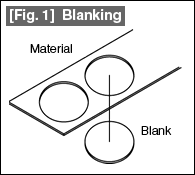 |
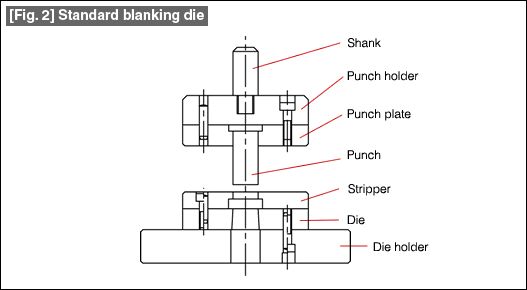
Fig. 2 shows the structure of a standard blanking die. This is a die of the fixed stripper structure. The blanking die is divided into a top die (which is constructed from a shank, a punch holder, a punch plate, and a punch) and a bottom die (which is constructed from a stripper, a die, and a die holder).
As shown in Fig. 3, the top die is installed to the slide of the press machine. In this example, the shank of the die is installed by fixing it using a shank holder. This is a method of installing the top die in the case of relatively small dies.
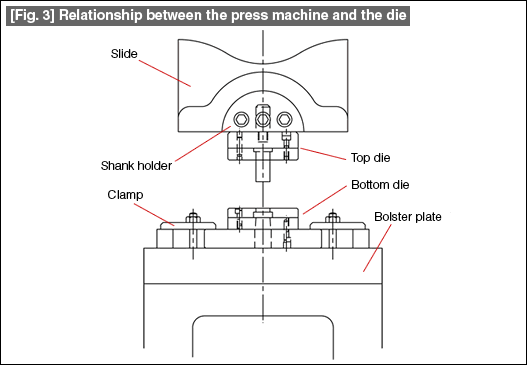
The bottom die is fixed using clamps on the bolster plate of the press machine.
A very important factor in dies is the clearance.
In this example, the clearances of the punch and die are matched at the time of installing the die in the press machine. This type of die is called an open die. The operation of installing the die in the press machine is called "setting up the die". The clearance changes depending on the skill of the worker in setting up the die in the case of an open die.
This can also mean that the quality of the formed product is likely to change every time the die is set up.
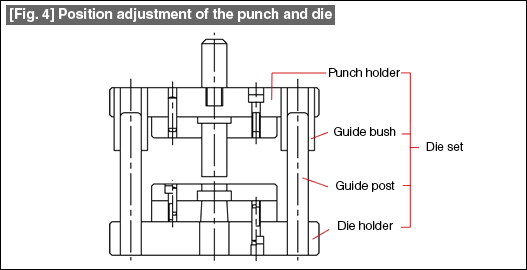
In order to solve this problem, a guide post and a guide bush are used as shown in Fig. 4 so that the relationship between the top die and the bottom die is maintained in the dies themselves. A large number of dies of this type are being used in which the relationship between the top die and the bottom die are maintained constant.
A unit in which the punch holder, guide bush, guide post, and the die holder are integrated into one single unit is called a "die set".
Further, a die of this shape is called a "die with a die set".
(2) Details of die design
Firstly, a die has a specific purpose of metal forming. In this case it is blanking. The functions necessary for blanking are to be understood first and then the concept is to be established.
Work is started after installing a die in the press machine. The method of installing the die is investigated and determined. In this example, the method of fixing used is that of fixing using a shank and a general purpose clamp.
In addition to take measures to make the setting up of the die easy, measures should be taken so that there is no fluctuation in the product quality even if the die is used repeatedly. In this example, the relationship between the die and the punch is maintained constant using a guide post and a guide bush (preventing fluctuations in the clearance), and setting up the die is made easy.
During die design, the necessary items are listed up, the policy is established, and then the detailed design is carried out.
![[Fig.1] Drawing force](http://www.misumi-techcentral.com/tt/en/press/images/127.gif "[Fig.1] Drawing force")
![[Fig.1] V-Bending](http://www.misumi-techcentral.com/tt/en/press/images/126_1.gif "[Fig.1] V-Bending")
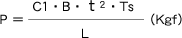 P: Bending force (kgf)
C1: Coefficient
B: Bending line length (mm)
t: Plate thickness (mm)
Ts: Tensile strength(Kgf/mm2)
The coefficient (C1) is 1.33 when the die shoulder width (L) is 8 times the material plate thickness (t), 1.5 when the die shoulder width is about 5 times the plate thickness, and about 1.2 when it is about 16 times the plate thickness.
P: Bending force (kgf)
C1: Coefficient
B: Bending line length (mm)
t: Plate thickness (mm)
Ts: Tensile strength(Kgf/mm2)
The coefficient (C1) is 1.33 when the die shoulder width (L) is 8 times the material plate thickness (t), 1.5 when the die shoulder width is about 5 times the plate thickness, and about 1.2 when it is about 16 times the plate thickness.
![[Fig.2] L-Bending](http://www.misumi-techcentral.com/tt/en/press/images/126_2.gif "[Fig.2] L-Bending")
![[Fig.3] U-Bending](http://www.misumi-techcentral.com/tt/en/press/images/126_3.gif "[Fig.3] U-Bending")

