June 2010 Archives

(the center of the forming force when the die is working) matches with the center of the slide of the press machine. However, due to the restrictions of the product shape or due to the forming method, etc., in a large number of cases it may be difficult to make the center of the die match with the center of the load. In the dies for progressive formation, it can be assumed that all the centers of dies are shifted from the center of the load. When such a die is installed in a press machine, an eccentric load will be applied because the center of the press machine and the load center are shifted with respect to each other.

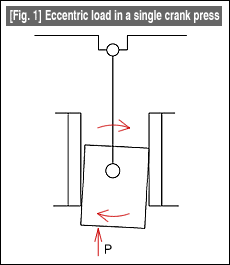
In a single crank press machine (one point press), the slide becomes tilted as is shown in Fig. 1, and the parallelism between the bolster plate and the slide gets disturbed. This inclination is proportional to the magnitude of the load. Naturally, even the life of the die is affected. In a single crank press machine, there are no rules about the relationship between the eccentricity and the load. It is necessary to take measures such as making the eccentricity small by changing the method of installing the die, or to use a press machine with a large capacity. Fig. 1

In the case of a double crank press machine (two points), the effect will be smaller compared to a single crank press machine. In the case of formation of products demanding accuracy, one of the reasons why the use of a double crank press machine is better than the use of a single crank press machine is the relationship with this eccentric load. The method of obtaining the permissible eccentric load of a double crank press machine is shown in Fig. 2.
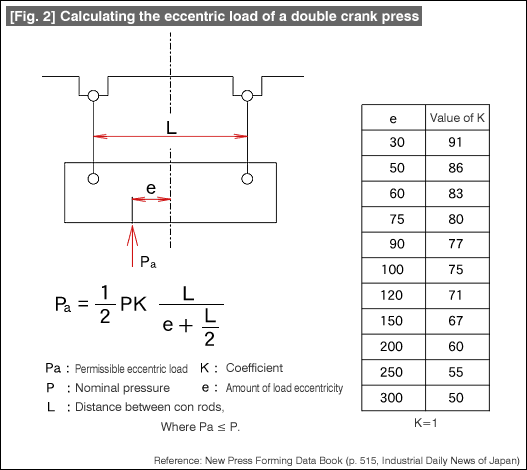
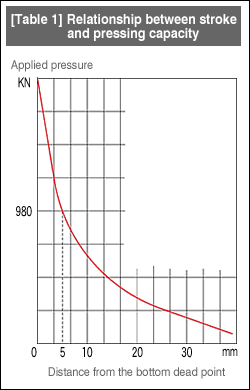
Fig. 2.

In the crank press which is used most widely in press forming, there is the pressing capacity (capacity to apply pressure) which is an indicator of the capacity of the press machine. Pressing capacity is the maximum pressure that the press machine can generate safely. As shown in Table 1 in the case of a crank press, the pressure generated changes depending on the stroke position of the slide. Therefore the pressing capacity indicates the pressure at a determined position above the bottom dead point. In the example shown in Table 1, it can be seen that a pressure of 980kN (980 kilo Newtons = 100 tons) is being obtained at a position of 5 mm above the bottom dead point. Table

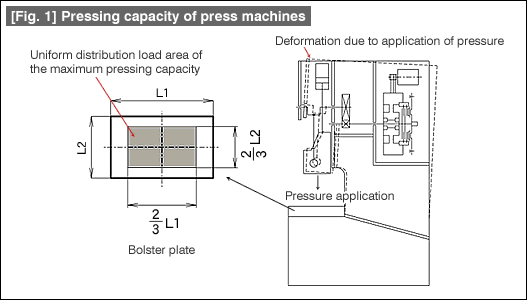
While it is wrongly thought that the press machine is hard and does not get deformed even when the applied pressure is acting, even within the permissible range of the pressure applying capacity, the frame and the bolster plate of the press machine become elastically deformed as shown in Fig. 1. Even when there is deformation of the frame etc., safety is guaranteed if the load is less than the pressure applying capacity.

Fig. 1

The pressure called pressing capacity assumes that uniformly distributed load is active on a predetermined region in the area of the bolster plate as shown in Fig. 1. Even within the permissible range of the pressing capacity it is not good to make a concentrated force act on a narrow region.

From the aspect of life of the die, if work is done at the maximum pressing capacity, the life of the die becomes shorter due to the effects of deformations of the frame and the bolster plate of the press machine. When the life of the die is considered, it is necessary to carry out the work while having some leeway with respect to the pressing capacity. In general, it is considered good for the life of the die to carry out work at pressures up to 60 to 70% of the pressing capacity.

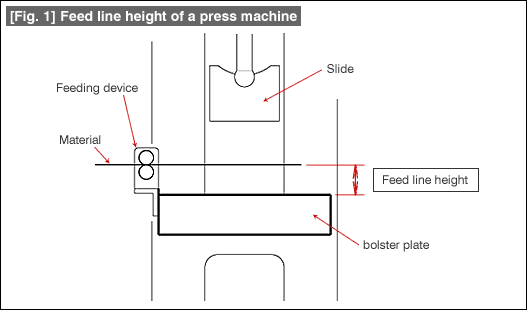
The feed line height of the material is the height from the bolster plate surface to the movement position of the material, as is shown in Fig. 1. This may also be referred to as "feed level" or "path line". In the case of a press die for carrying out automatic forming using a material feeding device, it is necessary to make both the die height and the feed line height match with the press machine.

Fig. 1 Feed line height of a press machine

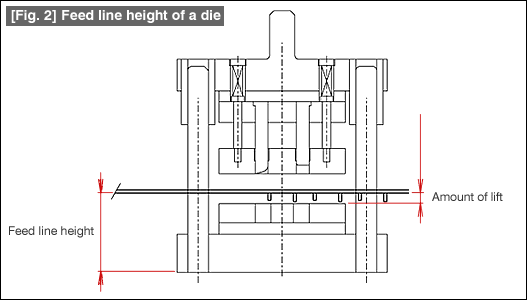
The feed line height of a press die is shown in Fig. 2. This is the distance from the top surface of the bolster plate (bottom surface of the die holder) to the position to which the material has been lifted up from the die surface.

Fig. 2 Feed line height of a die

The feed line height of a press die is shown in Fig. 2. This is the distance from the top surface of the bolster plate (bottom surface of the die holder) to the position to which the material has been lifted up from the die surface.

Lifting up occurs unavoidably in the forming of products that includes forming operations such as bending, etc. The forming of the product is done after pressing the material down from the lifted up state down to the die surface. At this time, if the amount of lift is large the inclination of the material becomes large causing defects in forming. At the time of designing the die care should be taken to ensure that the amount of lift is as small as possible.

If the amount of lift has become large unavoidably, the position of the feed line height of the press machine is set to the position of about half the amount of lift. By doing so, the material tilts slightly upward at the time of feeding the material. At the time of forming the product, the material is pressed down by the top die, the material that has tilted upward first becomes flat (when equal to the feed line height of the press machine), and then starts tilting downward from that state and comes into contact with the die surface. Compared to the normal setting of the feed line height, it is possible to make the tilt small of the material during product forming, and it is also possible to reduce defects in forming.

#043 Relationship Between Press Machine and Die (1) Die Height

There are two types of die heights, namely, die height of the press machine and the die height.

Die height has restrictions related to the height of installing the die. The primary height of the die is that of the press machine, and the secondary height of the die is of the die.

The die height of the press machine is shown in [Fig. 1].

[Fig. 1]

In the condition in which the slide adjustment screw is raised to the upper limit and the slide stroke is lowered to the bottom dead point, the distance from the top surface of the bolster plate to the bottom surface of the slide is the die height of the press machine. In this press machine, it is not possible to install a die with a die height more than this height. If the die has a die height smaller than this height, it is possible to adjust using the height adjustment screw. In the case of a die with a low die height that is outside the adjustment range of the slide adjustment screw, a plate for height adjustment (called a parallel block) is placed above or below the die and then the die is installed.

If the die height varies, it will be necessary to rotate the adjustment screw of the press machine several times, and the time taken for replacing the die becomes long. Therefore, as far as possible, it is better to make uniform the height for all dies that are used by installing in the same press machine, thereby making the amount of adjustment small.

 The die height of a press die is shown in [Fig. 2].

[Fig. 2]

The die height is the height from the bottom surface of the die holder to the top surface of the punch holder in the condition at the bottom dead point when the punch and the die have mated together and the operation has been completed. In the case of a die with a structure in which the punch can penetrate the die to any extent, such as in the case of a blanking die, the depth of penetration of the punch should be decided and the height at that time is taken as the die height.

There are some people who call the die height of a press machine "shut height". The shut height is the distance from the bed surface (bolster surface) to the bottom surface of the slide under the same conditions as for the die height.

About this Archive

This page is an archive of entries from June 2010 listed from newest to oldest.

May 2010 is the previous archive.

July 2010 is the next archive.

Find recent content on the main index or look in the archives to find all content.