October 2009 Archives

#016 Basics of Blanking Work (6) Slit Cutting Work

Slit cutting operations are a type of operation for adding a cutting line. It is possible to form the shape without generating any scrap. Please learn the method for using the slit cutting work.

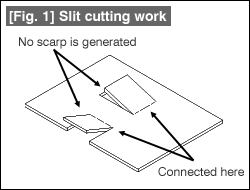
Figure 1 shows the forms of slit cutting work. There is a method for making incisions from an edge of the material and there is a method for making incisions inside the material. Slit cutting work is a type of shearing work in which the punch is provided with an inclination angle. By starting the cut from the tip of the punch and stopping the cut in the middle of the angle of inclination, a part that is not cut will remain in the material. It is possible to form a shape without generating any scrap. Figure 1

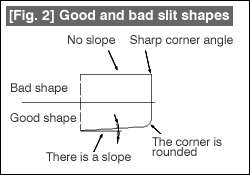
However, there are also problems. Since the cutting is done using an angled punch with a sharp angle, the tip of the punch gets chipped (the corner gets broken by small amounts), and the generation of burrs starts earlier. Although the cutting material under the punch enters into the die, sometimes it does not get dislodged from the die easily. This is because the cut material bites into the die at the width part of the slit that has been cut. A countermeasure for this type of problem is shown in Fig. 2. The part above the middle line is the shape that is not good. The problem gets reduced if this shape is made into the shape shown below the middle line. Figure 2

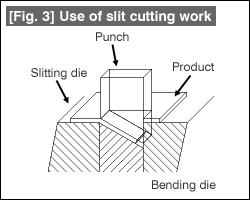
An example of using this method is shown here. Fig. 3 shows a method in which a bent shape is formed while cutting. Although this is a method in which the punch is subjected to a large load, the attraction of this method is that the work can be done in one process. Figure 3

Figure 4(a) shows a method in which slitting and forming are done at the same time. The height of forming is prepared by the elongation of the material. Although both sides are cut in the figure, it is also possible to carry out formation in which only one surface is cut. This type of formation is called louver formation. Louver cutting is used very frequently for vent holes. Fig. 4(b) shows a form in which the slit cutting operation can be used for drawing. By making two slits, the fluctuation of the material due to shrinkage of the blank during drawing work is absorbed.
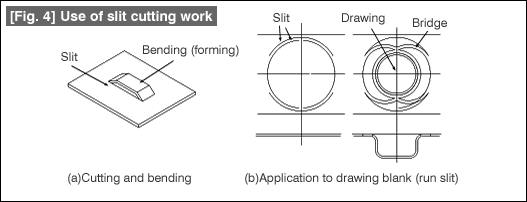
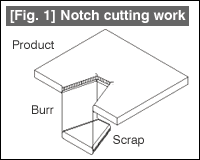
Figure 4

#015 Basics of Blanking Work (5) Notch Cutting Work

Although notch cutting work is an unspectacular type of work, it is a method of working that is used extremely frequently. Please learn the features of this work.

Figure 1 shows a notch. The setting of the dimensions of the notch cutting work is the same as in the hole punching work. The dimensions of the notch that is cut out are equal to the punch dimensions. Therefore, the clearance is taken on the die side. As can be seen from Fig. 1, the feature of the notch cutting work is that the entire periphery is not cut and there is a surface of the punch that does not take part in the cutting. This causes some problems. Fig. 1 Notch cutting work

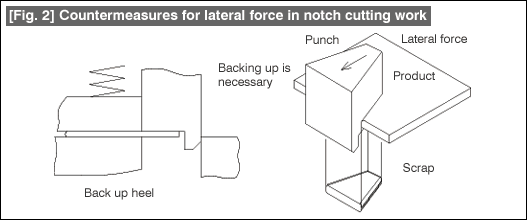
As is shown in Fig. 2, a lateral force (thrust load) acts on the punch. As a result, the clearance becomes widened which becomes a cause for burr generation. As a countermeasure for this, the punch is backed up. One such method is a back up heel. In the method for using the back up heel, before starting the work, the heel part is put inside the die, and when a lateral force acts, it is received by this part so that the punch does not move. As a countermeasure other than a back up heel, there is also the method in which the die side is made in the form of a projection and the lateral force is taken by that part. This method is called the back up block method. Even this is used for the same purpose. Either of these two methods is selected depending on the details of the work to be carried out.

Fig. 2 Countermeasures for lateral force in notch cutting work

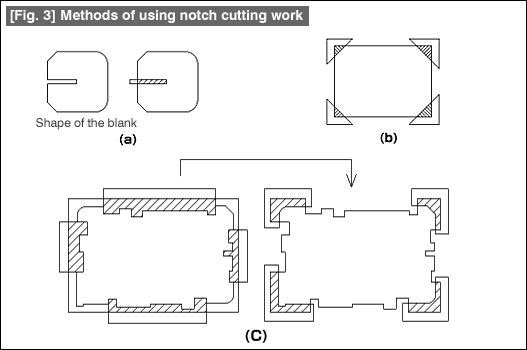
Figure 3 shows some examples of using the notch cutting work. Fig. 3(a) shows a shape in which there is a slot (a notch with a narrow width is usually called a slot) in a part of the blank, and this shape causes the die to break in the part of the slot during blanking. In such situations, the blanking operation is done without the slot part, and a notch cutting operation is made in a separate process (this type of work may also be called slotting work). When there is a hole in the product, the notch cutting operation is combined with the hole punching work. Fig. 3(b) shows a frequently occurring case of carrying out the drawing operation of a rectangular shape from a cut length sheet (sketch material) in which problems in drawing are avoided by cutting the corners. The cutting of the corners in such situations is done by notch cutting work. (Some people may say that this is a type of cutting work because the cutting is made along a single straight line. This is a shape causing conflict between these two opinions.) Fig. 3(c) shows a different case. When the contour of a large shape is cut simultaneously (blanking or trimming, etc.), there may be problems in handling the scrap. In such situations, very often the work is done dividing it into several steps using notch cutting work as is shown in this figure. This is relatively more frequently used for work in the press lines using cut length sheets.

Fig. 3 Methods of using notch cutting work

#014 Basics of Blanking Work (4) Segmenting Work

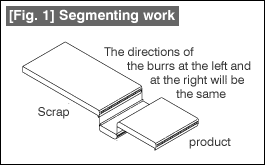
Figure 1 shows a diagram of realizing segmenting work. This is very often compared to cutting work because it is quite similar. While the directions of the burrs at the left and at the right of the product or opposite to each other in cutting work, these directions will be the same in segmenting work. On the other hand, scrap will be generated since the work is done along the width (along two lines). The rate of material utilization becomes somewhat poor compared to the cutting operation. Basically, this method is used when the directions of the burrs at the left and at the right have to be made the same. Fig. 1 Segmenting work

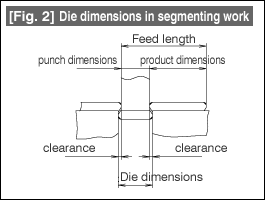
The relationship between the die dimensions and the product dimensions will be as shown in Fig. 2. The feed length (the feed pitch) will be equal to the product dimensions + the punch width. Any fluctuations in the feed length will appear as they are in the product dimensions. The clearance is made on the die side. Fig. 2 Die dimensions in segmenting work

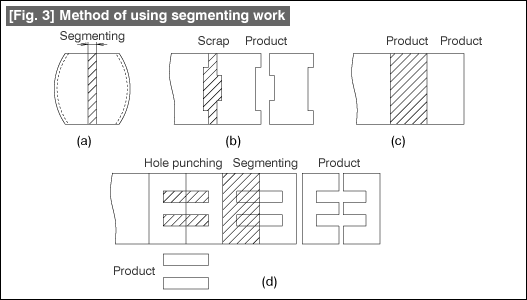
Figure 3 shows a method of using the segmenting work. Fig. 3(a) shows a method of use in which the segmenting work is very clear. Two left and right symmetrical products or two products are produced because of the balance of the working force in bending or flange formation work or when the production quantity is large. Thereafter the segmentation work is made. Fig. 3(b) is the case when blanks are taken from a sheet material or a coil material. Scrap equal to the punch width will be produced. Fig. 3(c) is a modified application of (b). If the shape is as shown in the figure, and if the die dimensions are determined so that even the scrap becomes a product, it is possible to carry out the work without generating any scrap, and even the production efficiency becomes better. Fig. 3(d) is still another modified application. This form is very famous as the method for producing EI cores. In this case, the product has been designed considering the rate of material utilization and the production efficiency. This can be said to be an extremely superior working method that has cleverly matched the features of the product shape and the features of the working method. This can be said to be an example of the result of cooperation between pressing work and product design.

Fig. 3 Method of using segmenting work

#013 Basics of Blanking Work (3) Cutting Operation

Cutting operation is a simple type of shearing work. If this method is used, it is possible to carry out work with a good yield using a simple die.

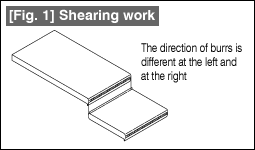
Figure 1 shows a cutting work. The material is cut along a single line. Because of this, the direction of burrs after cutting at the left and at the right will be opposite to each other. Depending on the product, this method may not be able to be used because of the specifications of the direction of burrs, but if this method can be used, it is possible to carry out work without any scraps thereby making the rate of utilization of the material very high. Fig. 1 Shearing work

There are limitations such as those shown in Fig. 2 in carrying out the work along a single line. In other words, the shapes should be the same at the left and at the right. Some times it is possible to carry out shearing work by slightly changing the product shape therefore it is desirable to use shearing work.

Fig. 2 Limitations of shearing work (same shape at the left and at right)

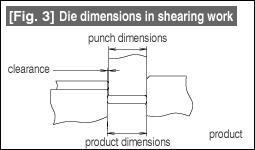
The relationships among the punch, die, and clearance in shearing work will be as shown in Fig. 3. The product dimensions will be shorter than the length of the feed by an amount equal to the clearance. Among blanking operations, the method of setting the clearance is special only in this type of work, and hence care should be taken in regards to this. The reason for this is that the work is done along a single line. Fig. 3 Die dimensions in shearing work

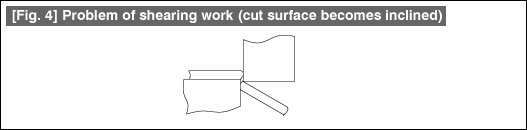
Another cause of trouble due to working along a single line is shown in Fig. 4. Since this is a one sided piece, because of the bending moment generated at the cut part, the material below the punch becomes inclined. If the cutting is made as it is in that condition, even the cut surface of the product becomes inclined. As a countermeasure, the size of the clearance is made less than half the clearance of normal blanking operations. As a strong measure, the inclination of the material during working is suppressed by providing a reverse pressing member in the die.

Fig. 4 Problem of shearing work (cut surface becomes inclined)

If a simple method of work can be used, even the preparation of dies becomes easy, and the cost gets reduced. It is important to review one's work by remembering the basics.

About this Archive

This page is an archive of entries from October 2009 listed from newest to oldest.

September 2009 is the previous archive.

November 2009 is the next archive.

Find recent content on the main index or look in the archives to find all content.