We have so far explained about air cylinders and linear motion guides as the representative machine elements for actuators and slide guides. Before proceeding on to explaining more wide variety of machine elements, concepts of mechanism will be explained.
(1) Differences between hand operations and mechanisms
Design and development concepts for assembly machinery (jig fixtures, semi-automatic machines, fully automatic machines) generally originated from hand operated assembling work. But it can be said that it is virtually impossible to perfectly replicate the movements of manual operations with mechanisms. It is not a good idea to attempt to imitate perception sensors, controls by brain, joints with multiple degrees of freedom, and handling with soft fingers of humans with mechanisms.
Mechanisms are suitable for the movements characterized by the following.
1. Simple 2. Repetitions 3. Continuous 4. Rotation
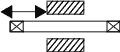
Hand operations can move freely about the space and assemble, but mechanisms can only move reciprocally over slide guidance. |
|
Therefore, the exact movements of hand operations are not to be replicated, though the concept is based on such, but the aim is to replace the hand operations with mechanical elements utilizing the characteristics 1~4.
(2) Fundamental Structure of Machinery (LCA)
Machines are the means to convert materials and parts (INPUT) into desired products (OUTPUT). The [Fig.1] is the fundamental structure. The Mechanisms apply assembling, machining, and moving operations to the (INPUT) and turn them into (OUTPUT).
The actuators (Drive Section) process the Energy, and the Information is processed by a controller (Control Section) to logically operate the mechanism.
All parts of machines are comprised of mechanisms but the most important mechanism is the section that creates the added value of (OUTPUT), and is called in a narrow sense the "Mechanism".
![[Fig.1] Fundamental Structure of Machinery](http://www.misumi-techcentral.com/tt/en/lca/images/052.gif)


 Sliding Pair
