July 2012 Archives

This tutorial describes types of swaging and corresponding characteristics. Figures are sourced from an assembly component technology manual produced by Nikkan Kogyo Shimbun Ltd.

1) Riveting

Riveting is a method for joining parts by drilling holes in two sheet-shaped parts, inserting rivets thinner than the hole diameters, and crushing the rivet tips.
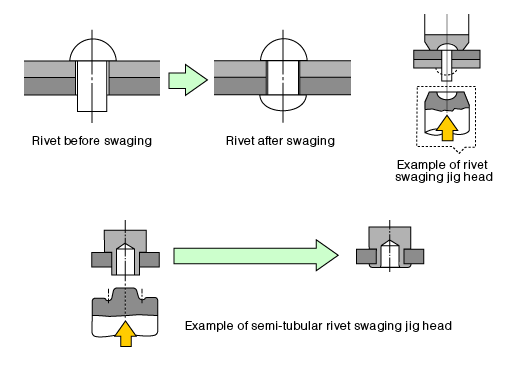
Riveting


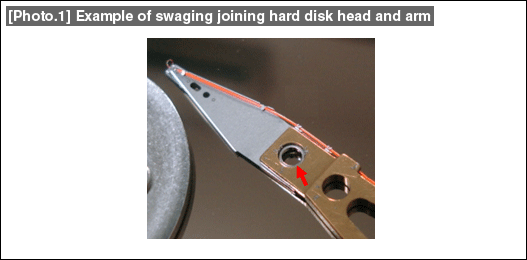
Example of swaging joining hard disk head and arm

Description: An SUS head-mount rivet is inserted into an aluminum arm hole formed in a concave/convex shape and is quickly swaged by passing a steel ball through the rivet hole.
Products are generally made by functionally assembling various parts. Product design and assembly/production technology enabling stable product quality at low cost (in other words, products that are easy to make) are key to this assembly process. Additionally, environmental considerations call for products that are free of disposal costs. This tutorial describes "swaging technology," a representative assembly component technology.

(1)What is swaging technology?
- Part securing methods include the following: (1) Screw fastening, (2) Adhesives, (3) Press-fitting, (4) Welding, and (5) Swaging.
- Swaging is the deformation of fixing portions of workpieces in order to permanently fix parts to each other.
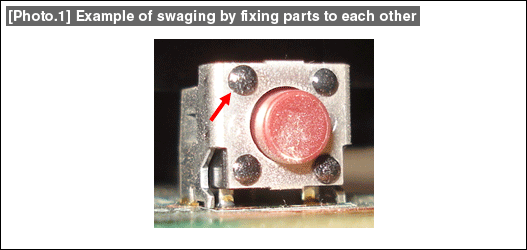
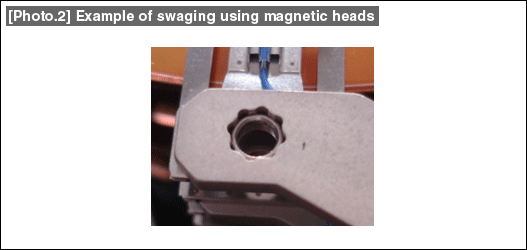
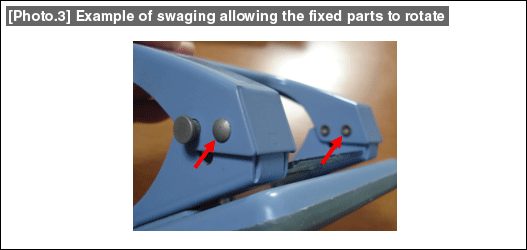
- There are two types of fixing using swaging: a) fixing parts to each other (Photo 1, Photo 2), and b) fixing parts to each other such that rotary motion is still enabled (Photo 3).

Photo 1: Example of swaging by fixing parts to each other


Photo 2: Example of swaging using magnetic heads


Photo 3: Example of swaging allowing the fixed parts to rotate


(2)Characteristics of swaging technology
1.Advantages
- Assembly with strong fixing force can be achieved in a short processing time using jigs and automated equipment.
- As a method, it is highly reliable and easy to automate.
- The swaging process is greatly affected by the design quality at the design stage of the parts to be swaged.
2.Disadvantages
- Investment is required to install jigs and automated equipment.

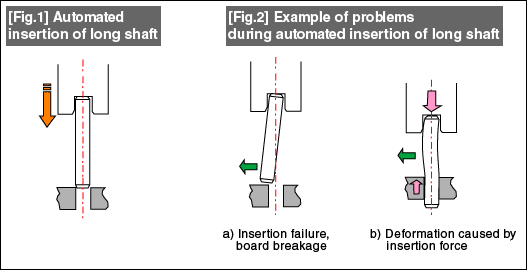
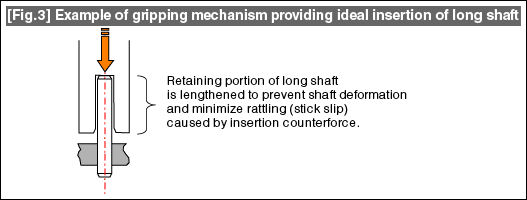
When designing the gripped portions of parts to be inserted using automated insertion equipment, the characteristics of the parts' shapes and the force created during insertion (leading to, for example, deformation due to insertion counterforce) must be taken into account.

(1)Example: Automatic insertion of a long shaft

- If automatically inserting a locating or rotary shaft into a circuit board or plastic board (Fig. 1), the inserted shaft can be fixed in place without the use of adhesive or similar material by using the elastic deformation force of the insertion hole.

- When performing this type of insertion, errors during automatic insertion can result in troublesome process faults such as board breakage and reclamation difficulties.

- Elastic deformation from a board at insertion generates an unexpectedly complex counterforce. Stick slip causes problems such as intermittent repulsive force and rotating torsion. It is important to use gripping mechanisms that minimize the effects of these types of fluctuations (Fig. 3).

Fig. 1: Automated insertion of long shaft

Fig 3: Example of gripping mechanism providing ideal insertion of long shaft

This tutorial provides examples of the key automation design considerations for low-cost automation of insertion assembly.

(1) Key automation design considerations for insertion assembly
1. Relationship between part chamfering dimensions and required locating accuracy

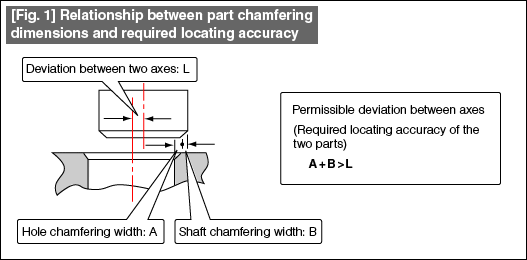
The relationship between the required locating accuracy of automated equipment and the chamfering dimensions of the two insertion assembly parts is shown in Fig. 1. When designing low-cost automation, locating accuracy must be within the limits given by this equation.

Fig. 1: Relationship between part chamfering dimensions and required locating accuracy

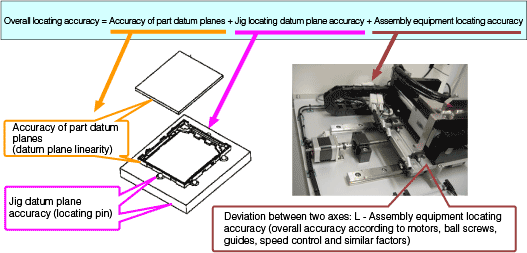
2. Overall locating accuracy

- Refer to the basic principles of locating technology that are explained in the series of technical tutorials starting from No. 97.
- Overall locating accuracy is the sum total accuracy of the various types of locating accuracy.

Overall locating accuracy = Accuracy of part datum planes + Jig locating datum plane accuracy + Assembly equipment locating accuracy

- The overall accuracy of multiple accuracies can be calculated by obtaining the square root of the sum of each accuracy's square.

(Overall locating accuracy)2 = (Accuracy of part datum planes)2 + (Jig locating accuracy)2 + (Assembly equipment locating accuracy)2

月別 Archives

Pages

Powered by Movable Type 6.0.3

About this Archive

This page is an archive of entries from July 2012 listed from newest to oldest.

June 2012 is the previous archive.

August 2012 is the next archive.

Find recent content on the main index or look in the archives to find all content.